Sensei
Built at Meta Global AI Developer Hackathon · Oct 26, 2026 · Remote
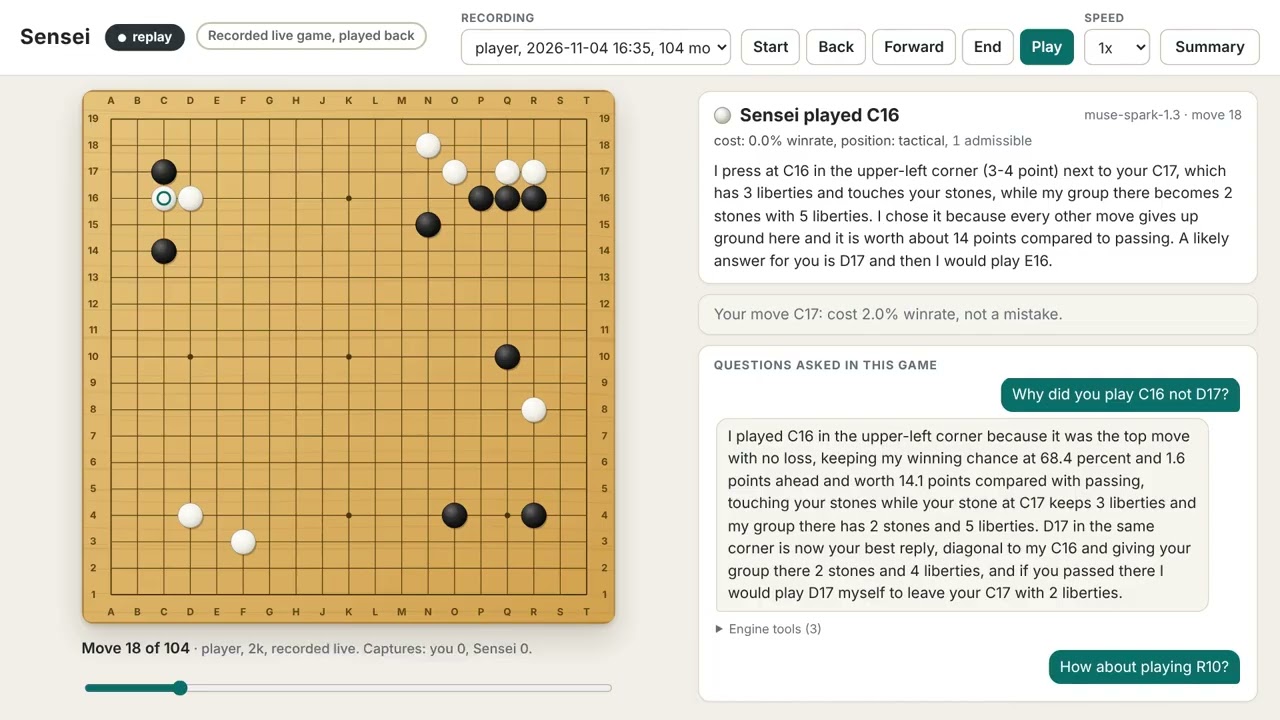
Sensei is a Go coach that teaches by playing. Go engines are far stronger than any human, but they are poor teachers: they show the best move, not the move you are ready to learn, and they cannot say why it matters at your level. You play a full 19x19 game against Sensei at your rank (20k to 5d). On every move: - It teaches with its moves. Among the moves that cost almost nothing in strength, it plays the one a player of your rank would rarely find. Move choice is deterministic, tested code; the model never chooses moves. - It explains every move from engine facts only: what you would play if Sensei passed and what that would do to its stones, captures, ataris, connections, forcing moves (sente) and the points at stake. Example: "If I passed you would play C5 yourself and capture 2 of my stones." - It answers questions ("Why did you play C16?", "What if I play R14?", "Will the corner die?") by calling engine tools, draws every variation on the board, and says so when the tools cannot answer. - It checks your moves, groups your mistakes into topics, and a Thompson-sampling curriculum picks the topic the next game trains. The game ends with your result, rank estimate, weakest topics and next target. A guard rejects any reply that names a board point absent from the facts or tool results. Evaluation, pre-registered before any run, with every README number rendered from result files and checked by a script: - Strength cost of teaching: -12 Elo (95% CI -45 to 21) over 400 games against the raw engine, within the bound. - Lesson relevance on human games: the moves Sensei teaches one rank band are played 1.00 percentage points more often by the next stronger band (95% CI 0.03 to 1.95, 2,000 positions); a descriptive comparison shows this is no larger than for any good move, and we report it that way. - Curriculum in simulation: Thompson sampling closes 83% of the gap to an oracle (95% CI 80% to 85%) over 50 simulated learners. - Explanation quality, graded by one 2d to 4d player (the author) against a 3.5 out of 5 bar set in advance: 2.50 for the first version, 3.80 for the submitted one. The gain came from moving the "why" out of the model and into the engine. Replay mode runs the recorded demo game with no GPU and no API key.