DISTRIB
Built at Meta Global AI Developer Hackathon · Oct 26, 2026 · Remote
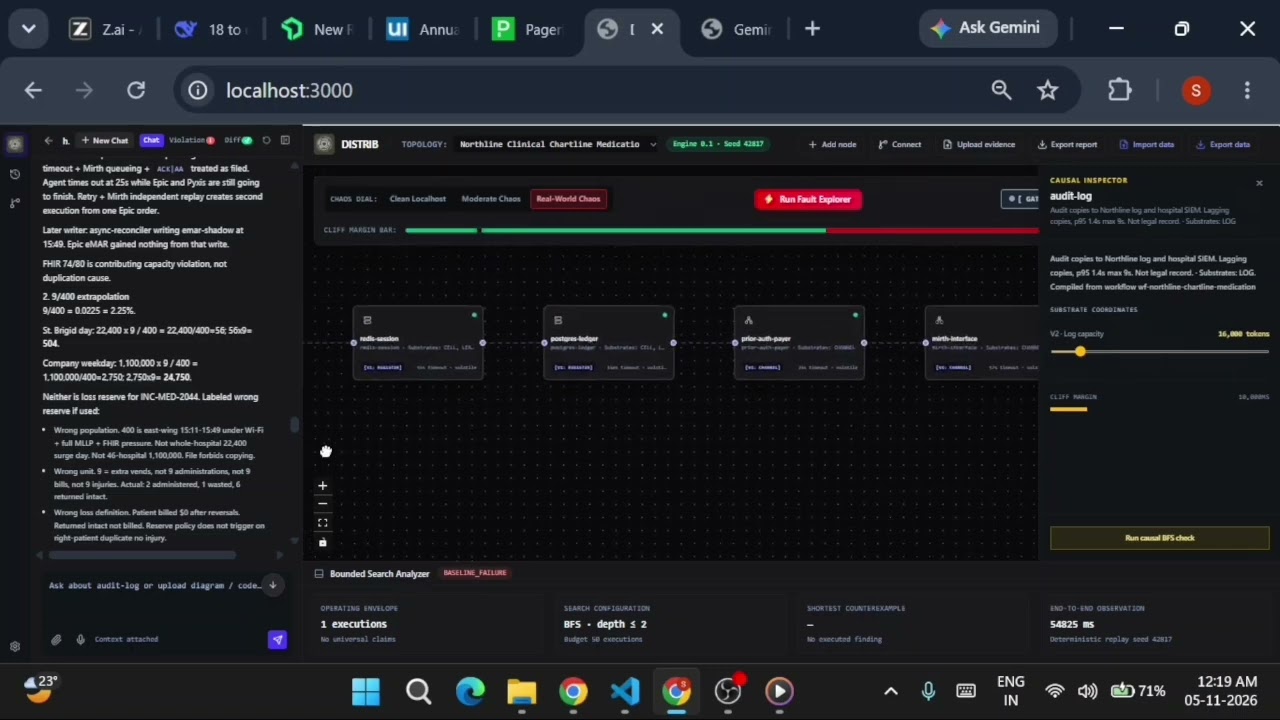
1. The Problem High-impact digital downtime costs enterprises a median of $2 million per hour (New Relic). While this metric historically reflects classical distributed system outages, the rise of autonomous AI agents dramatically amplifies this blast radius. When agents move from chat to executing actions across real APIs and databases, non-deterministic model retries collide with traditional infrastructure. A single dropped ACK, unkeyed retry, or unreleased database connection can silently cause duplicate charges, connection pool starvation, or accidental medication re-dispensing. Traditional testing fails here: unit tests miss distributed timing anomalies, end-to-end staging is slow, and postmortems only discover bugs after customers are harmed. 2. The Product: DISTRIB DISTRIB is a deterministic crash-test and formal verification engine for AI-powered distributed systems. Think of it as a virtual wind tunnel for modern software infrastructure. Instead of waiting for architectures to fail in production, DISTRIB allows engineering teams to model workflows, deliberately inject physical failure conditions, and mathematically prove whether critical system invariants hold before deploying code. 3. Core Architecture & Key Innovations - The Causal Alphabet: Rather than constructing bespoke simulators for every API, DISTRIB compiles enterprise topologies into 4 foundational distributed substrates: 1. Cell (State Registers): Local and durable stores. 2. Lease (Locks & Pools): Finite resources and connection leases. 3. Log (Event Streams): Append-only audit trails and queues. 4. Channel (Network RPCs): Transport and retry boundaries. - Deterministic Bounded Search (Virtual-Time Kernel): Running on a virtual clock (0ms wall-clock) with deterministic PRNG seeding (Seed 42817), DISTRIB executes bounded search across physical fault consonants: Drop, Delay, Reorder, Duplicate, Corrupt, Saturate, Crash, and Partition. It traverses state permutations in milliseconds to extract minimal counterexample traces that violate business invariants. - Closed-Loop Adversarial Replay & Verification Gate: When an invariant breach is exposed (such as double-capture or lease saturation), DISTRIB synthesizes a production-ready unified code patch (e.g., zero-hold connection releases, SHA-256 idempotency keys, and 56% capacity load-shedding). Its Adversarial Replay Engine immediately re-tests that patch against the failing counterexample under the identical seed. Only when zero regressions are proven does the CI/CD gate transition from [GATE: BLOCKED] to [GATE: APPROVED]. 4. Real-World Validation & Principle DISTRIB has been validated against real enterprise incidents—from B2B payment settlement double-billing to a 12-node clinical medication pipeline spanning Epic FHIR and Pyxis dispensers. Our guiding principle: The AI proposes. The deterministic engine verifies.