See The Germs
Built at Meta Global AI Developer Hackathon · Oct 26, 2026 · Remote
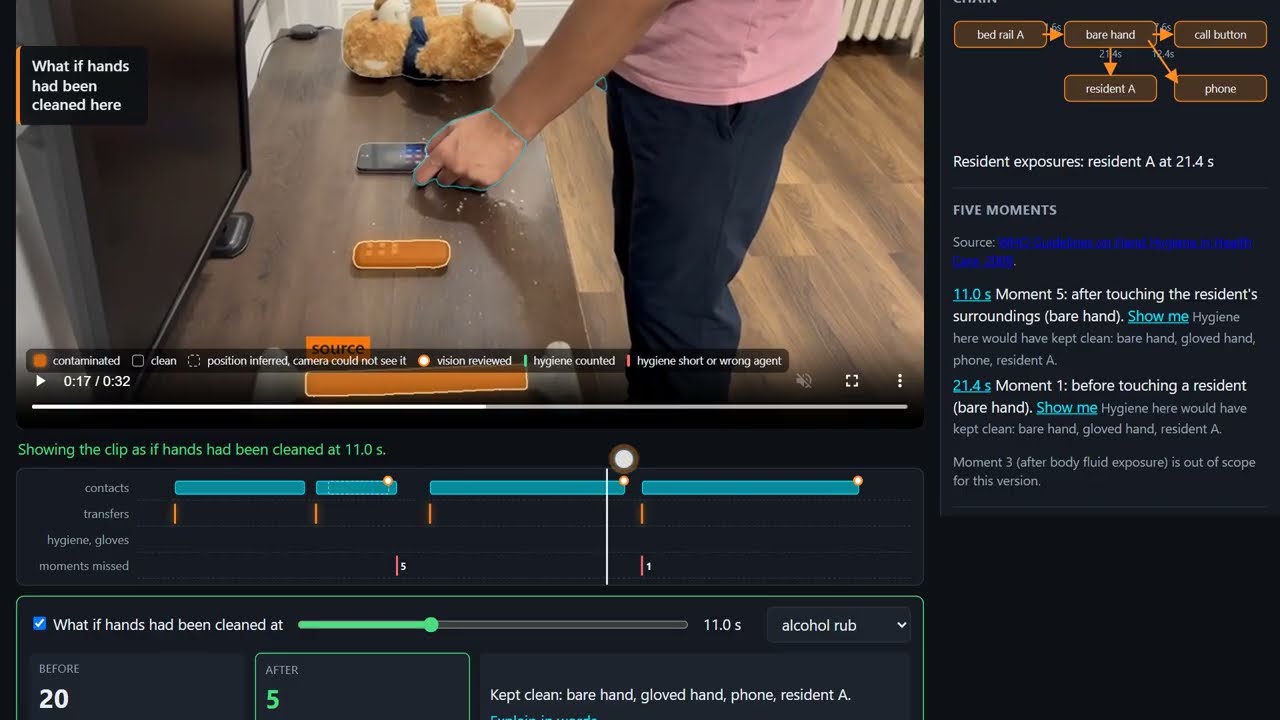
See the Germs makes invisible contamination chains visible on staged video of care tasks, so nursing home staff can see which missed hand-hygiene moment spread a pathogen and replay the fix. Problem. CDC estimates 1 to 3 million serious infections a year in US long-term care, and hands are the main route. Staff know the WHO Five Moments for hand hygiene and still miss them, because the thing they are supposed to interrupt is invisible. I am a physician running clinical informatics across more than forty skilled nursing facilities. Today's tools watch the sanitizer dispenser or rely on a person with a clipboard. Neither shows a nursing assistant that the phone she picked up after adjusting a bed rail is now carrying C. auris to the next room. What it does. One phone clip of a staged care task. SAM 3.1 tracks every hand and object. A deterministic engine replays each touch with pathogen rules cited to CDC and WHO (MRSA, C. difficile, C. auris, norovirus), glows where contamination travelled, maps the Five Moments, times every hand rub against the WHO minimum, detects glove changes from the video, and answers "what if hands had been cleaned here?" at any second with a slider. Muse Spark writes a coaching note for the caregiver and an audit summary for the infection preventionist. A session report gives compliance by Moment and by caregiver. Meta tooling. SAM 3.1 on the Meta Model API is the only segmentation and tracking layer, used as a contact sensor. Bare and gloved hands are separate classes, which is how glove on and off are detected without markers. Scene setup is a loop: Muse Spark vision proposes props and phrases, SAM verifies each on a frame. Muse Spark vision reviews only the contacts the engine flags as ambiguous, two annotated frames in, one verdict out, cached and capped, every vote marked on the timeline. Muse Spark text explains the record and never changes it. Both Spark roles also run on Muse Spark Open through Fireworks and Baseten, agreeing with the hosted model on 26 of 29 verdicts. Technical depth. Pure TypeScript engine, 144 node: test cases, same input always gives the same output, no AI model in the decision loop. Hardened on nine public training clips it had never seen. Accuracy measured against hand labels written before looking at the engine: precision and recall 1.00/1.00, 0.67/1.00, 0.86/1.00, 0.86/1.00 on the four staged clips, every false alarm named in the README along with the limitations. Demo. Four staged clips run offline from committed caches, so a clone runs the whole demo without a key. Upload your own runs the live path with a 45-second cap. Everything written Oct 26 to Nov 4, 2026. Staged synthetic footage, a teddy bear as the resident. Staff training and audit aid. Not surveillance. Not medical advice.
