mentalist
Built at Meta Global AI Developer Hackathon · Oct 26, 2026 · Remote
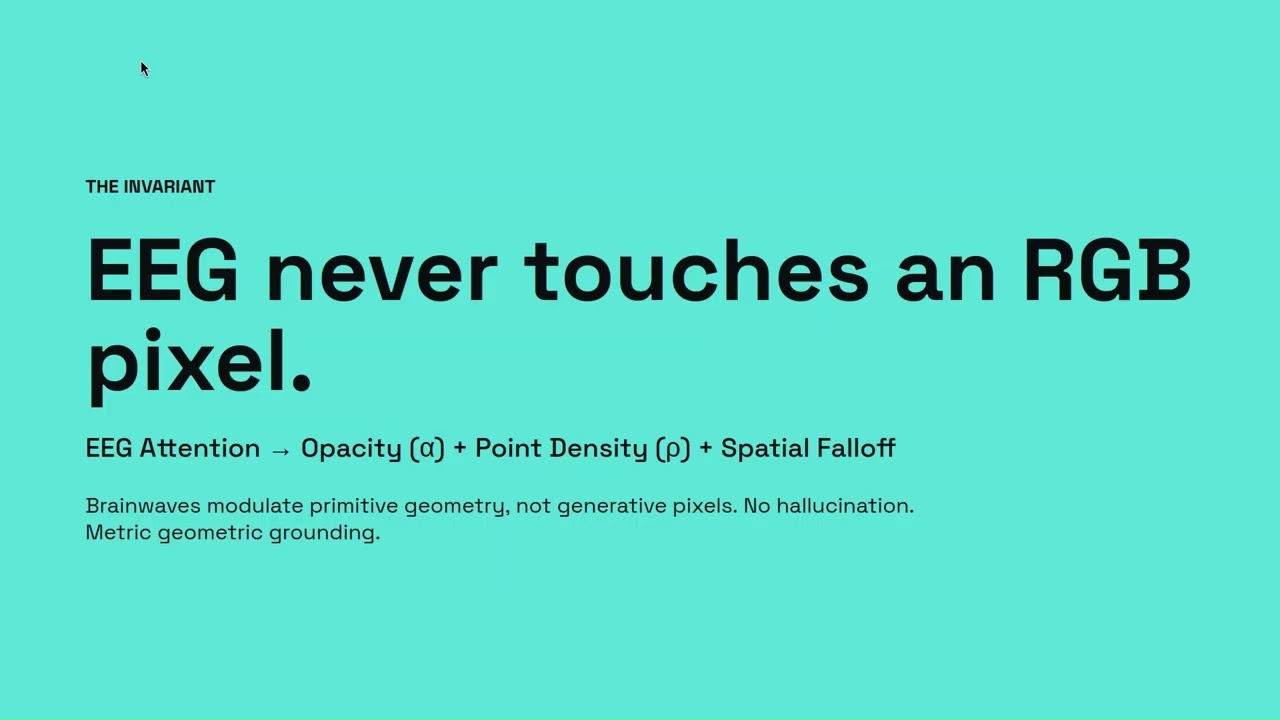
MnemoSplat is a neuro-generative framework that translates non-invasive EEG telemetry and structured semantic schemas into navigable, spatially persistent 6-DOF 3D Gaussian Splatting (3DGS) environments—reconstructing episodic visual memory from the inside out without ever touching a recorded camera feed. The pipeline extracts spectral band power (theta-band retrieval indices and gamma-band cognitive focus) to synthesize dynamic 2D spatio-temporal attention heatmaps. These heatmaps guide a latent generative pass that is immediately lifted into a global 3D world canvas using monocular depth estimation and visual SLAM principles. Cognitive salience directly governs Gaussian primitive density: focal recollections crystallize in sharp geometric detail, while peripheral context fades into natural volumetric bokeh viewable in WebXR. The Problem It Solves The Ground-Truth Leakage Bottleneck: Existing neural visual decoders either demand multi-million-dollar fMRI scanners or rely on trivial video-to-video style transfers that cheat by reading ground-truth footage. MnemoSplat achieves true zero-shot memory externalization using only non-invasive electrical telemetry and language priors. Temporal Drift in Generative Video: Diffusion video models hallucinate and flicker across frames. By anchoring generated features into a persistent 3D Gaussian coordinate field, MnemoSplat enforces geometric consistency, scale, and spatial orientation across the entire recalled scene. Clinical & Non-Verbal Isolation: Patients suffering from severe motor impairment (e.g., late-stage ALS, locked-in syndrome) lack expressive tools to communicate spatial and visual thoughts. Simultaneously, trauma clinicians lack objective, externalized representations of episodic triggers during PTSD memory reconsolidation therapy. MnemoSplat provides a shared, navigable reality for both.