Code_WithAI
Built at Meta Global AI Developer Hackathon · Oct 26, 2026 · Remote
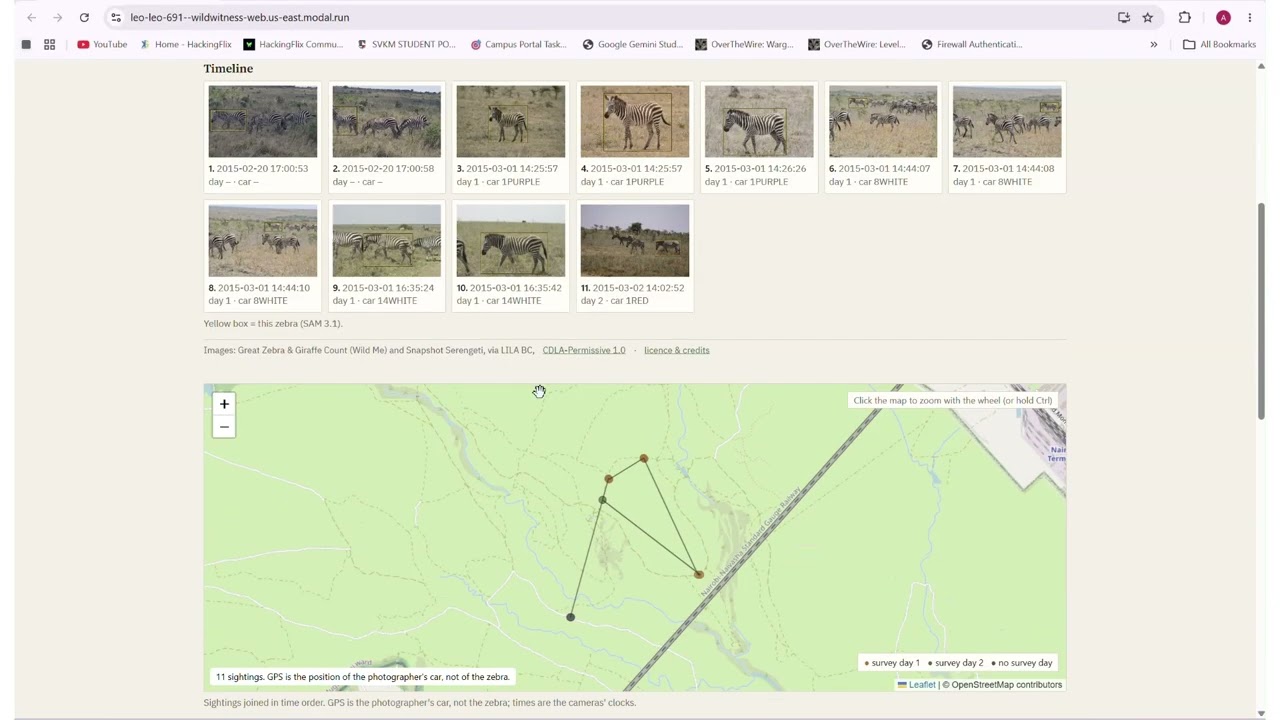
WildWitness turns raw camera-trap and aerial survey photos into wildlife population counts, individual animal re-identification, and honestly-measured accuracy — a job that normally takes conservation teams months of manual review. A six-stage pipeline: Muse Spark Open triages photos for empty frames and species; SAM 3.1 segments every animal with pixel-accurate masks from a single prompt word; classical computer vision (SIFT + RANSAC) matches individual stripe patterns across sightings; a Chapman capture-recapture estimator produces a population number with confidence intervals; and Muse Wonder powers a research agent that answers plain-English questions by calling tools over the real results, with every number traced back to its source. Measured against real expert ground truth on two licensed public datasets (Snapshot Serengeti, Great Zebra & Giraffe Count): 98.3% of expert-labeled zebras detected, 99.8% precision on automatic re-identification matches, and 93.7% detection accuracy on giraffes with zero retraining — just swapping one word in a prompt. We report our population estimate honestly even where it runs higher than the expert reference, because of a disclosed re-identification recall limitation — the methodology was pre-registered specifically so results couldn't be tuned after the fact. A deployed Gradio dashboard on Modal lets anyone explore the results, follow individual animals across sightings, and ask the research agent questions directly.