Lunes
Built at Meta Global AI Developer Hackathon · Oct 26, 2026 · Remote
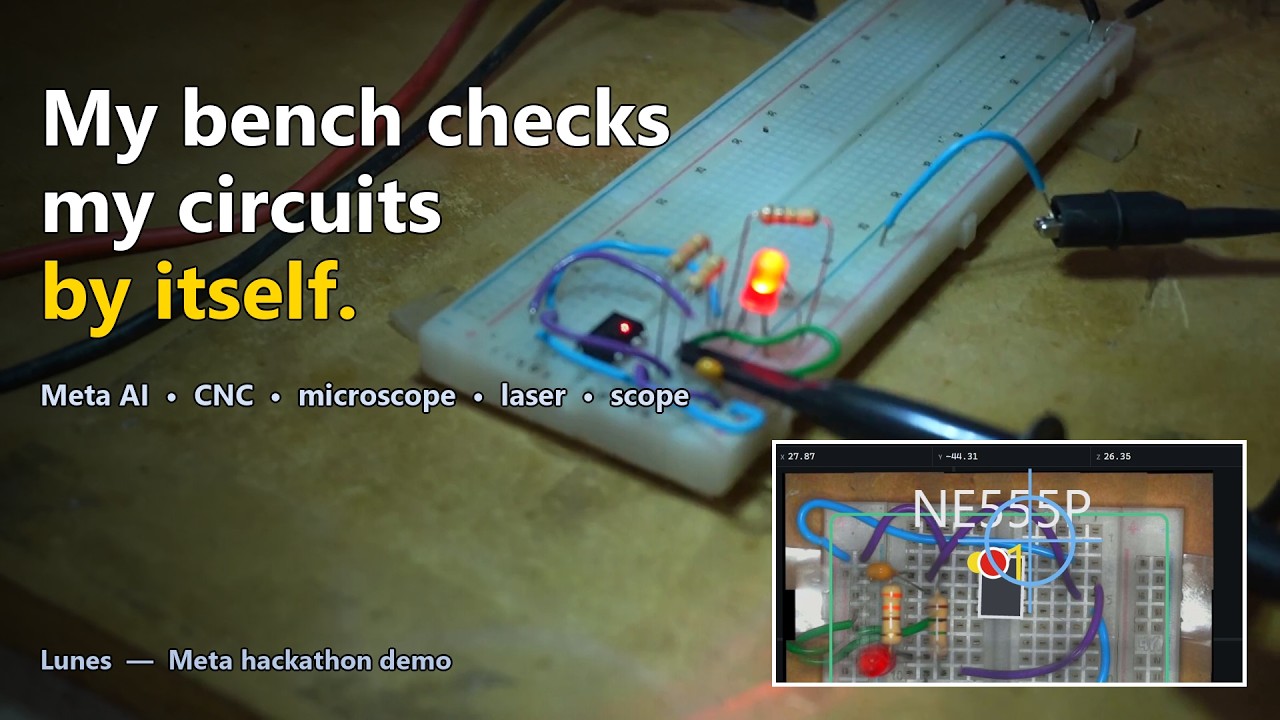
Lunes is a bench assistant for electronics: a home-built CNC that carries a USB microscope, a laser pointer and an oscilloscope probe, run by Meta's models. You talk to it in Spanish; it designs a circuit from the parts on your shelf, simulates it (ngspice), draws it on a breadboard and, once you have built it, checks the build: it stitches a mosaic of the board under the microscope, finds the chip and its notch, points the laser at the pin you need, measures with the scope and compares with the simulation. When it meets a chip it does not know, it finds the datasheet, writes a behavioural model, tests it and only then designs with it. What problem it solves: on a hobby or small-shop bench, checking a breadboard against a plan and probing the right pin is slow and error-prone, and there is no one to ask. Lunes looks, measures and explains, and it says so when it is not sure instead of guessing. Everything in the repository was built during the hackathon, from an empty repository on October 27, 2026: the firmware for the CNC controller (MKS Gen, our own motion firmware), the bench software, the agent, the web lab and the tests. The CNC frame, the KORAD supply, the USB microscope, the Hantek scope, a 2010 Kinect and the webcam existed before. Why it matters beyond my bench. I live in Cochabamba, Bolivia, where electronics labs are scarce, equipment is old and there is rarely someone to ask. Lunes is built from cheap or second-hand parts (a home-built CNC, a 70-dollar USB microscope, a 2010 Kinect), speaks Spanish, and keeps working without internet on open weights (Muse Glimmer on one consumer GPU). A student builds a circuit and the machine looks at it, points at the pin and measures it: learning electronics by controlled physical debugging instead of guessing. And every session leaves a record of what was planned, simulated, seen and measured on a real board. That is grounded data from the physical world that future AI models can learn from, to understand real circuits and not only text about them.