Footfall
Built at Meta Global AI Developer Hackathon · Oct 26, 2026 · Remote
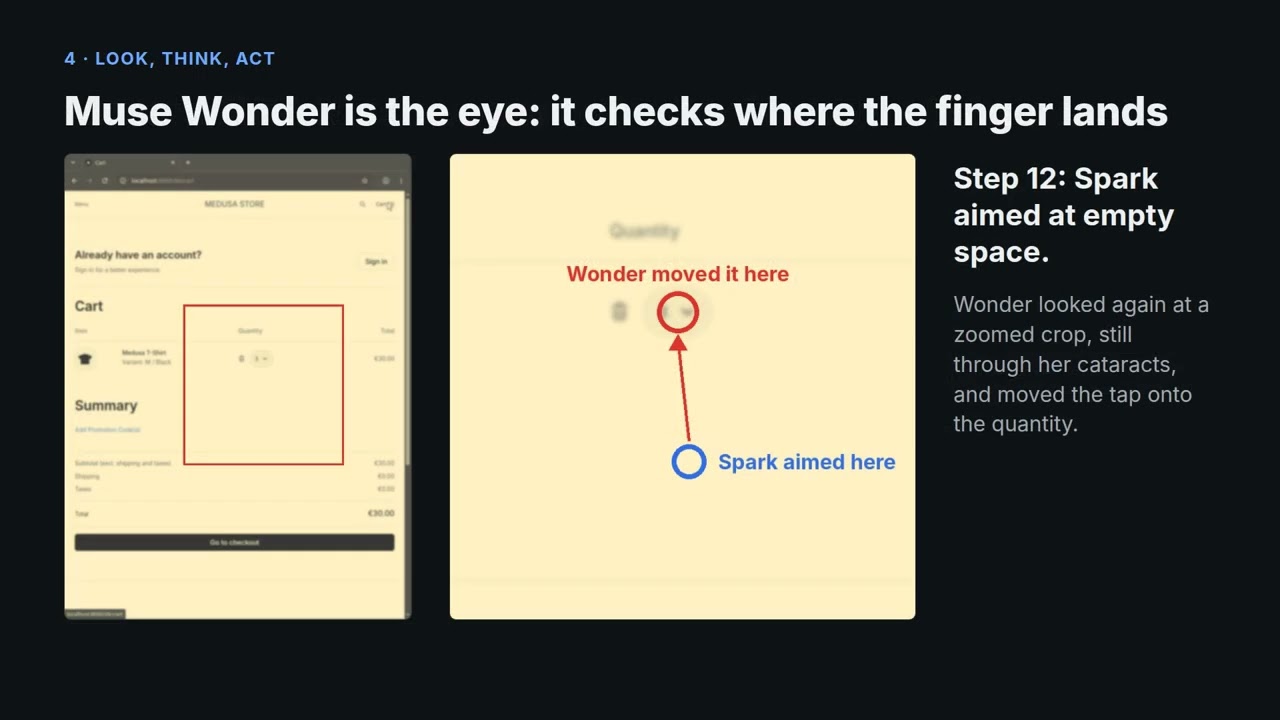
Footfall is usability testing with a crowd that does not exist. Give it a website and a task, and a crowd of synthetic shoppers tries to do it in real Chrome browsers, each with their own eyes, hands, device and patience, thinking out loud the whole way. 1. Recruit: Muse Spark visits the site as a first visitor would and recruits the people who would really come: ages, jobs, cities, devices, and impairments at the rate they occur in that audience (here a 68-year-old with cataracts and a tremor on a tablet, a colour-blind electrician on his phone, a busy mum in Lyon). 2. Shop: each persona gets a private desktop and a real Chrome. Every screenshot is degraded through their eyesight (blur, yellowed lens, colour-vision matrices) before the model sees it, and every tap goes through their hands (tremor). Muse Spark is their mind; Muse Wonder is their eye and corrects each tap on a zoomed crop seen through the same eyes. 3. Verify: success is never the model's word. A read-only SQL query asks the store whether an order with the right item exists for that persona. 4. Find: Muse Spark groups every journal into ranked friction points, keeps a quote only if it appears word for word in the log, then looks again at the screens before, at and after each quote to decide whether the site or our own harness caused it. 5. Fix and re-run: the same crowd, same task, on the new version, compared turn by turn along the funnel. On an unmodified open-source Medusa store (Next.js, self-hosted with its real checkout and Postgres), a crowd of eight placed 8/8 verified orders and found six real problems, none planted: a silent add-to-cart (Agneta, 68, ended up with three shirts), empty country field, XL preselected, checkout below the fold, hidden delivery cost, no products on the home page. I fixed the store three times and sent the same people back: 216 turns down to 101 (-53%). Best moment: my round-1 fix preselected Denmark for everyone, and the crowd caught it on the very next run. A crowd of eight costs about $3 and eight minutes. Everything in the demo video, from the wall of browsers to the replayed thoughts, is rendered from the recorded runs by code in the repo.