HackPulse
Built at Meta Global AI Developer Hackathon · Oct 26, 2026 · Remote
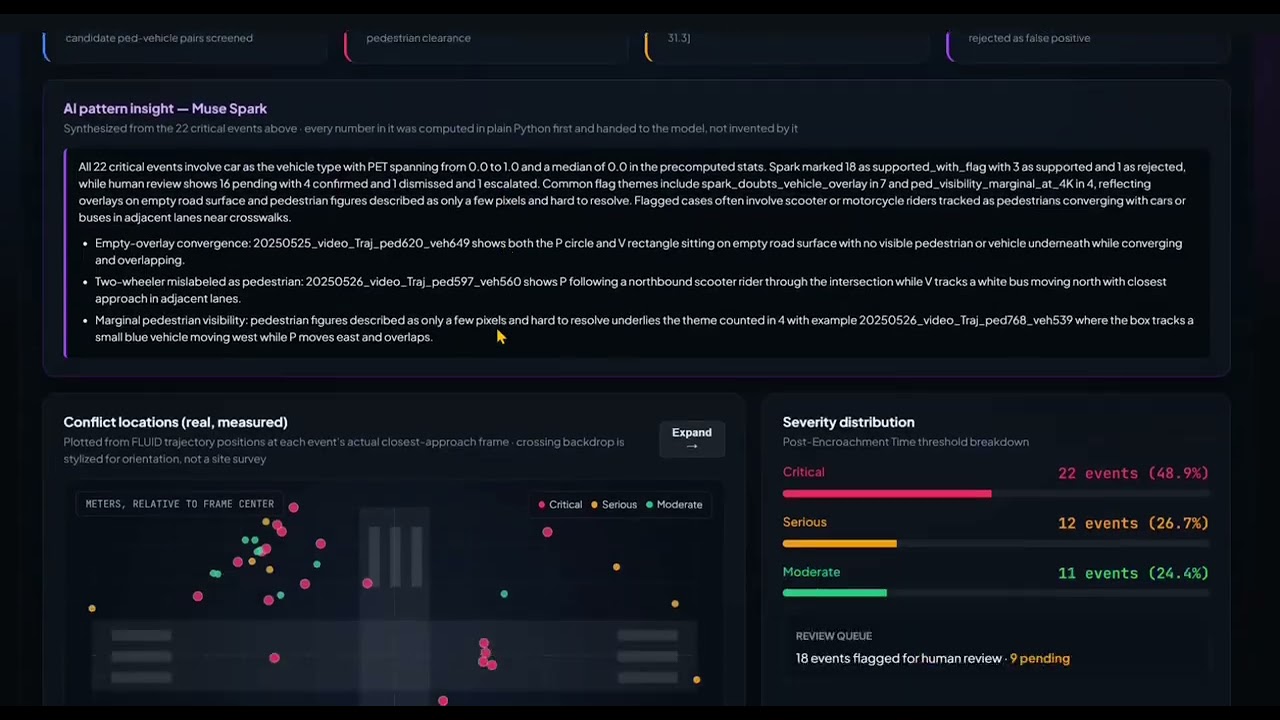
The problem: Pedestrian deaths from vehicle encounters are a solvable visibility problem. Cities and campuses already have drone/CCTV footage of dangerous intersections, but nobody has time to manually watch hours of footage looking for near-misses—the close calls that precede fatal collisions and reveal exactly where infrastructure (crossings, signage, sightlines) is failing people. Near-misses are the leading indicator; today they go completely unmeasured. What NearMiss does: It's an automated near-miss detection and triage system for pedestrian-vehicle interactions, built and tested on real aerial drone footage from the FLUID dataset. 1. Detect—SAM 3.1 segments every pedestrian and vehicle per frame; a custom PET (Post-Encroachment Time) engine computes real geometric closeness and timing for every pair, flagging events as critical/serious/moderate based on how little time separated them. 2. Verify—Muse Spark visually re-inspects every flagged event's evidence frames, confirming or disputing the computer-vision read and writing a plain-English note—cutting false positives before a human ever looks. 3. Triage—A human review queue surfaces only the events that actually need judgment, with evidence frames, Spark's verdict, and now voice-note capture (via 'muse-voice-transcribe-1.0') so analysts can log decisions verbally instead of typing. 4. Report—A live "Mission Deck" dashboard (Cockpit, Analytics, Radar, Ledger tabs) gives a real-time operational view: KPIs, a spatial radar plot of where near-misses cluster, per-event Q&A ("Why was this flagged?" and "What can we do?"), and a grounded, fabrication-checked pattern-insight summarizing recurring risk patterns across all critical events. The output isn't just a detector—it's a decision-support tool: it tells a city or campus safety team where the dangerous spots are, why they're dangerous, and what action each specific event suggests, using only real, verifiable numbers.