RiskLens
Built at Meta Global AI Developer Hackathon · Oct 26, 2026 · Remote
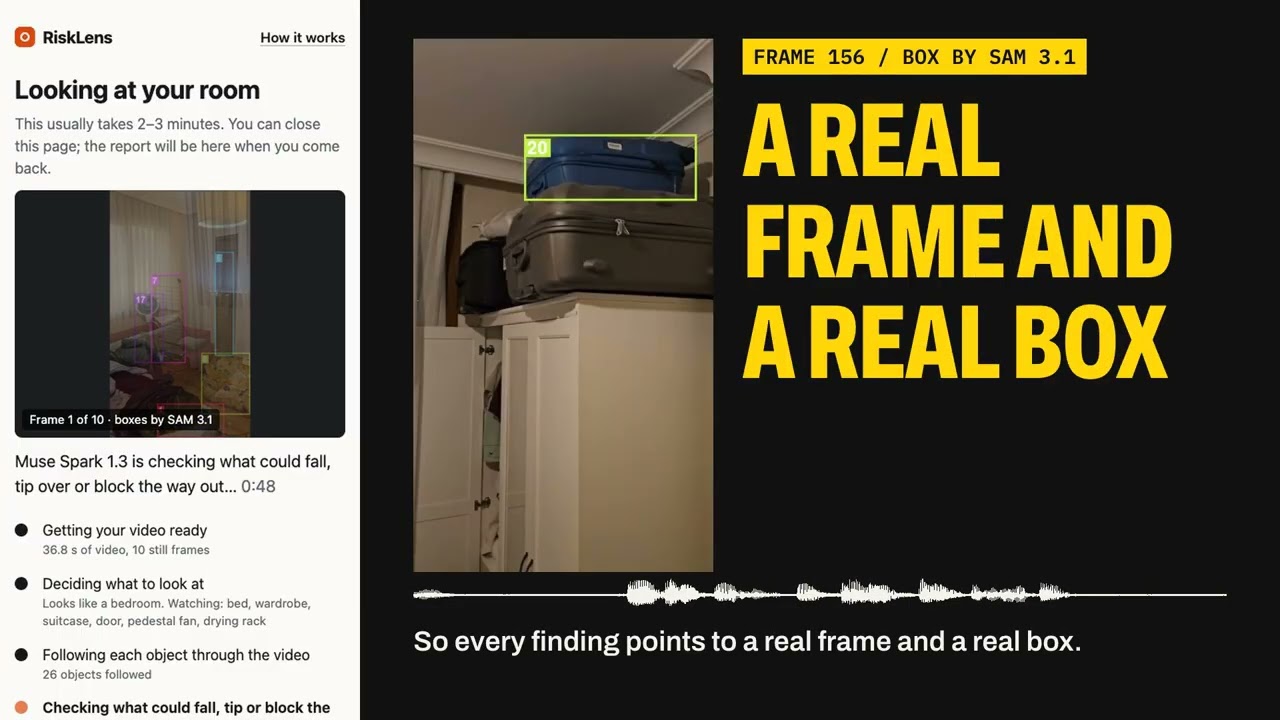
RiskLens (theme: Build for Your World) turns a one-minute phone video of a room into a list of things that could fall, tip over or block your way out in an earthquake. Each finding shows the exact frame and box it is based on, says what the video can't show, and links next steps to FEMA E-74 guidance. I live in Istanbul, where most of us know an earthquake is a question of when. An engineer can't visit every flat, but a wardrobe that can tip, a shelf above a child's bed or boxes narrowing the way to the door are things a family can deal with today, if someone points them out. The wider problem is well documented: in a study of New Zealand commercial buildings during the 2010-2014 earthquakes, 556 of 947 injuries were attributed to non-structural damage (Yeow et al., 2020). That sample isn't homes, but the hazards are the kind RiskLens looks for. RiskLens is for families and renters preparing the rooms they live in. It needs a phone and about a minute, with no account and no expert on site. A run costs about $0.30 in model calls, so it can be offered free. Try it without filming: https://selcuksntrk--risklens-web.us-east.modal.run opens four examples, including my own home, with no model calls. "Run it again live" starts a new run. Engineering: - Exact evidence: findings link to a tracked object, frame and box. - Enforced checks: a next step without a verified FEMA source is blocked in the interface and the endpoint. An identical re-filmed file is caught by a SHA-256 check before any model runs. - Reliability: idempotent uploads, a bounded job queue, per-call budget reservations, a $15 daily model cap, and polling when live progress drops. Interrupted jobs never silently restart paid calls. - Privacy: scans belong to a browser session, access is checked on every private route, videos are deleted after 7 days and reports after 30. - Tests: 73 backend and 14 frontend tests, plus a regression comparing Spark alone with the full pipeline, including negative controls with zero false confirmations. Evaluation: on three test rooms with planted hazards written down in advance, it found 13 of 14 and did not flag the secured control items (one run per room, matched by hand). The miss is shown in the app and the demo. These are test scenes, so no accuracy on real homes is claimed. Limits: it is a visual check, not a building inspection, and says nothing about structural safety. It only sees what the video shows, hidden fixings stay unknown, and the FEMA-linked steps are not reviewed by an engineer. Validation on real before-and-after fixes is future work. Next: a volunteer pilot in real homes and expert review of findings, to test whether people act on them. All of the project was built during the event. Third-party code and data are labelled in the README and DATA_LICENSES.md.