Then & There
Built at Meta Global AI Developer Hackathon · Oct 26, 2026 · Remote
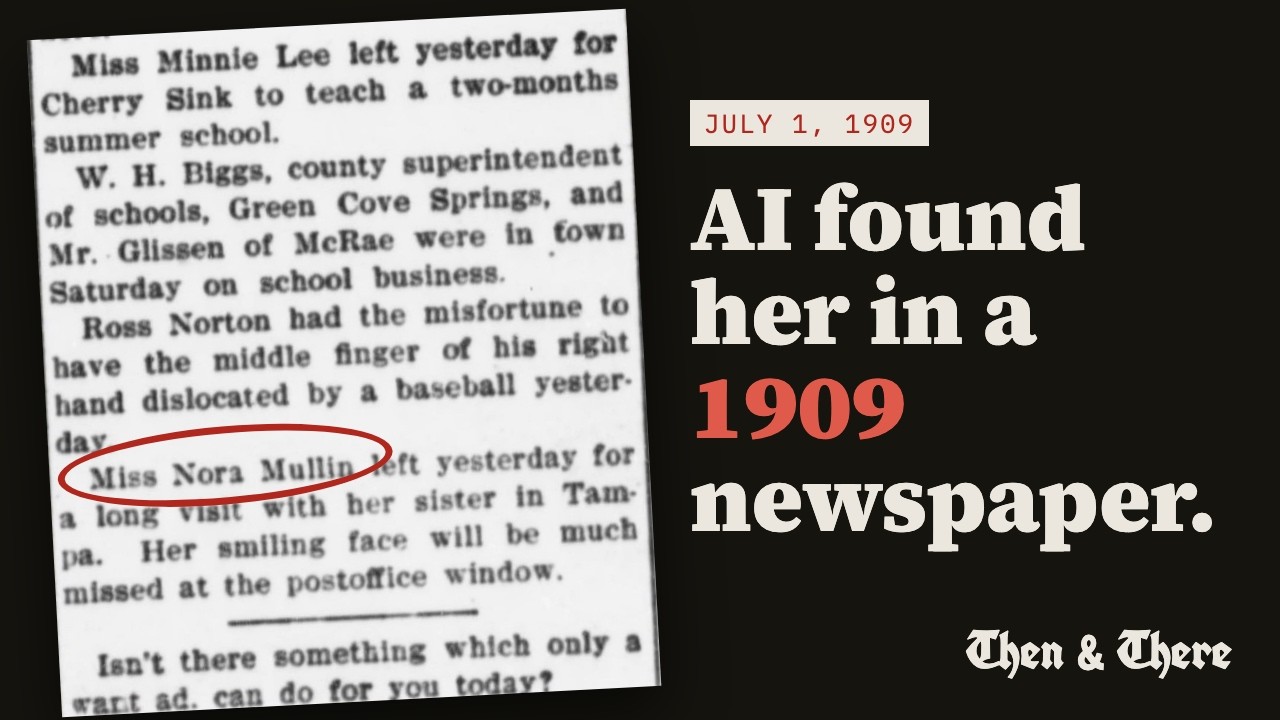
Then & There turns the Library of Congress's historic newspaper archive into something people actually read: daily history games, a story finder that needs no search terms, and a personal agent that watches new pages for your family's name. https://then-and-there-flame.vercel.app/ THE PROBLEM The Library of Congress has scanned 23.8 million pages of American newspapers. Almost nobody reads them, and not because the scans are bad: when I checked the machine-read text of Milwaukee's Black weekly from December 1898 against the scans, it was mostly right. The paper called an Appleton barber, J. E. Ellmore, "the smartest gentleman of our race." The Library's search finds that story, but only if you already know to type "Ellmore." Search only works when you already know the name. So the real job is an editor's: pull out the human stories and put them in front of people. WHAT IT DOES Meta's models cut each page into stories, repair garbled text, find the human stories and check claims against the scan. Then, three ways in: 1. The stories come to you. Today's Front Page: the same real page for everyone, one clue at a time; guess where and when it was printed. Detective: follow Nellie Bly's 1889 race around the world using only what the papers had printed by then. One Day, Many Papers: the 19th Amendment on three front pages, wire copy versus each paper's own words. Spot the Forgery: Muse Image plants one product from the future on a real 1889 page. Plus a Great Migration quest through the Black press. 2. No name needed. The Story Finder opens on shelves instead of a blank search box: the Black press, German-language Milwaukee, the race in the papers. Every story sits on its scan, says whether it was verified, and cites itself in MLA, APA or Chicago. Teachers can print packs. 3. An agent for your name. Give it a surname or a hometown. Every night it reads every page the Library just added, matches your list in our own code (your list never goes to an AI model), and leaves a note only when the Editor confirms the find on the scan. On November 1 it found a real match in pages from Guam the Library had published days before. TRUST IS THE PRODUCT Every clue links to a scan you can open at loc.gov. A second model check, the Editor, compares game clues and explanations to the scan; anything it can't confirm never reaches a player. It has run 1,045 checks and rejected 174 (17%). Old pages carry racist ads and slurs; they get a calm content note, never hidden and never decorated. Forged images always carry their label. IT WORKS TODAY Live, free, no sign-up, on phone and laptop. 922 pages processed so far, all printed before 1931, at a measured $0.041 a page. 326 automated tests run in CI before anything ships. WHY ME I work in public radio in Milwaukee. Finding the human story in old material is my job. Then & There is built to do it at archive scale, for teachers, students, family historians and anyone curious. Nellie Bly's race starts again Nov. 14.