Dekuboy
Built at Meta Global AI Developer Hackathon · Oct 26, 2026 · Remote
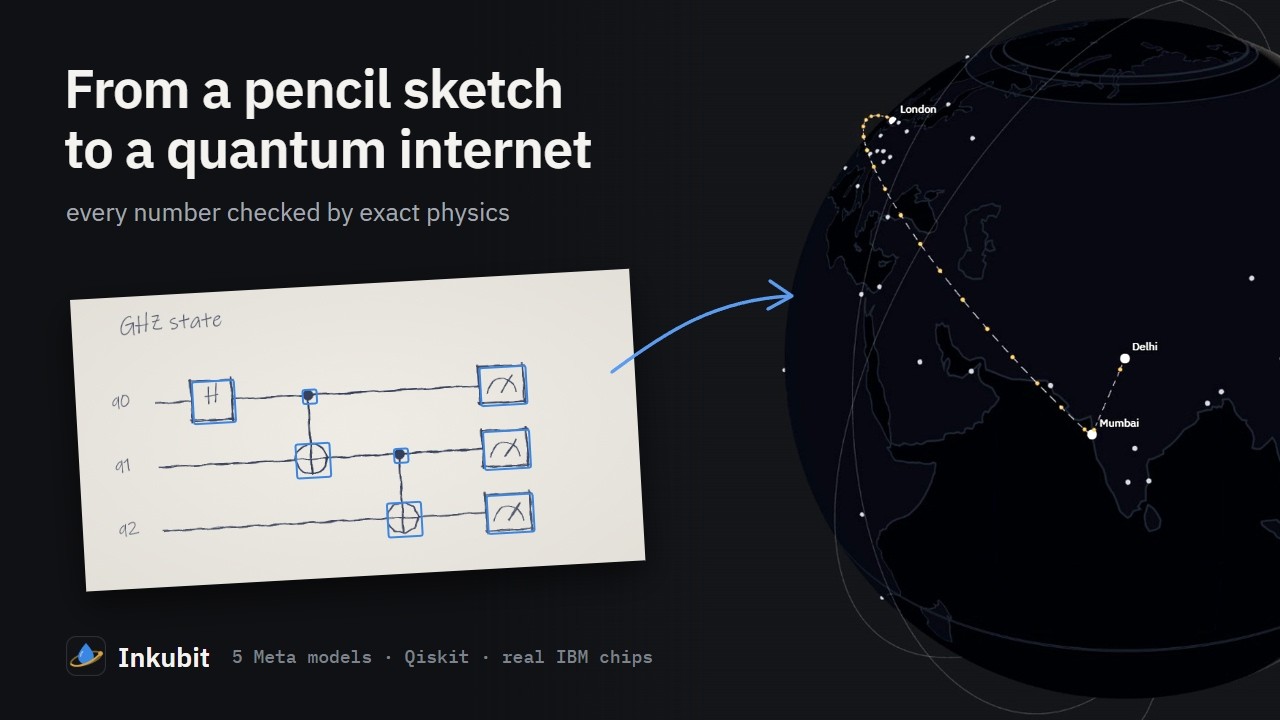
A wrong quantum program still runs. A reversed CNOT or an off-by-one qubit prints a perfectly believable histogram that's simply the wrong one. And most quantum ideas start on paper, as a sketch on a whiteboard or a drawing in a notebook, long before anyone writes code. Inkubit closes that gap: sketch it, say it or photograph it, and Meta's models turn the idea into working code, while exact physics checks every number before you see it. Take a photo of a pencil sketch. SAM 3.1 finds every drawn gate, and Muse Spark reads the photo into an exact circuit, with each gate linked to the box it came from. Muse Spark then writes the Qiskit code, which runs under realistic noise. A separate exact simulation predicts what the result must be without ever looking at the code, so a wrong program can't pass by accident. If the run fails, Muse Spark gets the evidence, explains what went wrong and repairs its own code. If it can't fix it, Inkubit says "not verified" rather than faking success. From there it grows into a full quantum lab: • Mission control turns one sentence into a plan of exact tools that run in parallel. In a 30-mission live benchmark, all 68 steps were verified and 204 of 209 report numbers were traced to the tool that computed them. • The lecture checker uses all five Meta models in one run. Muse Voice tells the speakers apart, SAM 3.1 tracks the drawing through the video, and Muse Spark writes out every claim. Exact physics then found the 3 wrong claims out of 12, each judged against the board as it was at that moment. • The discovery lab found a 7-qubit GHZ circuit that needs 6 CNOTs where the textbook needs 10. On IBM's real ibm_fez quantum computer it beat the textbook circuit: fidelity 0.814 against 0.795. • The quantum internet runs on a 3D Earth. Name some cities and Muse Spark designs the network; Muse Wonder challenges it and, after seeing the physics score, raised the weakest link from 586 to 8,070 secret-key bits a day. Today's quantum satellites fly their real orbits overhead, and you can edit any route. • There's also Shor's algorithm, QAOA, the H₂ molecule, catching a spy in quantum key distribution, a learned error-correction decoder, a proof sheet with 299 checks passed and 0 failed, and an AI referee where Muse Wonder debates Muse Spark. Why verify everything? We measured it. Asked alone, the model was exact on small circuits but on only 3 of 6 bigger ones, and once it was 43% off with full confidence. Inkubit was built by one developer during the hackathon (Oct 27 to Nov 4). It uses FastAPI, Qiskit and Aer, React and three.js, and has 626 backend tests. The code is open source under MIT.