PiSpace Innovations
Built at Meta Global AI Developer Hackathon · Oct 26, 2026 · Remote
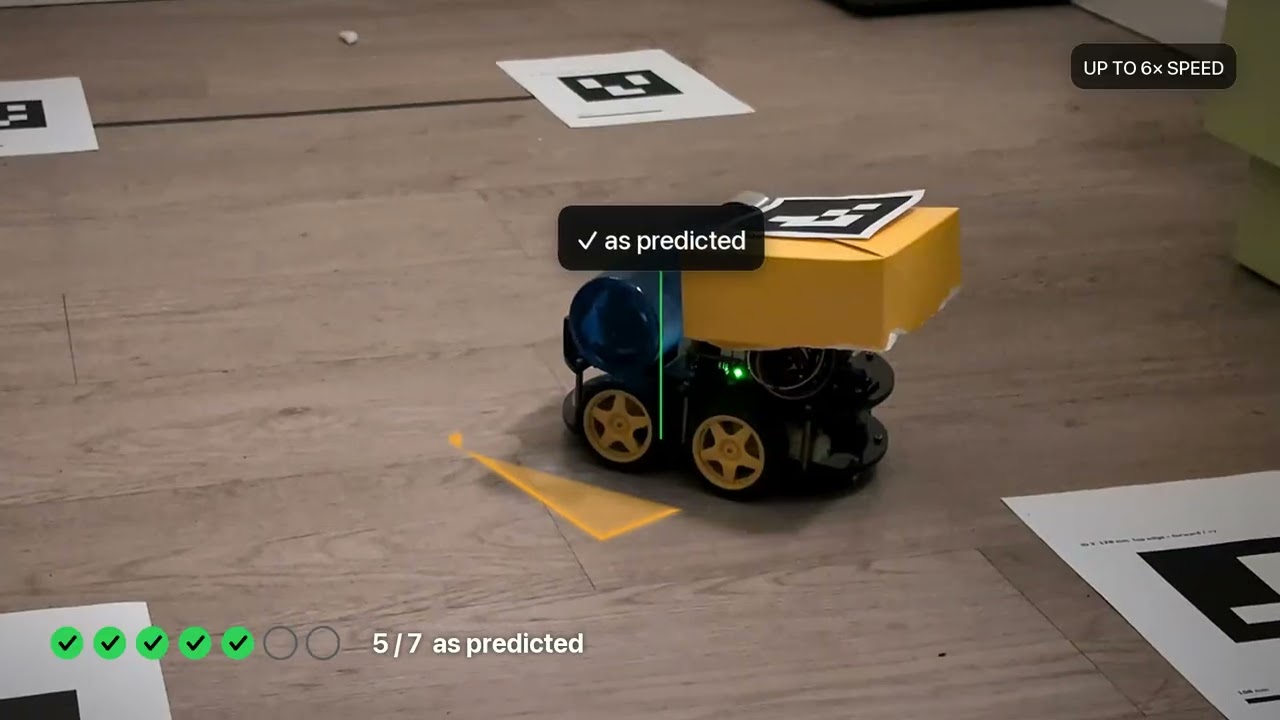
Robots break quietly when their bodies change. Every robot drives by a model of its own body (how far and how fast a motor command moves it), tuned once by an engineer. Then it carries a heavy tote, tows a cart, its tyres wear or its battery sags, and the model is wrong: the robot stops short or drifts and doesn't know it. Today the fix is a service call. Over a robot's life, setup, tuning and upkeep cost more than the robot itself (purchase is 25–40% of lifetime cost), and 98% of manufacturers are small businesses with no robotics engineer on staff. AIRO (Adaptive Intelligence for Robots) lets a robot notice that its body changed, test itself and recalibrate in minutes, with one phone camera and no wheel encoders. Muse Wonder acts as the scientist: it designs each test drive and states a falsifiable prediction before the wheels turn. The robot measures the result, fits a physics body model with calibrated uncertainty, and only accepts a new body once a prediction it made lands. On our real $50 car with a water bottle strapped on, the old model predicted 0 cm and the car moved 17; after relearning, 7 predictions in a row landed. Every learned body goes into a memory the whole fleet shares: in the MuJoCo warehouse twin, the first robot loaded with a heavy tote learns it in about 12 s, and every later robot recognises it in 2.1 s with one probe (41/41 heavy loads identified, 0 false relearns, 180/180 deliveries over 10 stress runs). Because the robot knows its body, you can talk to it: Muse Spark turns plain words into a plan, Muse Voice Transcribe hears it, SAM 3.1 reads the floor, and Muse Image draws each body's self-portrait.