Locked Computer Assist
Built at Meta Global AI Developer Hackathon · Oct 26, 2026 · Remote
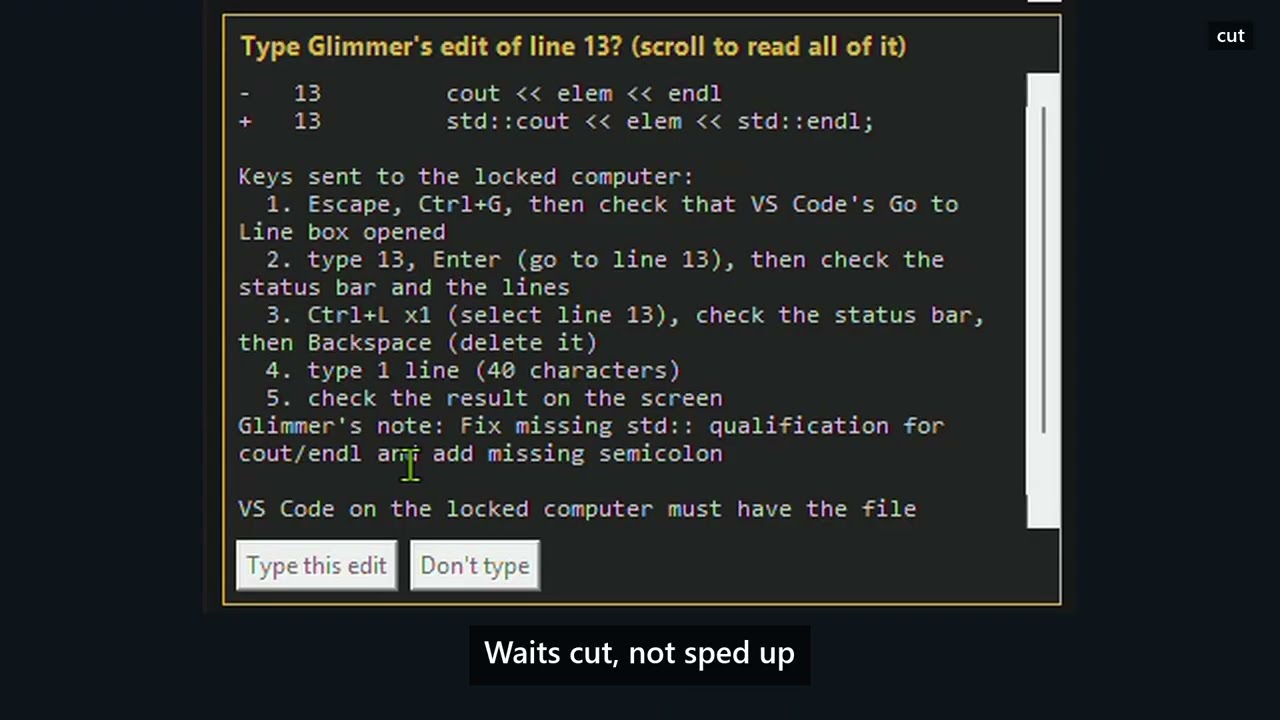
Some computers aren't allowed to run AI: a locked-down work laptop or a lab PC. When code on one won't compile, or an old tool shows an error, its user is on their own. Locked Computer Assist is for them and the organisations that own those computers. With the owner's approval, it helps without installing anything or getting around any control. A small USB KVM links the locked computer to my AI laptop. To the locked computer it's just a monitor, keyboard and mouse; pulling one cable stops all typing. The proof of concept, in the video: in my viewer I type "whats wrong with this code?" and press Fix it. Meta's open-weights Muse Glimmer, on the AI laptop's GPU, reads the screen, finds the bugs and writes the edit. I see the edit and how it will be typed first; after my click, the KVM types it blind, by line number: no line number goes in until Glimmer sees the Go to Line box, nothing is deleted until the status bar shows the right line, and new lines are read back. Saving waits for FIXED on a fresh reading and my yes. In the video's run, the check after typing caught VS Code indenting the next line by itself, so the run stopped before the save. Fix it sends nothing by default, and the project writes no screen capture to disk. Every hardware run used a spare Windows laptop standing in for the locked computer, with the real models. The code on it is test C++ with deliberate errors of the kinds real code has. On 1 Nov, Fix it made the right fix to hello.cpp there and saved it. All 298 automated tests pass, with no hardware needed. Why Muse Spark, Meta's cloud model, if Glimmer can do this locally? This fix doesn't need it. Glimmer only became a coder on 1 Nov, when I found llama-server returns its tool calls. Until then Spark was the only coder. My 30 Oct milestone was its work: from redacted text alone it found junk I hadn't described and had it deleted, and the file was saved. Meta's own scores put Spark ahead at computer use, and my laptop runs Glimmer at 4 bits with capped thinking, which should matter on harder problems than a missing std::. I haven't run the two head to head. The user picks per screen: Glimmer alone for anything redaction can't protect, such as names or patient details, or Spark on redacted text where the owner allows it. Screen images never leave either way. Typed edits work only in VS Code, and FIXED is the model's judgement: nothing compiles the code. Built before the event (tag pre-event-baseline): the KVM service, the nanokvm command's diag and status, the Glimmer server setup, a Meta API smoke test and the simulated locked computer. Everything Glimmer and Spark do in the entry was built during it. HACKATHON.md in the repo shows what was built when.