Resonance Labs
Built at Meta Global AI Developer Hackathon · Oct 26, 2026 · Remote
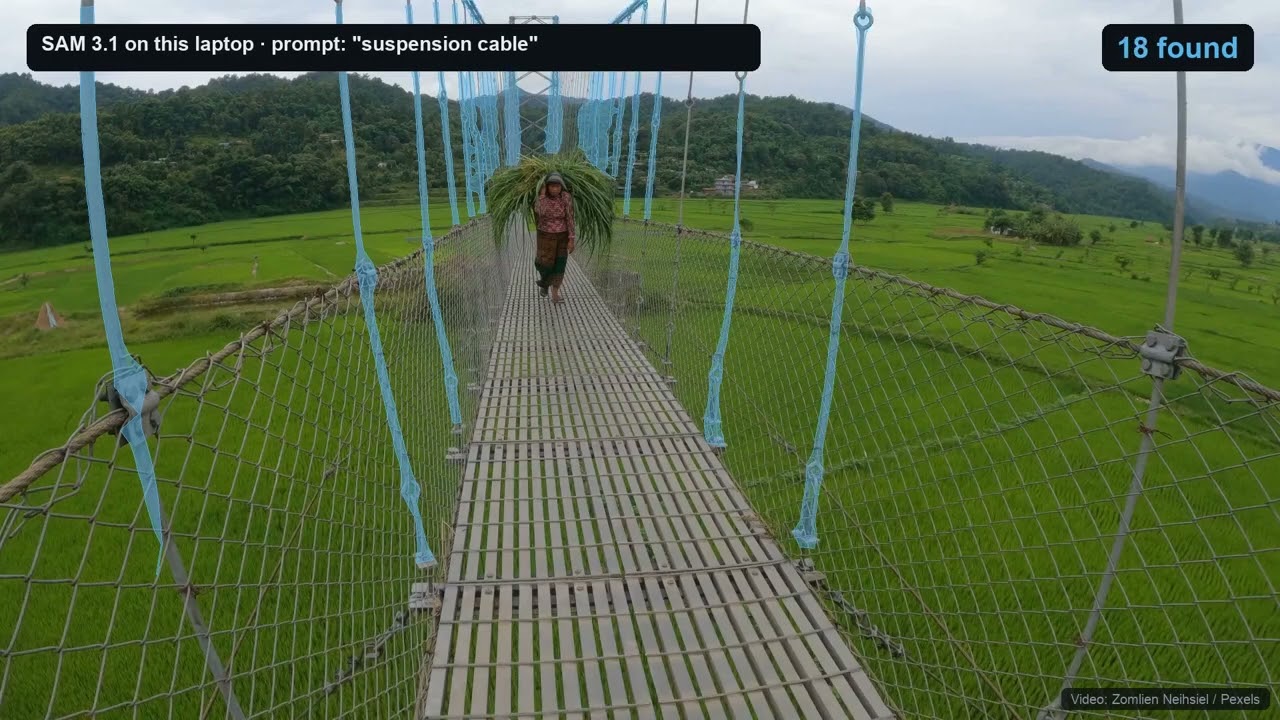
Resonance measures cable vibration and tension from a slow-motion video, and refuses — with the reason — whenever the physics does not check out. Nepal crosses its rivers on more than 10,000 cable footbridges. In August 2026 one flood damaged 53 of the 64 suspension bridges between Mugling and Timure. Hanger tension is the first thing a flood or corrosion changes, but measuring it today needs a crew with accelerometers or a tension meter costing thousands of dollars, so most bridges are never checked. The Department of Roads' terms of reference for the World Bank BIMP-III programme (July 2026) explicitly ask consultants to "measure the vibration of the cables to estimate tension." Phones that shoot 240 fps are already everywhere. How it works: 1. Clip check — reads the true frame rate from per-frame timestamps, checks timing, camera motion and exposure, and states which frequencies the clip can and cannot resolve. 2. SAM 3.1 finds the cables from a two-word prompt ("suspension cable"), on the laptop via MLX, no network. 3. A Muse Spark Open agent reviews each SAM candidate on the frame: floor leads and frame bars are rejected before anything is measured. 4. Physics measures and self-checks — each cable becomes a line of virtual sensors tracked to ~0.01 px; a reading is verified only if the harmonic ladder, the mode shapes, the frame rate (no aliasing) and a steady camera all agree, otherwise provisional or refused with re-shoot instructions. 5. A Muse Spark Open agent writes the report from tool calls only; a separate Muse Spark Open call verifies every claim against the evidence and fails closed. Given field notes with wrong rope lengths, it disputed four of five statements. 6. An engineer approves (name + SHA-256 of the evidence, including the source clip). 7. One-click field assistant: a Muse Spark Open agent runs the whole pipeline within code guardrails. 8. Change detection: film a baseline, film again after the monsoon — "rope 3: tension down 25.0% ± 0.2% since baseline." Validated on public CC-BY recordings with independent references: a cello string at 7000 fps (108.8 N reference, 105.9/106.2 N measured), a wind-tunnel bridge-cable model (9.55 Hz accelerometer vs 9.57 Hz), a shaking table (4.847 vs 4.832 Hz), oak-tree sway (0.23–0.24 Hz). At 30 fps the same cable is correctly refused. Honest limits: a screening tool, not a safety certificate; an engineer signs every report; absolute field tension is never reported, only relative change; no phone clip has been measured yet.