Beucheh Maxime
Built at Meta Global AI Developer Hackathon · Oct 26, 2026 · Remote
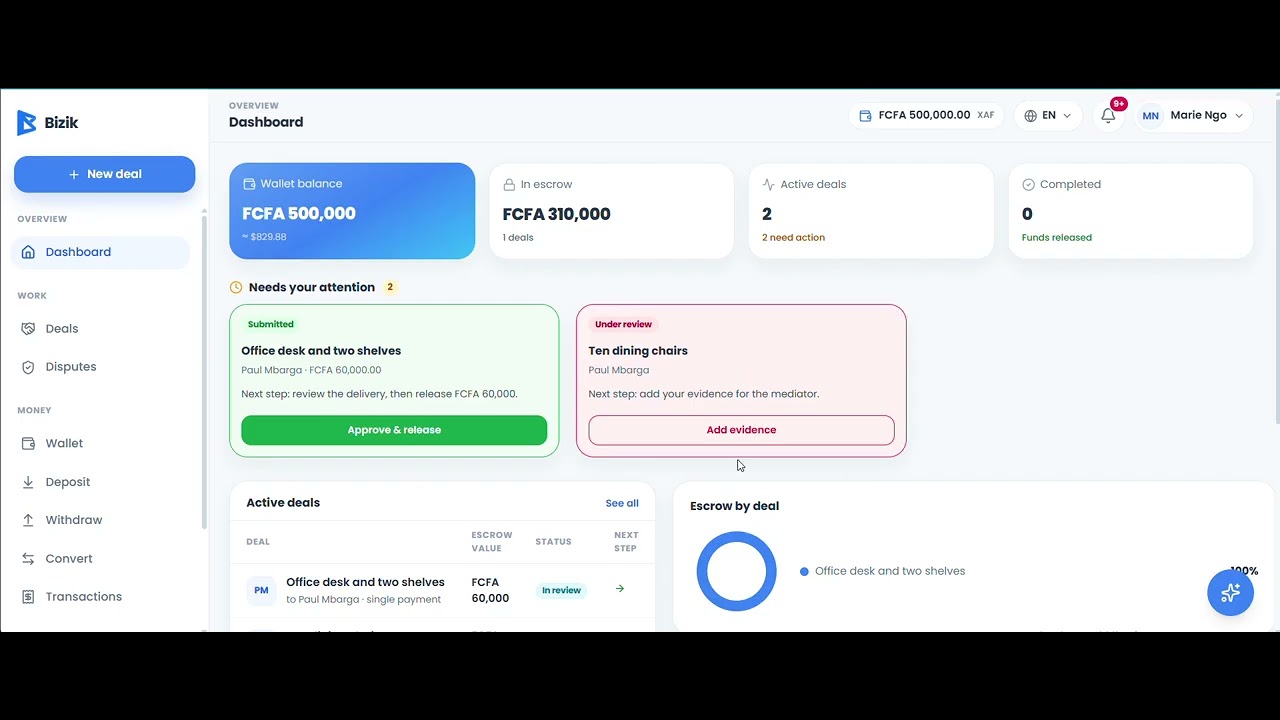
BiZik is an escrow platform for Cameroon. A buyer's money is held safely until the goods or work arrive, then the seller is paid. People here trade on WhatsApp and Facebook Marketplace and settle over MTN and Orange Mobile Money, and the thing that stops most deals is simple: neither side trusts the other to go first. Escrow fixes where the money sits. It does not fix the argument. When a buyer says, "He sent me four chairs, not ten," and the seller says, "I sent everything," a human has to decide. And here, that argument arrives in a shape nothing off the shelf reads well. It is spoken, not typed, because voice notes are how people talk. It changes language mid-sentence: French, English and Cameroonian Pidgin in one breath. And the proof is photographs the two sides disagree about. One case costs a mediator twenty minutes, and the money stays frozen the whole time. What we built for this hackathon is the part that reads all of that, using Meta's models. An assistant inside the app, running on Muse Spark, with 26 tools over the real platform. A buyer can say, "I paid for ten chairs but only four came," and it finds the deal, checks its state, and acts. Voice notes go through Muse Voice Transcribe first. A reading of the delivery photographs, also powered by Muse Spark. On a real photo filed by a seller, it answered: ten chairs in two rows of five, but the rows look identical, so it is probably the same five photographed twice, and there is no room, no packaging and nothing that looks like a delivery. It declined to count ten. A mediator could have been fooled by that picture. One rule shapes the whole design: no model outcome moves money. The assistant can propose; it cannot execute. Approving is a separate authenticated call that needs the user's PIN, and the chat endpoint has no path to the ledger at all. The AI service runs in a container with no database handle and no payment credential, so that is a property of the deployment rather than a promise. Twenty-four tests exist only to break that separation: approving an action nobody proposed, approving twice, and approving without a PIN. None of them can move a franc. The transcript of a voice note is shown to the user before anything happens. Speech recognition mishears, and it mishears Pidgin more than English. In this product, a wrong word is not cosmetic: "four" heard as "forty" files a dispute over the wrong amount. So the machine shows you what it heard, and you correct it before it acts. BiZik is a live platform that existed before this hackathon. Its mediator console already had an "AI" badge that had never once been lit, because nothing filled it. The repository separates what was already there from what was built during the hackathon, file by file, in the README.