Admiral
Built at Meta Global AI Developer Hackathon · Oct 26, 2026 · Remote
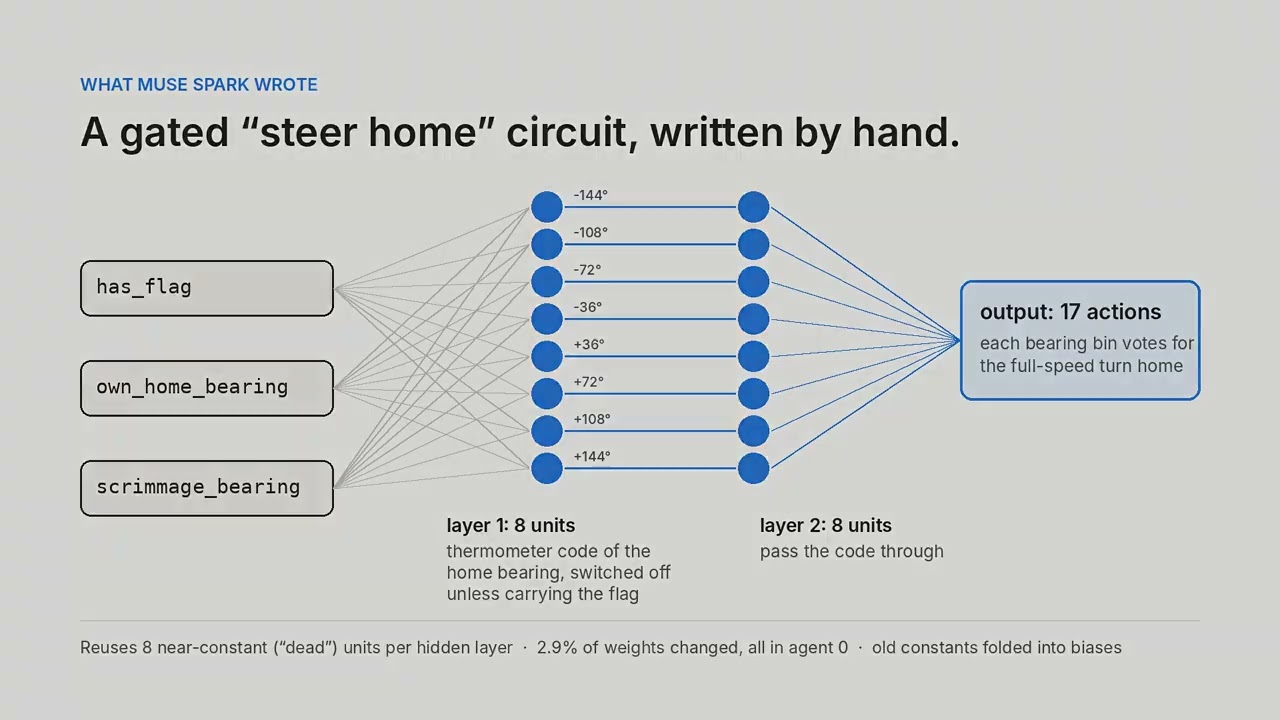
Admiral: Muse Spark repairs an RL policy by editing its weights When a neural network policy fails, the usual fix is to retrain it and hope. Admiral tests a different idea: can a frontier model read a trained network's raw weights, work out why it fails, and fix it by hand, with no gradients? The patient is a multi-agent RL (MAPPO) policy I trained for PyQuaticus, MIT Lincoln Lab's capture-the-flag simulator for autonomous boats. Its attacker grabs the enemy flag about once a match but had never scored: while carrying the flag it drifts home at 0.28 m/s and picks "stop" 19% of the time, until it is tagged. Muse Spark (muse-spark-1.3) gets the policy's 163,874 weights as numpy arrays in an isolated Docker sandbox (no network, numpy only, no simulator or optimiser), 8 recorded matches, and a budget of 100 Python runs and 50 practice matches. In one 30-minute session it: - diagnosed the fault: while carrying the flag, the attacker's turn choice ignores the bearing to home (correlation about 0); - found 8 saturated, near-constant units in each hidden layer; - rewired them into a gated "steer home" circuit: a thermometer code of the home bearing that only switches on while carrying the flag, wired to the full-speed turn toward home; - folded the old constant outputs into the biases so the rest of the behaviour is kept (same action on 99.8% of non-carry states, by its own check). It found the fault and designed the edit from offline analysis alone; its first practice match came at turn 51 of 66. The edit changes 2.9% of the weights, all in the attacker. A separate circuit check on 60,000 recorded states confirms the mechanism: while carrying, the edited network turns toward home 74% of the time (12% before), and zeroing the circuit's 8 output columns restores the original's choices on 99.7% of carrying states. Results on 200 held-out paired matches per opponent (start seeds it never saw, two opponents it never played), with 95% bootstrap CIs: - vs heuristic "hard": W/D/L 0/81/119 -> 33/69/98; score difference +0.36 (+0.24 to +0.50); captures per grab 0 -> 0.33; carry speed 0.28 -> 1.68 m/s - vs the original policy playing red: W/D/L 1/197/2 -> 28/172/0; +0.15 (+0.10 to +0.20) - vs heuristic "medium": no measurable change (+0.01); the team rarely grabs the flag there This applies MIT CSAIL's Weight-Space Programming (Nov 2026), where GPT-6 Astra repaired a PPO policy, with a non-OpenAI editor, on a multi-agent policy, and with held-out tests against unseen opponents. Limits: one editor run, not yet replicated; the team still loses to "hard" on average; matches are paired by start position but not bit-reproducible. The repo has the full transcript, prompt, tool calls, edited checkpoint and reports.