Jabardast Jetha
Built at Meta Global AI Developer Hackathon · Oct 26, 2026 · Remote
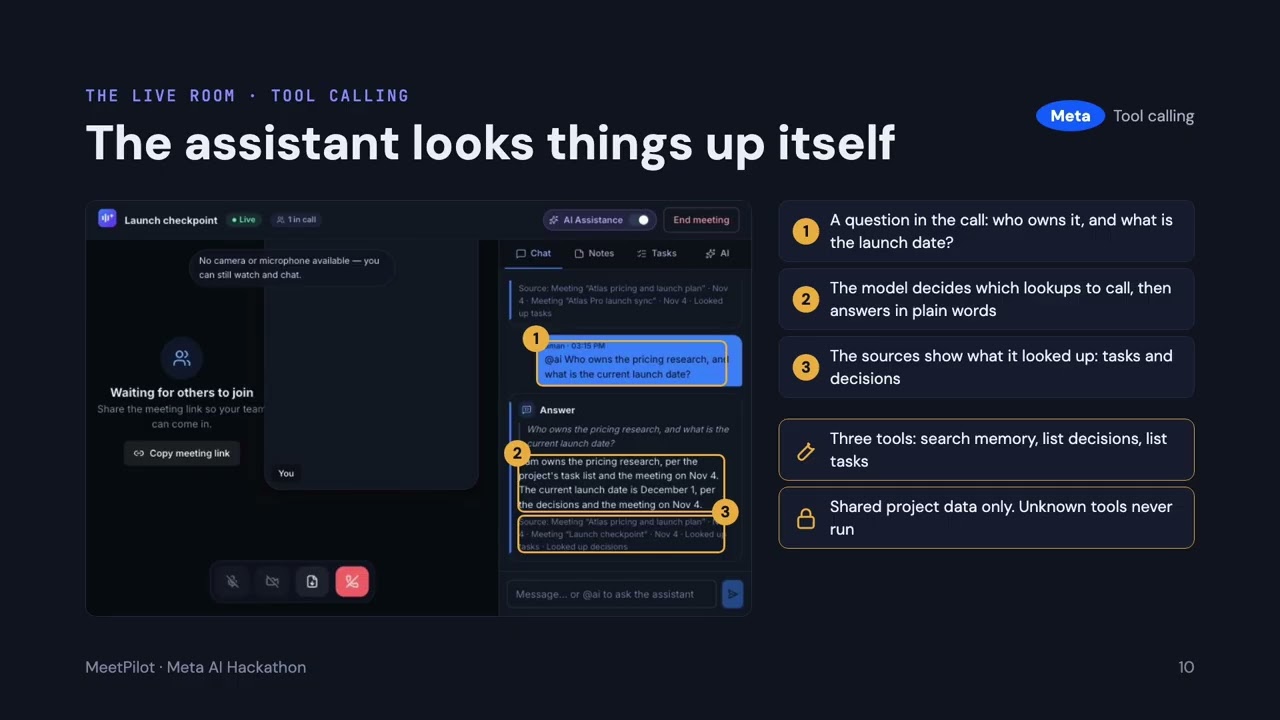
The problem. Meetings end with decisions and action items, then the work stalls. Someone still has to write the follow-up email, research the question, draft the plan, design the page and fix the bug. Notes tools stop at the summary. What it does. MeetPilot turns a meeting into finished, reviewable work. Teams run a live video room with an AI teammate that answers project questions with sources and flags contradictions with earlier decisions. When the meeting ends, it extracts tasks with owners. A router on Meta’s Muse Spark, with plain rules able to veto it, sends each task to a specialist agent or leaves it with a person: Research: a cited report. Our code checks every citation against what web search actually returned. Marketing: a dated campaign plan and an editable PowerPoint deck. Communication: email drafts in the user’s own Gmail thread. Designer: two directions, then a built site once one is approved. Code: a diff with a test, even from a screenshot of a failing test run. Every result goes to a human for review. Nothing is sent, published or opened as a pull request without a click. How we use Meta AI. We use Muse Spark and Muse Wonder, chosen per agent. Chat Completions gives us JSON-schema output, tool calling, vision, streaming and prompt caching; the Responses API gives us web search with a call budget. The 1M-token window lets the Code agent read up to 40 files in one prompt. About two thirds of prompt tokens came from cache in a repeated-prompt test. Each capability was tested against the real API, not only mocks. A quality gate checks every result, repairs it once and reports a confidence score. Engineering. Four services: a React app, a Node backend on Postgres with pgvector, a Python AI service, and a connector for Gmail, Drive and GitHub with sealed tokens. Generated code runs in a Modal sandbox. Our code handles retries, cost tracking, a daily spend cap, schema validation and scrubbing of private details from searches. 399 automated tests. Ships as one Docker image, with guides for Vultr and Hugging Face. Honest status. Gmail and Drive work today; company chat channels are planned. A Code fix is marked “not tested” until the Modal sandbox runs it. Why it matters. Each task costs cents once it is drafted, reviewed and approved. It runs on one small server with the team’s own Gmail, GitHub and keys, and the owner controls privacy and spend.