Latent
Built at Meta Global AI Developer Hackathon · Oct 26, 2026 · Remote
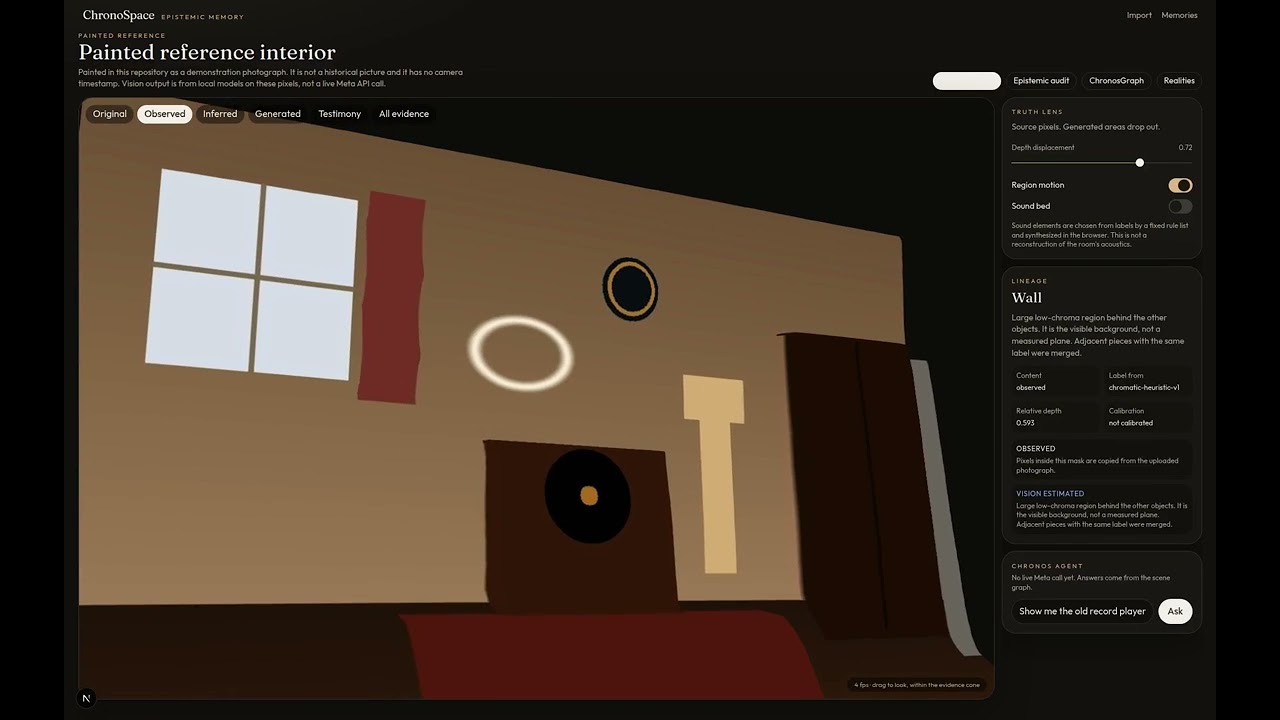
Photographs preserve moments but flatten the worlds in which those moments happened. Existing generative image-to-3D systems can create convincing environments but often blur the boundary between what a photograph actually reveals and what AI invents. ChronoSpace addresses this problem by transforming photographs into interactive, navigable spatial memories through multimodal AI and computer vision. The system combines Meta SAM 3.1 for object segmentation, Muse Spark for multimodal scene understanding and spatial reasoning, and Muse Image for controlled generative scene completion. A pretrained monocular depth-estimation model provides spatial information, which is converted into explorable geometry using Three.js and WebGL. Its defining innovation is the Epistemic Memory Engine. Every reconstructed region carries provenance indicating whether it originates from observed photographic evidence, computer-vision inference, generative reconstruction, or human testimony. Through the interactive Truth Lens, users can inspect the reconstructed environment and understand what the system actually observed versus what it estimated or imagined. ChronoSpace also introduces spatially grounded AI interaction, allowing users to ask about objects and navigate directly to relevant regions of their reconstructed memories. The broader vision is to transform personal photographs from passive archives into interactive, evidence-aware spatial memories.