SmearLens
Built at Meta Global AI Developer Hackathon · Oct 26, 2026 · Remote
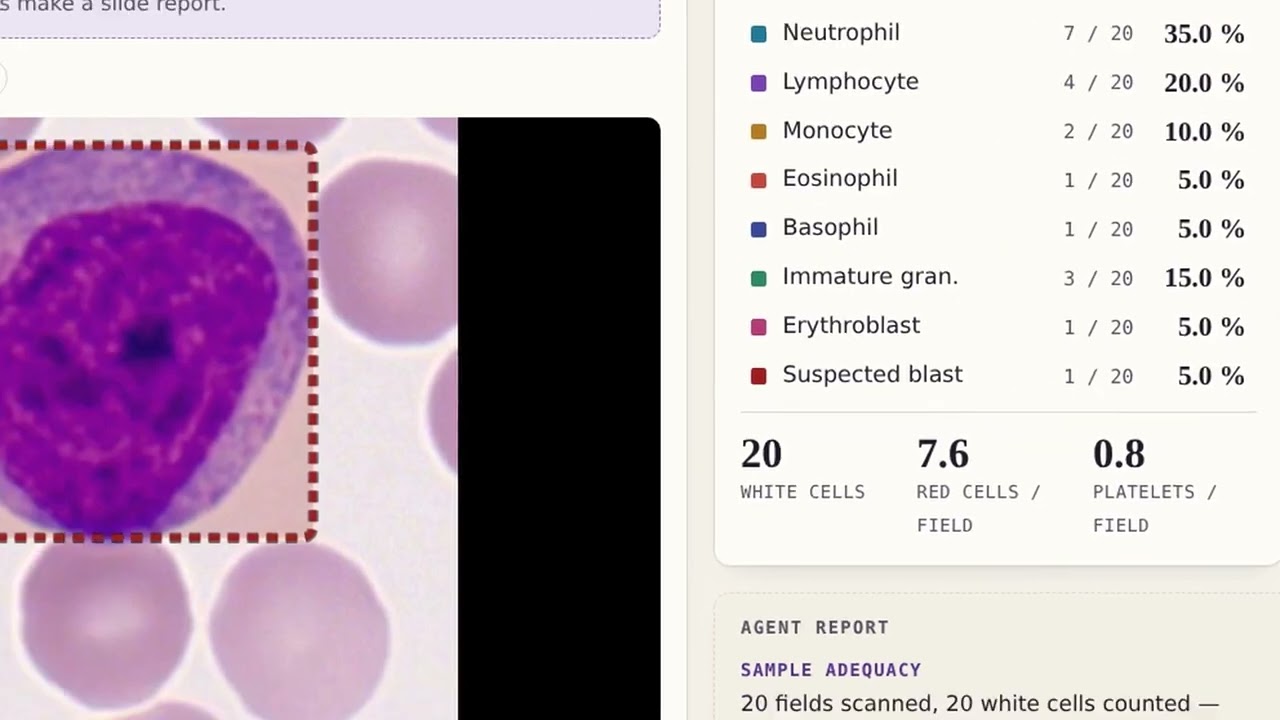
SmearLens is a review assistant for peripheral blood smears, for lab biologists. Reading a smear means looking at about a hundred white cells by eye, one by one, most of them unremarkable. SmearLens does the first pass, so the biologist can spend their time on the cells that need a closer look. It is a lab workflow tool, not a diagnostic device: it never gives a diagnosis or medical advice, and every count is a draft that a biologist reviews and validates. From one field of view or up to 20 fields of a slide, it returns: - every white cell with its type and confidence, among 8 types plus "suspected blast"; - red cell and platelet counts; - a differential count; - a review queue: suspected blasts first, then cells below a calibrated 92 % confidence cutoff; - a slide report written by an agent, with the cells to open first and its limits. Results, all measured and documented in 19 public experiments: - 97.6 % right type on PBC test cells, against 65 % for zero-shot Muse Spark; - checking the 10 % least sure cells leaves 0.3 % errors; - 83.7 % on a lab in Munich the probe never saw, without retraining; - 97 % of Munich test blasts flagged first, with 88 % of the flags right and none on 2,560 normal PBC cells. This recall is optimistic: the blasts come from one lab and the split has no patient ID. Known weak spots are stated too: pale white cells on BCDD images, and red cells undercounted on crowded fields. It has only been tested on public datasets, never in a clinical setting. Live demo: https://ravriely--smearlens-app-web.us-east.modal.run The page opens on a recorded run that needs no GPU. To run it live, click "Access token", paste the token below, then "Slide · 20 fields" and "Run it live". The first request after a pause takes about 45 s while the GPU starts. Access token: FtSbVKl9Vaj43Mtmc3HV2d-JsGN3SGpn