CinemaFabric
Built at Meta Global AI Developer Hackathon · Oct 26, 2026 · Remote
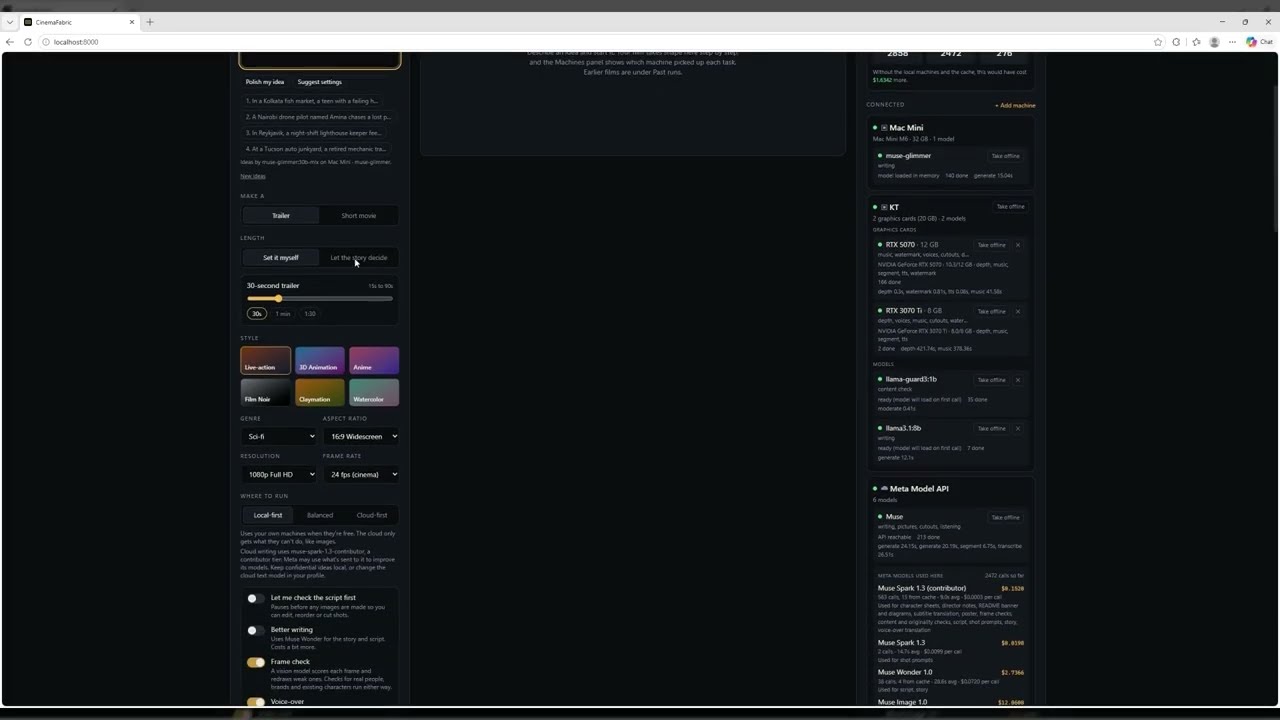
CinemaFabric makes the machines you already own and the Meta Model API work as one AI studio. A distributed inference fabric sends every task to the place that runs it best (a local NVIDIA GPU, a Mac running Muse Glimmer, a CPU or a Meta model in the cloud), weighing quality, latency, queue depth, licence and cost. It records why each decision was made, reroutes when a machine drops out mid-run, and caches results so nothing is made twice. Local machines take what they run well (writing, safety checks, depth, voice, music, watermarking); the cloud takes what they cannot do as well, chiefly Muse Image. In our benchmark, local-first and balanced routing ran about 70% of every film's tasks locally, and a machine taken offline mid-film moved 23 tasks to the cloud with none lost. The workload that proves it is film-making: one sentence becomes a finished trailer or short film, with script, storyboard, character sheets, poster, voice-over in 18 languages, score, subtitles in 19 and an optional director's commentary, around sixty tasks of nine kinds for a 20-second trailer. A crew of eleven agents reviews and corrects the work: a script doctor, continuity supervisor, editor, translation reviewer, and a test screening that hands its notes to a director agent. Every film is checked for harmful and borrowed content, labelled as AI-made, watermarked with AudioSeal and signed with C2PA Content Credentials.