Lost & Frame
Built at Meta Global AI Developer Hackathon · Oct 26, 2026 · Remote
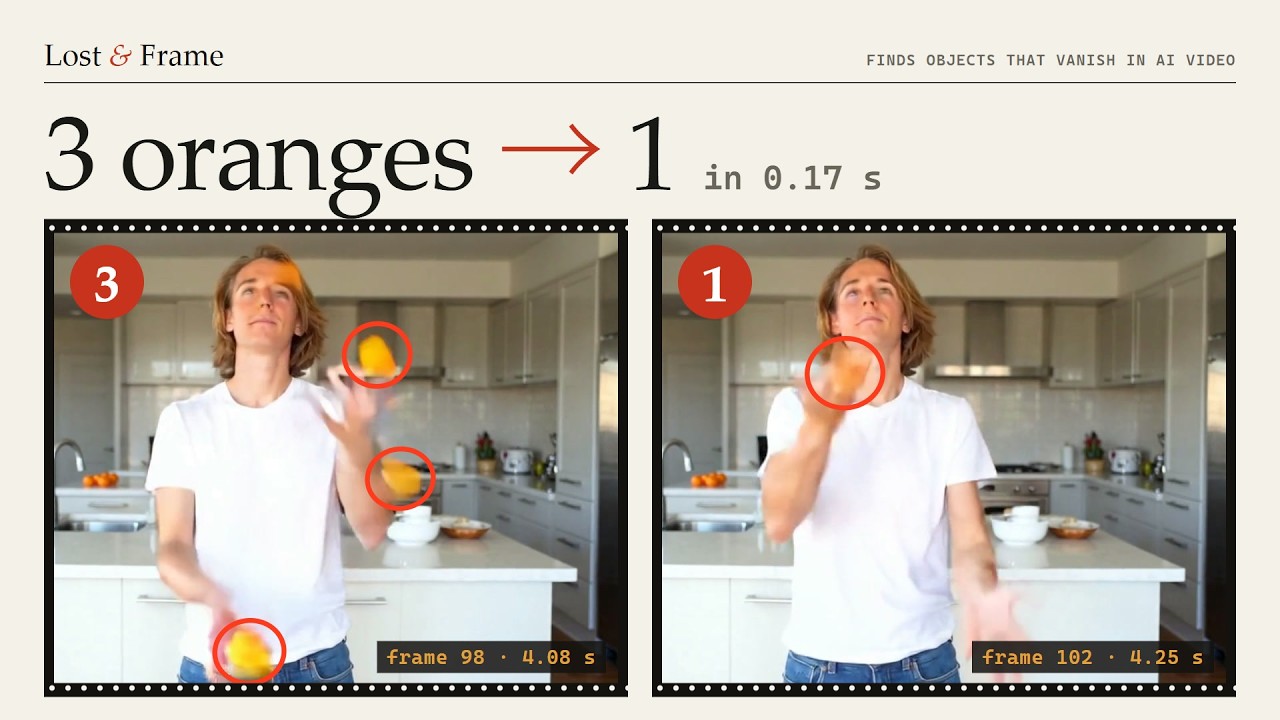
Lost & Frame finds the moments in AI-generated video where an object disappears or appears with no visible cause. The problem: AI video generators lose track of objects. A mug appears on a table nobody touched, or three juggled oranges become one within a sixth of a second. People who publish AI video, and teams that compare video models or filter generated clips for datasets, have to step through every frame to catch this: a 5-second clip has about 120 frames. What it does: you drop in an MP4 or MOV clip and name the objects to watch, such as "cup, ball". The app extracts frames, asks the models, and opens a review page with one card per moment: the two frames before and after the change, a Blink button that flips between them, and the model's one-line reason. A strict setting gives fewer false alarms; a sensitive setting catches more. The app runs locally in the browser, in English and Korean, and only still frames are sent to the model. How it works: every 16 frames, three witnesses examine eight stills spread over about a second. The scene judge (Muse Spark) says whether the object vanished or appeared with no visible cause. The counter (Muse Spark) counts the object in each still, which catches one change among look-alikes. The spotter (SAM 3.1) restores the weak detections SAM 3.1 normally discards and zooms in where a copy starts or stops. Results: each test set and scoring rule was fixed before the first run and scored once. On the sensitive setting with Muse Spark Open, Lost & Frame caught 23 of 25 clearly visible real glitches (92%), 99 of 126 including likely visible ones, and 135 of 140 copy glitches (96%). 10 of 18 pre-registered hypotheses held; RESEARCH.md records every result, including the failures. Limits: glitches that still frames cannot show are caught only at chance level, and about half of clean clips still get at least one alert. It is a review aid: it narrows 120 frames to a few moments, and a person makes the final call. All code in the repository was written during the hackathon.