Ailism
Built at Meta Global AI Developer Hackathon · Oct 26, 2026 · Remote
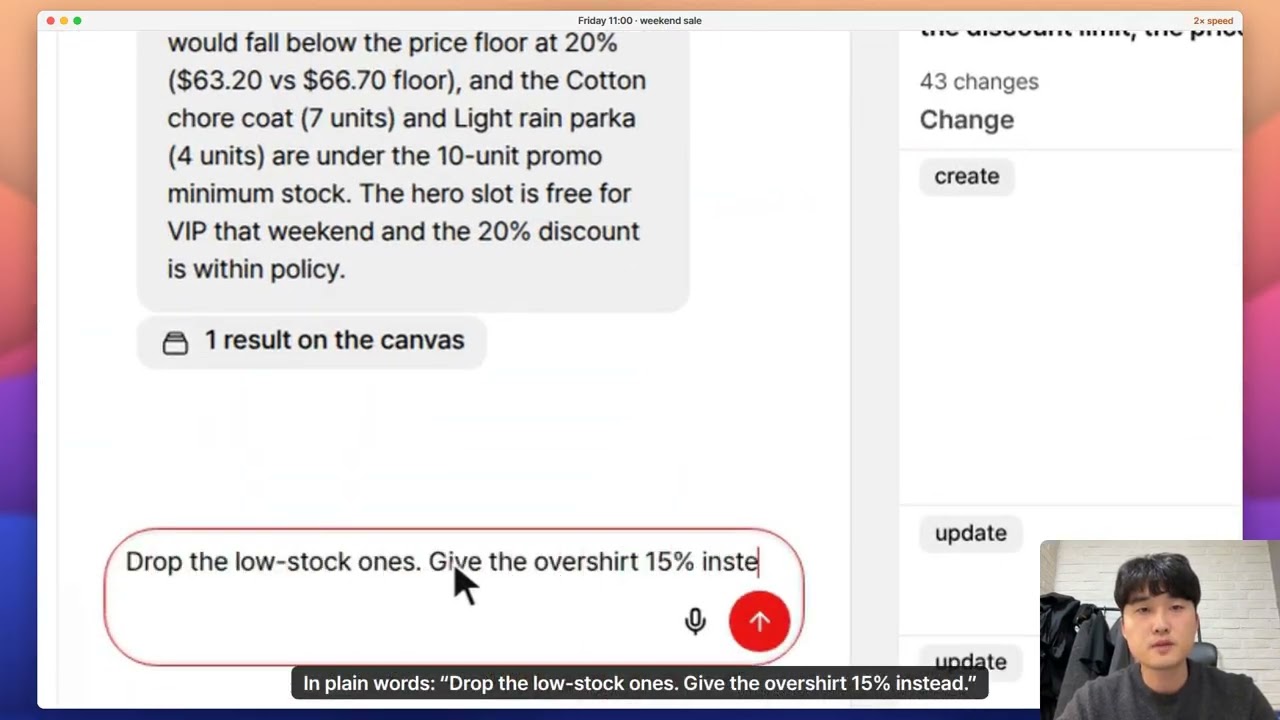
A-Commerce is an online store you run by talking: an AI-native commerce back end, rebuilt so that a small open-weights model can do the store's routine work. Operators and shoppers just talk. The agent finds the store's tools, chains them, previews every write, and puts the result in one change set that a person approves, like a pull request. Try it: https://a-commerce.ailism.team (storefront) and https://a-commerce.ailism.team/bo (back office, admin / admin123). Built during the hackathon, first commit Oct 27, 2026. Commerce back ends are hundreds of screen-shaped APIs with legacy names and ordering rules only people know, so today's "AI commerce" is mostly a chatbot next to screens people still operate. We rebuilt the layer underneath for the agent instead: 1. Tools speak the store's units: an order number, an email, a product name. 2. Every change is a proposal first: preview, change set, approval, run, verify, undo. 3. Rules are data (discount limits, price floors, approval thresholds), checked by the back end, so a wrong model still cannot break a rule. 4. The store brings the work: watchers open tasks with a drafted change set before anyone asks. 5. The answer is a UI, not a paragraph: 21 UI blocks picked per task and per person. Example: "Run a 20% weekend sale on summer outerwear for VIP members and put it on the main page." The agent drafts the sale prices and the main-page banner, and the store's checks catch an overshirt that would go under its price floor and two products too low on stock. "Drop the low-stock ones. Give the overshirt 15% instead." gives version 2, and every check passes. Nothing changes until the owner approves. The same flow makes store pages: "Make a collection page called Cozy knits … and generate a picture for the top of the page" drafts the page with a banner Muse Image draws at preview, so the person approving sees the picture before shoppers do. Measured on Nov 3 (390 runs, on the 400-product store of that day) on the same back end and the same model (Muse Glimmer 30B), with tasks we did not design against: - Held-out set (9 tasks x 10 runs): 0% through a screen-shaped API, 33% through auto-converted tools, 44% through A-Commerce tools. - Fresh set (8 tasks x 5 runs): 0% / 12% / 50%. - Customer messages sent without a person's approval: 10 of 10 through the converted tools, 0 of 10 with A-Commerce, which drafts them for approval.