strollcall
Built at Meta Global AI Developer Hackathon · Oct 26, 2026 · Remote
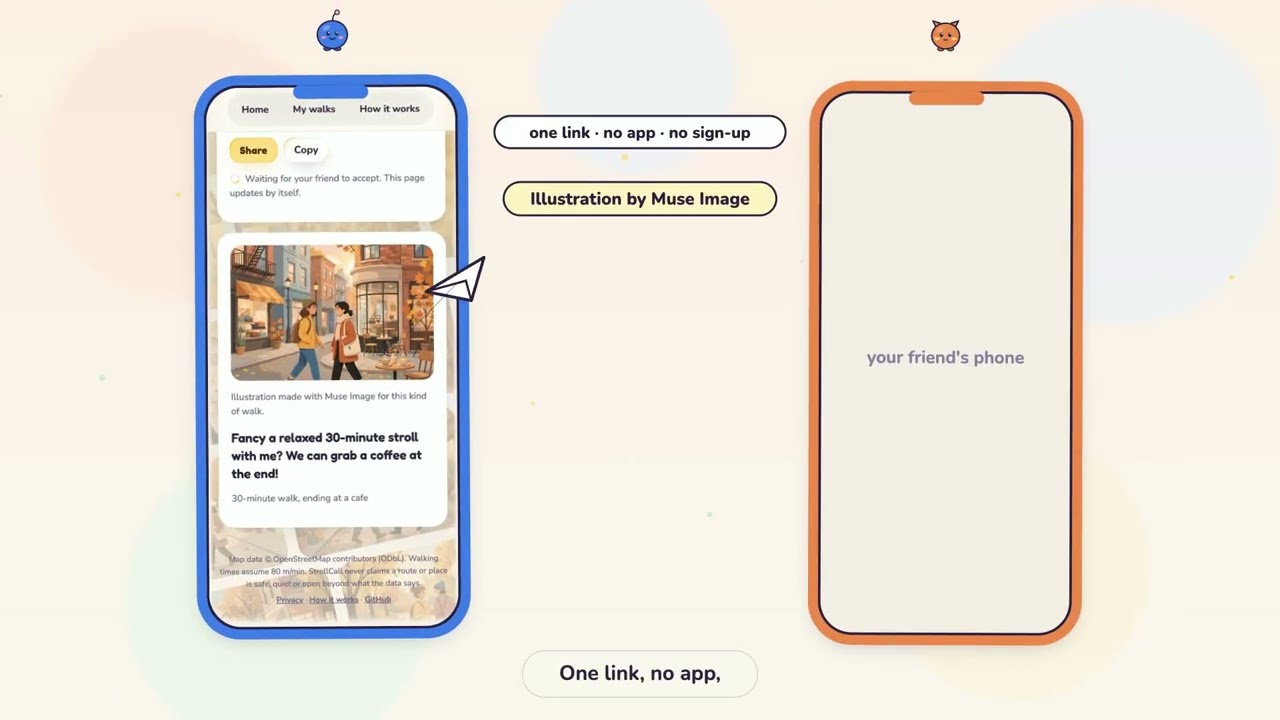
StrollCall gets you outside. Many of us want to go for a walk but don't know where to go, and "we should hang out sometime" with friends rarely turns into a plan. StrollCall turns one sentence into a short, real walk, on your own or with a friend. How it works: say or type what you feel like, e.g. "25 minutes, quiet streets, coffee at the end", and pick a start point. StrollCall plans a 20–30 minute walk past places nearby, ending somewhere worth arriving. To walk with a friend, send one link: your friend taps "I'm in" on their phone, no app or account needed, and adds what they'd like. StrollCall finds a meeting point that is fair by walking time, not by distance on a map, and then a shared walk to a destination that fits both of you. In-app guidance follows you with a full-screen map, turn prompts and a voice walking buddy that can change the route mid-walk ("add a coffee stop", "I only have 10 minutes"). Meta models do the human side: - Muse Glimmer (open weights, self-hosted on Modal) reads each wish into structured constraints. - Muse Spark reconciles two people's preferences, explains the trade-off, ranks candidate plans and powers the walking buddy through tool calling. - Muse Voice Transcribe turns speech into text; Muse Image illustrates invite cards. A deterministic planner on our own New York walking graph (built from OpenStreetMap) handles geography in milliseconds. Model output is validated against real data: an automated check rejects any claim our data can't support, so we never invent places, opening hours or routes. Every evaluation was pre-registered. On 12 New York test pairs the planner gave the correct outcome in 12/12, with a median arrival gap of 0.2 minutes. Meta's reading caught 10/10 pre-registered wishes vs 7/10 for keyword rules, and Muse Glimmer read wishes in a median 0.55 s vs 3.58 s for the hosted API.