pixeltruth
Built at Meta Global AI Developer Hackathon · Oct 26, 2026 · Remote
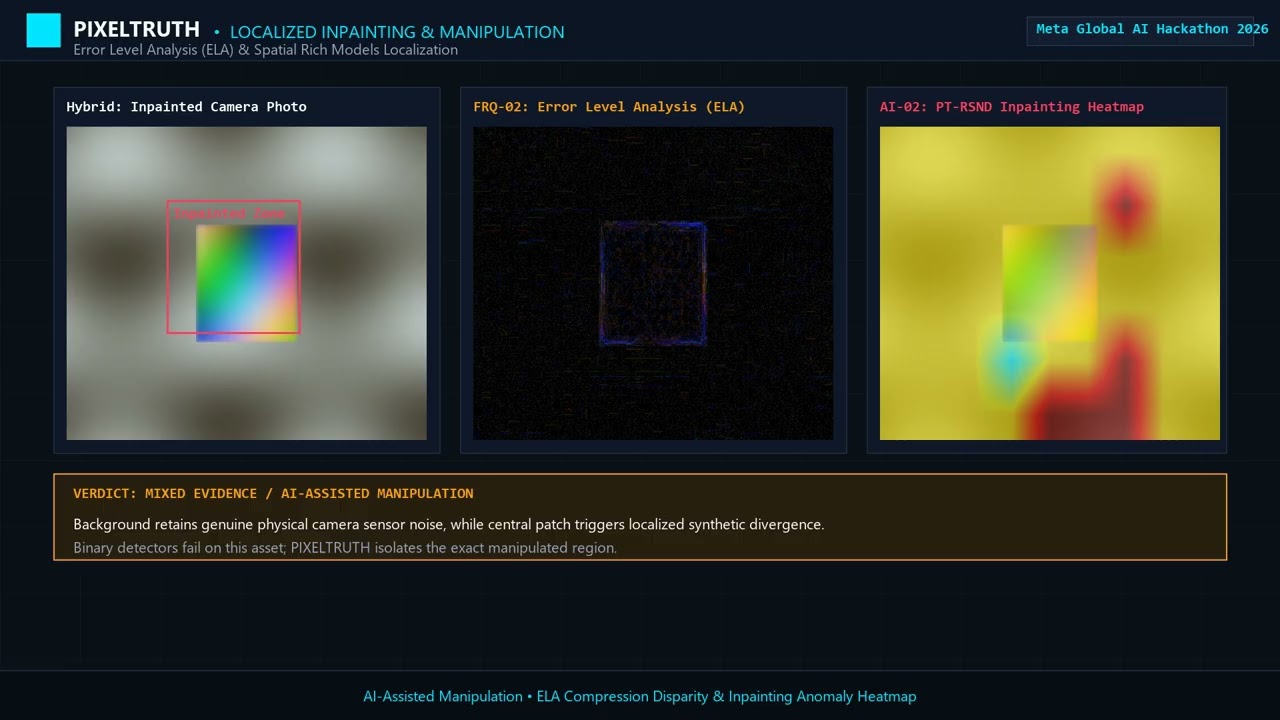
PIXELTRUTH is an open-source digital image provenance and forensic investigation platform built to solve the visual trust crisis on the modern internet. Existing AI image detectors are simplistic binary black boxes that output arbitrary percentages (e.g., "94% AI") without explainability. They break when images are compressed on social media (WhatsApp, Instagram, X), fabricate false accusations when metadata is stripped, and fail completely on hybrid media where real camera photos have selective generative inpainting or background edits. PIXELTRUTH abandons the binary classifier paradigm. Guided by the principle: "Don't judge how an image looks. Investigate how it came to exist," it evaluates available physical and mathematical evidence across five independent forensic engines: 1. Camera Fingerprint Analysis (PRNU sensor noise residuals, Bayer CFA Nyquist demosaicing periodicity, Poisson shot-noise scaling, and optical lateral chromatic aberration). 2. Physical Scene Consistency (illuminant vector field coherence and specular highlight chromaticity under the Dichromatic Reflection Model). 3. Pixel & Frequency Domain Forensics (2D Fast Fourier Transform scale invariance [1/f^α], Error Level Analysis, DCT Benford's Law, and spatial patch Shannon entropy). 4. AI Generation & Inpainting Localization (PT-RSND Spatial Rich Models steganalytic filter banks and sliding-window patch heatmaps). 5. Provenance & C2PA Credentials (EXIF hardware headers and raw container byte scanning for cryptographic C2PA JUMBF manifests). At its core is a calibrated Evidence Fusion Engine that accounts for post-processing transformations (JPEG quality factor Q, resampling periodicity, screenshot heuristics, and edge sharpening halos). Instead of forcing a guess, PIXELTRUTH yields five calibrated outcomes: Camera Capture, AI Generation, AI-Assisted Manipulation, Mixed Evidence, or Inconclusive. Examiners can inspect diagnostic layers with an interactive opacity/split-view workspace, run multi-image batch queues, perform dual side-by-side comparisons, and export court-ready PDF forensic dossiers.