CHINCHIRU_35
Built at Meta Global AI Developer Hackathon · Oct 26, 2026 · Remote
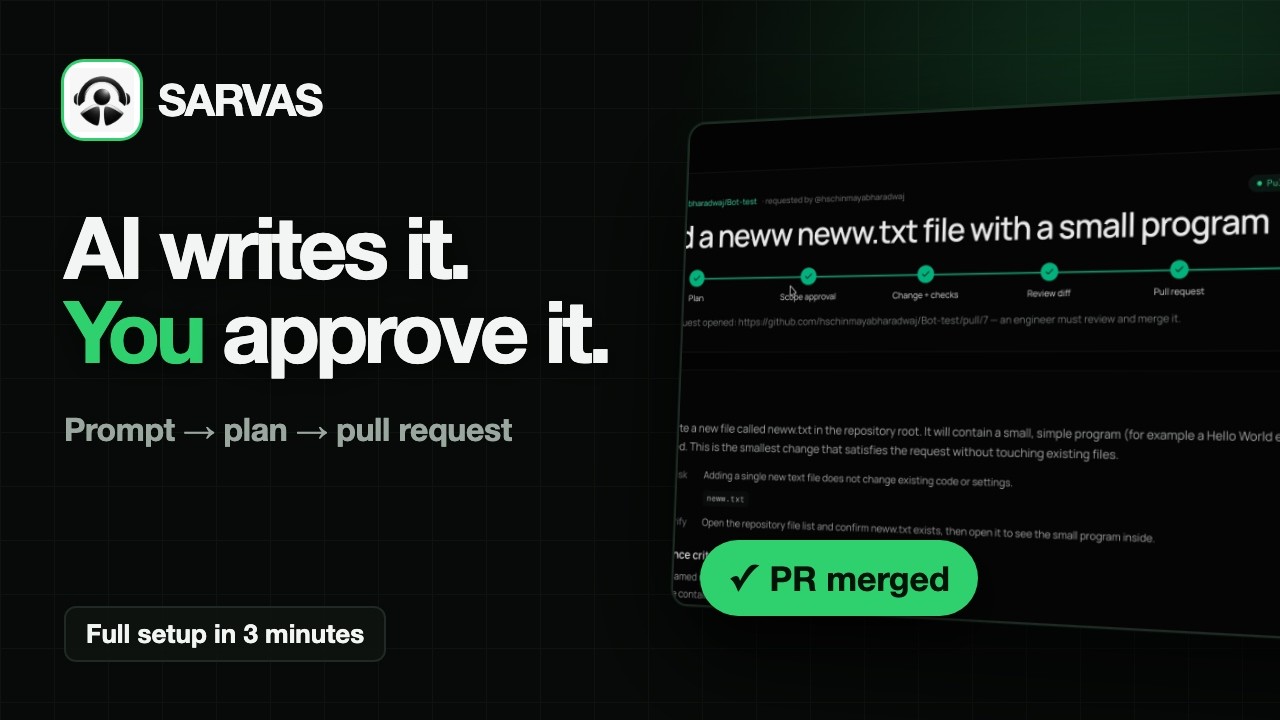
THE PROBLEM Product managers, designers, support staff and founders often need small changes to their codebase, or answers about it: "Where is the pricing logic?", "Fix the typo on the contact page", "Add a dark-mode toggle". Today they file a ticket and wait, or they interrupt an engineer. AI coding tools exist, but they are built for developers. Giving them to non-developers raises real worries: code pushed straight to production, leaked secrets, and changes nobody reviewed. THE SOLUTION SARVAS is a coding Bot. You sign in with GitHub and pick a repository. 1. Ask SARVAS answers questions from an index of the repository's code, docs and dependencies. Every answer cites file paths and links to the exact lines. If the code doesn't support an answer, SARVAS says so instead of guessing. 2. Build (request a change) - You describe a feature, bug fix or UI change, and how you'll know it's done. - If anything is unclear, the agent asks follow-up questions. - The agent proposes a plan with acceptance criteria and a risk level (low, medium or high). - Once the plan is approved, the agent writes the code in a throwaway sandbox and runs the repository's own tests and checks. - You review the exact diff. Approving it opens a pull request that lists the task, the changed files, the test results, the risks and the limitations. 3. Ask to Build One click turns an answer into a change request, pre-filled with the question and the files it cited. 4. README tool Add or remove a README.md, with an exact preview of the change before anything happens. 5. Dashboard - Your GitHub identity, your role and the repositories you're authorised to use - Which AI model is in use and whether code leaves the server - A page for each task - A full audit log SAFETY BY DESIGN No direct pushes SARVAS never pushes to a default branch and cannot approve or merge pull requests. GitHub branch protection decides who merges. Human approval at every risky step - Requesters approve their own low-risk plans. - Medium-risk plans need approval from an engineer with push access to that repository. - High-risk requests are declined outright. This covers anything touching authentication, payments, infrastructure, CI or credentials. Isolated sandboxes AI-written code runs in throwaway sandboxes with resource limits. Tests run with no network access. Only a diff comes back, so a sandbox can never rewrite git history. Least-privilege GitHub access - Users sign in with GitHub OAuth. Their tokens are encrypted at rest and never sent to the agent. - Changes go through a GitHub App that can only access repository contents and pull requests. - Every repository access is checked again against the user's own GitHub permissions. Guardrails - Secret scanning - Protected paths - A deny-list for sensitive files - A sanitiser for untrusted input - Per-hour and per-day usage limits - A strict Content Security Policy - An admin kill switch that stops all new work at once Consent for sending code Repository code is sent to a remote AI provider only when the operator explicitly allows it, and the Dashboard tells users when that happens.