Trust Boundary
Built at Meta Global AI Developer Hackathon · Oct 26, 2026 · Remote
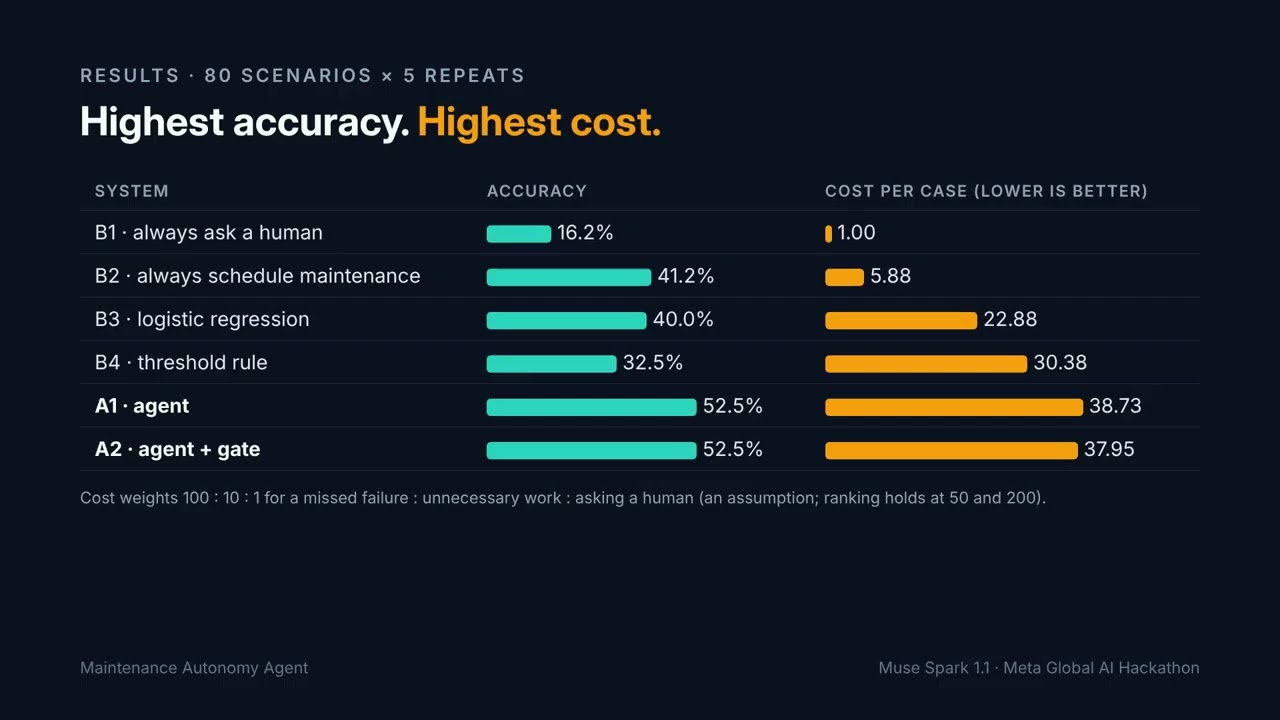
The bottleneck for AI in industry is not model capability. It is verification: proof of how far an agent can be trusted before it is deployed. This project is that verification, built for predictive maintenance. An agent on Muse Spark reads sensor data, error codes and maintenance history through four read-only tools and proposes an action. A code-based policy gate decides what it may do alone; stopping a line is always a human decision. We tested it on 80 frozen scenarios from a public dataset (strict dev/eval split, pre-registered analysis, 5 repeats), including paired traps that separate injected degradation from a stuck sensor, against four simple baselines. Accuracy alone would have said "deploy it": the agent scored highest (53%) and caught every stuck sensor. Verification said otherwise. It missed 85% of subtle degradation, so its expected cost was the worst of all systems, and the policy gate reduced that by only 2%, because guardrails stop wrong actions, not wrong inaction. The result is a concrete boundary: trust the agent as a sensor-sanity filter, not as a failure detector.