DecideOnce
Built at Meta Global AI Developer Hackathon · Oct 26, 2026 · Remote
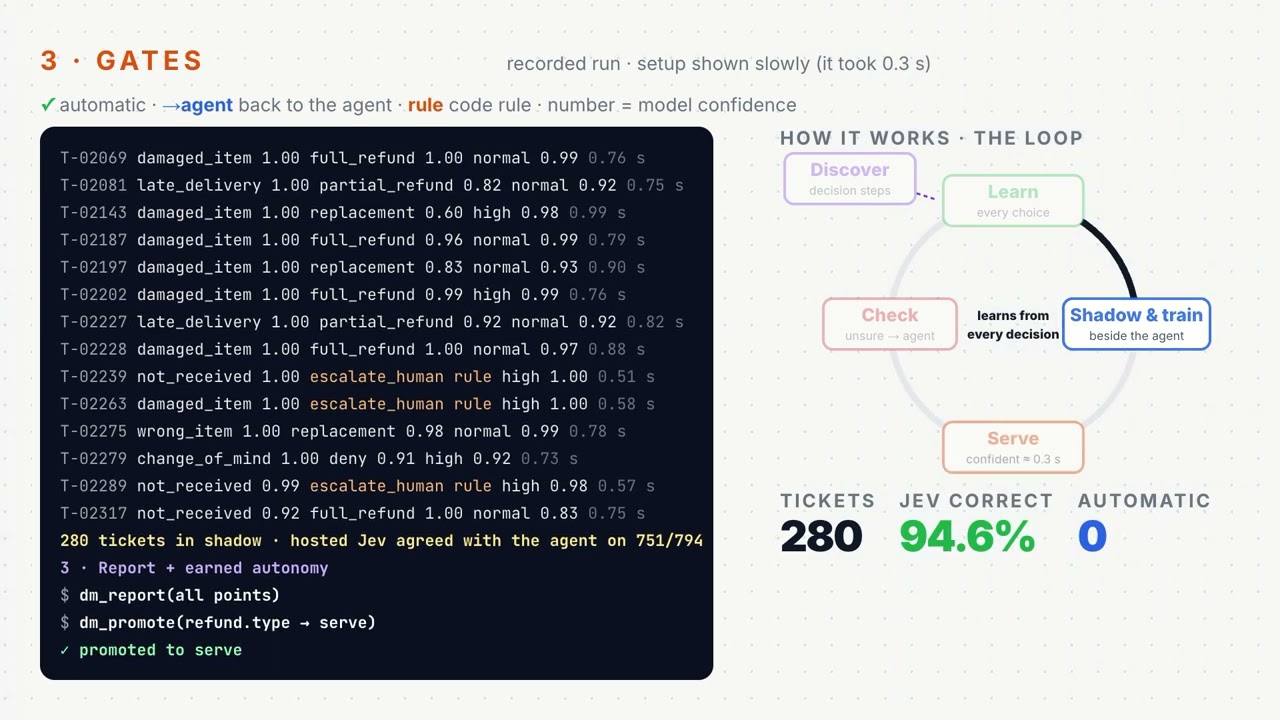
DecideOnce: the CUDA moment for decision models. CUDA moved heavy, repetitive work from general CPUs to specialised GPUs, but programmers had to find that work and rewrite it by hand. AI agents have the same problem: they burn frontier-model reasoning on the same small decisions all day. Refund or replace? Urgent or not? Which queue? Moving one of those to a cheap model today means finding it, collecting data, fine-tuning and ML staff. DecideOnce is the first system built to close that loop end to end. It is an MCP server you plug into the workflows you already run: 1. Discover the decision steps and their options. Prompts alone mislead: in our annotation study, careful readers agreed only a third of the time. So DecideOnce reads behaviour too: the code, the traces, and whether the next step actually uses the answer. Two of three signals must agree. 2. Learn while the agent works as usual. Every choice and outcome is recorded, with zero extra calls. 3. Train only where needed. It uses an off-the-shelf decision model if one is good enough, and trains one if not (training shown by hand; one-click in build). 4. Serve once earned. A step goes automatic only when its error bound is ≤ 2% and beats random escalation. Unsure cases go back to the agent. It runs on autopilot within limits you set once. Results (synthetic tasks, one run each): • Discovery from behaviour. On the refund workflow, all three decisions are found with code, traces and text agreeing, and the reply step is rejected as free text. On 5 generated test workflows, each with a planted step whose answer nothing uses, the trace-pattern detector (v1) flagged that step as a decision; the new 'used next' check rejected it every time, and no real decision was lost. • Live MCP run, refund tickets. Hosted Jev agreed with the policy-following agent on 751 of 794 decisions (95%) in shadow. • Ticket type and priority passed the gates (relaxed for the demo). • On 20 new tickets, all 30 automatic decisions were correct. • The money-moving refund action did not pass: there was not enough evidence yet, so it stayed with the agent. • Training when a model falls short. Muse Glimmer 30B got the refund action right 63% of the time. After one hour of training on 150 tickets it reached 94%, and 98% overall, with zero mistakes on the 93% of decisions it was confident about. Hosted Jev already scored 96% here, so DecideOnce would not train at all: it trains only when needed. • New workflow, lead routing, no training. It matched Wonder at 60/60 each against the policy. It was 40% cheaper on the decision steps, and 10× faster (0.26 s vs 2.6 s) on the 25 of 60 leads it decided without Wonder. Built during the hackathon (all code written 1–4 Nov 2026, inside the 26 Oct – 4 Nov event; solo, with Muse Code; 100+ commits): • The MCP server: decision core, discovery from text, code and traces with the used-next check and 2-of-3 evidence levels, shadow and serve gates with audits and drift checks, autopilot (tested with a simulated trainer), zero-edit gateway, hosted-Jev tier, training export. 450+ tests. • The Muse plugin with the decideonce-workflow and decideonce-design skills. • The demo: synthetic refund tickets and policy, the live MCP run, the lead-routing pilot, the Glimmer training run. Used, not built by us: Meta's Muse Code, Muse Glimmer 30B and Muse Wonder; hosted Jev (TypeSafe, via OpenRouter); Fireworks training and its decision/kalshi_v1 recipe.