Quantum Concepts LLC
Built at Meta Global AI Developer Hackathon · Oct 26, 2026 · Remote
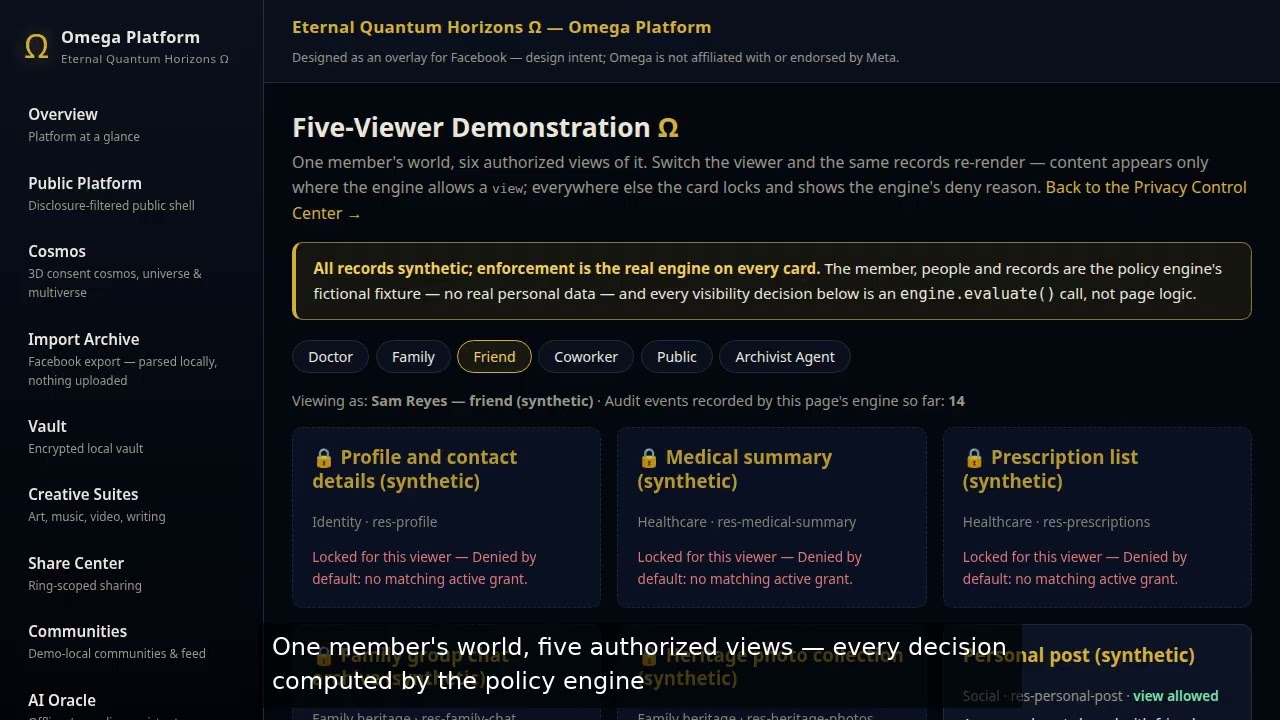
# Omega Platform — Eternal Quantum Horizons Ω **Creator: David Charles Bourassa · Quantum Concepts LLC, Santa Fe, New Mexico** **Event: Meta Global AI Developer Hackathon 2026 · Track: Startup · Themes: "Build for Your World" (primary), "Push the Frontier" (secondary)** **Submission due: November 4, 2026, 9:00 PM ET — via the Cerebral Valley portal** > **One-liner:** Your Facebook graph, as a living, consent-bound cosmos you actually own — designed as an overlay for Facebook, built on Meta's own AI stack, owned by you. > > *Design intent only: Omega is an independent project. Nothing here implies Meta endorsement, partnership, or approval.* --- ## The problem — and who benefits *(Impact)* People have spent fifteen years building a life inside social platforms — friends, family, memories, communities, creative work — and they hold none of it. They cannot see it whole, cannot carry it, cannot decide what an AI may know about them, and cannot pass it on. When a platform changes its terms, an account is lost, or a person dies, that life's record scatters or vanishes. Omega is built for the people who made that graph: **everyday Facebook members** who want ownership without leaving; **families** who want a parent's or grandparent's memories preserved with dignity and consent — not scraped; **creators** who want their work, their audience, and their AI tooling under their own keys; and **anyone who has watched an AI answer questions about a person's life with invented facts** and understood why that must never happen to someone's legacy. Omega does not ask anyone to leave Facebook. It is designed as an overlay on the graph people already have — the next-generation layer *for* Facebook: the same friends and memories, rendered as a navigable cosmos, wrapped in consent the member controls, with a personal AI grounded solely in the member's own data. If it works, consent stops being a settings page and becomes something you can see: switch rings, and the universe itself re-lights — *what changed is what the AI may see.* **The project's claim, deliberately scoped to a specific combination:** the first social platform to combine a navigable 3D cosmos interface with a member-keyed encrypted data vault and a personal AI grounded solely in each member's own data — every output carrying an "official personal AI" provenance badge. It is presented as the project's claim, scoped to that combination. ## What is built *(Technical Depth & Execution)* A TypeScript-strict monorepo (pnpm + Turborepo) with an honest working/scaffold split — every component below is labeled as it truly is. - **Holographic Cosmos Engine** (`packages/cosmos-engine`) — a real Three.js engine: single-draw-call instanced nodes with custom GLSL (pulse, fresnel rim, hover/select), four consent-ring shells, a Trust Beacon with GPU particle flow, fbm nebula + starfield, bloom post-processing, fly-to-node camera work, and camera auto-framing that fits each dataset's own bounds on load — **119 tests**, including **stellar physics**: every member is a star whose mass grows with their friend count and whose density and brightness grow with their follower count (at exactly unchanged mass — the monotonicity is a tested contract; the node inspector computes Friends / Followers / Mass / Density / Brightness live, under the in-product legend "Friends make a star massive. Followers make it dense and bright."), a seeded **cosmic-web Universe mode** (galaxies along filaments, clusters at intersections, true voids; distribution properties statistically tested) and a **Multiverse view labeled SPECULATIVE in-product**, because bubble universes are unproven and the product says so. - **Consent Ring Mesh** (`packages/consent-core`) — Family / Friends / Work / Public rings, consent receipts, exact-ring `canAccess`, deny by default — plus sync events and **revocation with context purge**: revoking a receipt purges cached AI/connector context for that subject and ring, recorded as sync events (demonstrated live on synthetic data in the Operator Control plane, `/control`). - **Universal Access Engine** (`packages/policy-engine`, `/privacy`) — the consent thesis generalized into a policy engine: every resource lives in one of **10 data domains** (identity, family heritage, social, healthcare, employment, financial, intellectual property, AI/agents, legacy, public-released) and every request is evaluated over the full tuple — subject + resource + action + purpose + relationship + consent + policy + context + expiration — **deny-by-default**, with **explicit individual denials that beat group grants**, purpose-limited grants, and **temporary access passes** that expire by time or task completion. Revoking a grant denies on the very next evaluation and purges the grantee's cached context through consent-core's sync primitives. The Privacy Control Center exposes the machinery live — relationship manager, permission matrix, **Access Preview** (exactly what any person or agent can reach, computed by the engine, grant/denial ids cited), consent dashboard, access audit, and a governed emergency-access flow — and the **Five-Viewer Demonstration** (`/privacy/demo`) renders one synthetic member's world five authorized ways (Doctor, Family, Friend, Coworker, Public): the doctor sees the medical record and is denied the family conversations; the coworker is blocked from the performance review by an individual denial despite a work-domain grant. The scenario is also an automated **28-case security-test matrix**. Legacy directives (lifetime vs post-death permissions, designated stewards, domains that never become public) are first-class data, surfaced on the Eternal Garden. Enforcement lives in this tested package on every demo data path; the production database schema (23 entities, RLS notes) is written as a labeled design artifact in `docs/PRODUCTION_SCHEMA.md` — designed, not deployed, and no compliance is claimed. - **Omni-AI Agent Fabric + Omni Execution** (`packages/ai-core`, `/agents`, `/review`) — the canonical eight agents (Oracle, Consent Guardian, Memory Curator, Avatar, Legacy Mirror, Studio, Connector, Economic Steward) as pure data definitions, with a deterministic runtime that runs the pipeline Intent → Ring → Consent Check → Retrieval → Response → Receipt: ring-scoped tasks without an active consent receipt are refused before any retrieval, the Connector prepares consent previews and never executes, the Steward's member/public audience receives only the member dispersion total, and every run emits step receipts plus a run receipt. On top of the fabric sits the **Omni execution layer**: a data-driven agent registry in which a proposed agent becomes active **only through a person's approval** (agent approvers and unapproved activation throw), a planner that turns a goal into a typed plan — **live-capable since Phase 4**: when a Meta Model API key is configured, the Meta Model client drafts the plan in the same schema, and the draft is treated as untrusted input — every step is validated against the agent registry, the gateway tool registry, and the plan's own earlier agent proposals before the plan exists (hallucinated tools and malformed output are rejected loudly, all reasons recorded; mock-fetch tests prove the accept/reject paths); with no key, a deterministic offline planner emits the identical schema and the badge says OFFLINE — and an executor that runs only approved, non-vetoed steps, in order, each gated by the policy engine under a purpose-limited pass issued by the member-owner that **expires when the run completes**. Agents hold **versioned skills** (modules over the gateway's real tools — Evidence Research, Community Launch, Archive Curation, Findings Writing, Graph Analysis), and the executor refuses any tool step its agent's skills don't cover, on top of the allowlist. Denied and out-of-scope steps are refused visibly with the engine's reason, every step lands a receipt in a versioned vault run record, and each run record closes with a **reflection** — written by the live model when keyed, a deterministic template otherwise, the source labeled in the record and in the workstation's per-agent run history. The Review Workstation (`/review`) is the human side of the same machinery — proposals, approvals, vetoes, run receipts, an agent monitor — with no UI path around approval or policy. - **Sovereign Vault** (`packages/vault-core`) — real client-side cryptography: per-item AES-GCM encryption with item keys wrapped per consent ring (AES-KW); unwrapping with the wrong ring's key fails — proven by round-trip and wrong-ring tests, and verified end-to-end in the browser. - **PhiSplit Economic Kernel** (`packages/economic-kernel` + `contracts/`) — a recursive golden-ratio split (Trust 61.8033988% / Members 23.6067976% / Operations 14.5898036%) in exact bigint math, property-tested over 1,000 amounts; the Solidity suite (PhiSplitRouter, ReserveVault, MerkleAnchor) passes Foundry 9/9 including fuzz. **Contracts are unaudited and testnet-grade, and are labeled that way everywhere.** The kernel also ships a **public disclosure facade**: public payloads are rebuilt through an allowlist sanitizer carrying only the member dispersion total, asserted free of forbidden keys at any depth, and leakage-tested — the payload the Public Platform shell (`/public`) renders as visible JSON. - **The overlay, made real** (`packages/meta-export` + the Import Archive page) — a Facebook "Download Your Information" export is parsed **entirely in the member's browser** (nothing is uploaded), normalized into a member graph, and every person is placed into a consent ring by deterministic rules — friend lists first, an interaction-frequency heuristic second, and deny-by-default last: the unclassified land in the most restrictive ring until a human reclassifies them (the UI supports per-person overrides). The imported graph renders in the same consent cosmos, with ring filtering live. The demo runs on a synthetic, fictional export, labeled as such. - **MCP Universal Bridge** (`packages/mcp-gateway`) — a working JSON-RPC 2.0 tool gateway (registry, `tools/list` / `tools/call`, stdio transport) whose first tool source is the member graph itself (`graph.summary`, `graph.listPeople`, `graph.searchPosts`), behind a pure 10-adapter catalog (18 tools): Meta-export, notes, and files working; GitHub and Notion working over synthetic fixtures; Stripe sandbox; AWS / Cloudflare / Hugging Face / Home Assistant stubs — with rate limiting, a circuit breaker, PKCE helpers, and per-call tool receipts, aligned to MCP 2026-07-28 (`server/discover`) — the connector fabric the overlay plugs into, tested at the protocol level. - **Continuity core** (`packages/legacy-engine`) — a versioned memory vault over the Garden archive: append-only versions, a receipt for every mutation, nothing silently rewritten — plus a consistency scorer that flags claims contradicting the archive and claims with no archival support. The real-data-only rule, enforced in code; the synthetic archive audits clean, 32/32. - **Eternal Garden — the Legacy Mirror** (`packages/ai-core/src/legacy/`) — the build's ethical core. A question-answering layer over a person's life archive that cites a source memory for every claim it makes, **abstains when the archive doesn't support an answer — it never invents a memory** — and refuses, via the Guardian, when the asker stands outside the consent ring. The demo archive is synthetic (a fictional member) and labeled as such in-product. - **Engineering discipline** — architecture decision records, CI-style gates run on every pass, a completion audit scoring all 20 routes and every package against a ten-criterion production rule (`docs/COMPLETION_AUDIT.md`), and a claims discipline enforced by sweep: no invented endpoints, no performance figure claimed from software-rendered captures, scaffold labeled scaffold. A closing optimization pass is measured, not asserted: camera auto-framing fits each dataset's own bounds (the 29-node import frames at distance 120.0 instead of a fixed 161.5; the 600-node demo at 220.9 with its full shell contained), First Load JS fell from 270 kB to 118 kB on `/` and from 427 kB to 144 kB on `/oracle` (heaviest route now 154 kB), and all 20 routes render on the production build with zero console errors. The repository licence is proprietary / all-rights-reserved with an explicit hackathon-review grant (`LICENSE` at the repo root; the decision is recorded in `docs/LICENSE-DECISION.md`). **Verified gates on the submitted tree (recomputed Oct 28 2026, after the Phase 4 Alive Pass): full turbo gate (`turbo build typecheck lint test`) 48/48 tasks · vitest 543/543 (cosmos-engine 119, ai-core 165, mcp-gateway 72, policy-engine 51, meta-export 41, economic-kernel 35, consent-core 25, legacy-engine 23, vault-core 12) · forge 9/9 · `@omega/web` build green (20 routes) · lint 0 errors, 0 warnings.** ## Use of Meta AI tooling *(Use of Meta AI Tooling)* Omega's AI core is built **for** the Meta Model API (`https://api.meta.ai/v1`) as its primary runtime: - **Muse Spark chat** — a production-shaped client (`packages/ai-core`): ring-scoped retrieval feeds the model *only* the data the active consent ring allows, and every answer carries its provenance. Model research was done against Meta's own documentation during the build: the adapter defaults to the newest documented Spark id, **`muse-spark-1.3`**, with **`muse-spark-1.1`** — the id confirmed in Meta's own published example — kept as a pinned fallback. Contract tests cover the documented request/response envelopes and the 401 / 429 / 5xx / malformed-response paths against mocked fetch. Findings, sources, and confidence grades are recorded in `docs/META_API_NOTES.md`. - **Muse Image** — a generation client against the documented `muse-image-1.0` generations endpoint, wired as a Creative Suites seam: an Art generation can be filed into the Vault with a full provenance record (prompt, model id, timestamp, ring, creator). Mocked contract tests cover the documented envelope. - **SAM 3.1** — confirmed as a Meta Model API product on Meta's model page, but its endpoint and payload shape are not publicly documented; rather than invent an integration, the Garden's photo-tagging seam ships as typed design only, honestly marked. (Muse Glimmer was also researched: it is Meta's open-weight on-device model, not an API product — noted, not integrated.) - **Zero-code-change activation** — one environment signal (`META_MODEL_API_KEY`, with Meta's documented `MODEL_API_KEY` as an alias) flips the Oracle and the Creative composers from the labeled offline fallback to LIVE, and the in-product badge names the answering model. The Eternal Garden's Legacy Mirror is deliberately **not** on that signal: it answers from the local archive only, by design, and its badge says so — a member's life archive is never sent to a live model in this build. A deterministic offline fallback with identical consent enforcement means the demo never hard-fails without a key, and no surface can silently pretend to be live: **until a key is connected, every AI answer in the product is visibly badged as an offline fallback.** That honesty is deliberate — it is what makes the LIVE badge mean something the moment credits land. ## The demo *(Demo)* `apps/web` is a **twenty-route working dashboard**: Overview, Public Platform, Cosmos, Import Archive, Vault, Creative Suites, Share Center, Communities, AI Oracle, Omni-AI Agents, Review Workstation, Eternal Garden, Consent Rings, Privacy Control Center, PhiSplit, Guided Demo, Operator Control, Settings. Everything runs locally; all demo data is synthetic and labeled in-product ("Synthetic demo constellation — no real member data"). - **Guided Demo (`/demo`)** — the two-minute story as clickable steps with script captions, so the live demo holds up under pressure: cosmos at 2,000 nodes → fly to a node → ring switch Public → Family → an Oracle answer with cited sources → the Guardian's visible refusal → the Trust Beacon close on the exact φ split. - **Public Platform (`/public`)** — the disclosure-filtered public shell: the member-dispersion payload rendered as visible JSON (only allowlisted keys exist — enforced in code by the sanitizer + assertion), connector name/status transparency, and the privacy principles. The PhiSplit page carries the counterpart label: it is the member/personal console (privileged-private), where the full split is visible to the member alone. - **Omni-AI Agents (`/agents`)** — all eight fabric agents rendered from the registry, with a console running canned tasks through the real runtime — including a disclosed Legacy Mirror answer and a Connector consent preview — showing step receipts and the run receipt for every task, badged with the honest offline environment status. - **The critical demonstration (`/review/demo`)** — one goal, run end to end: *"Omni, create a sustainable technology community, build three specialized research and creator agents, gather authorized evidence, organize the findings, create educational content, and prepare the community for launch."* The offline planner emits a 10-step plan; the member-owner approves it (any step vetoable); the executor runs it through the tool gateway and the policy engine — community created, three agents proposed and approved into activity, evidence gathered from a fictional authorized corpus, findings organized, an educational draft filed to the Share Center, a launch checklist completed, and the community + agents added to the cosmos. The run completed 10/10 steps in browser verification (Oct 28) with every step receipted and a versioned vault receipt; the community is inspectable at `/communities`, the additions at `/cosmos`. The **Review Workstation (`/review`)** exposes the same machinery free-form: propose an agent, approve it, plan, veto, execute, monitor. - **Operator Control (`/control`)** — package status computed from imported constants and the adapter catalog, contracts as documented (unaudited/testnet) status, a live revoke-and-purge demo over synthetic caches, the per-route disclosure classification, and the runbook list. - **Built to not choke** — the cosmos engine watches its own frame times and steps its quality down automatically (with hysteresis, and never against a reduced-motion preference), so a weak machine degrades gracefully instead of freezing. - **Demo video** — the final cut (`docs/demo-video/final-demo.mp4`, silent, 142 s, 1280×720) is produced by the same scripted capture pipeline (`tools/demo-video/`), driving the real production UI in headless Chromium with zero console errors: title, the three cosmos views, a member star's stellar-physics inspector (Friends / Followers / Mass / Density / Brightness computed live), the local import, the Vault's encrypt-and-verify, the Garden's cited answer and its abstention, the five-viewer privacy switch, the full Omni demonstration run completing 10/10, the community it built, and the public shell. Narration is burned in as text captions and section cards — there is no voice track — so the founder's voiceover can be laid over later without re-cutting. The 36-second DRAFT cut that proved the pipeline is retained in the same folder as a historical artifact. - **Run it** — see the Quickstart in `README.md` (`pnpm install`, then the web app); the repo is the submission: what the write-up claims is what the tree contains. ## Honest boundaries No live Meta integration is claimed yet — the adapter activates when the participant API key and credits land, and the product labels its offline state until then. Demo data is synthetic. The Facebook overlay is design intent, implemented against the member's own data (Graph API where platform policy allows; member data exports as fallback). Contracts are unaudited. Scaffold components (the `ui` package; MemberPool / TreasuryRegistry; `apps/docs`, `apps/worker`) are labeled scaffold in the repo and here. The export-ingest demo runs on a synthetic fictional archive — no real member export has been processed — and imported datasets live in browser memory only (no persistence yet); the MCP gateway ships its JSON-RPC core and stdio transport, with no HTTP transport or auth yet, and its GitHub/Notion/Stripe adapters run over fixtures/sandbox data — no live external accounts; the continuity core has no persistence layer yet; the Universal Access Engine enforces policy in its tested package on every demo data path — server-side enforcement (schema designed in `docs/PRODUCTION_SCHEMA.md`) is not deployed yet; the Omni execution state (registry, plans, runs, communities) is likewise demo-local and in-memory — it resets on reload — and its planner is the deterministic offline planner until the API key activates the Muse Spark planner behind the same plan schema. ## Where this goes next With a live key: Spark-powered Oracle answers over real member-consented data, Muse Image generations filed to the Vault with provenance, and SAM-based enrichment of legacy archives. Beyond the hackathon: the MCP Universal Bridge's Meta adapter, audited contracts, and the Eternal Garden as a family product — a person's life, preserved under their own keys, answerable only with the truth it contains and silence where it doesn't. **Built on Facebook. Powered by Meta's own AI stack. Owned by you.** — David Charles Bourassa, Founder, Quantum Concepts LLC, Santa Fe, New Mexico