ABHISAR PRATAP SINGH
Built at Meta Global AI Developer Hackathon · Oct 26, 2026 · Remote
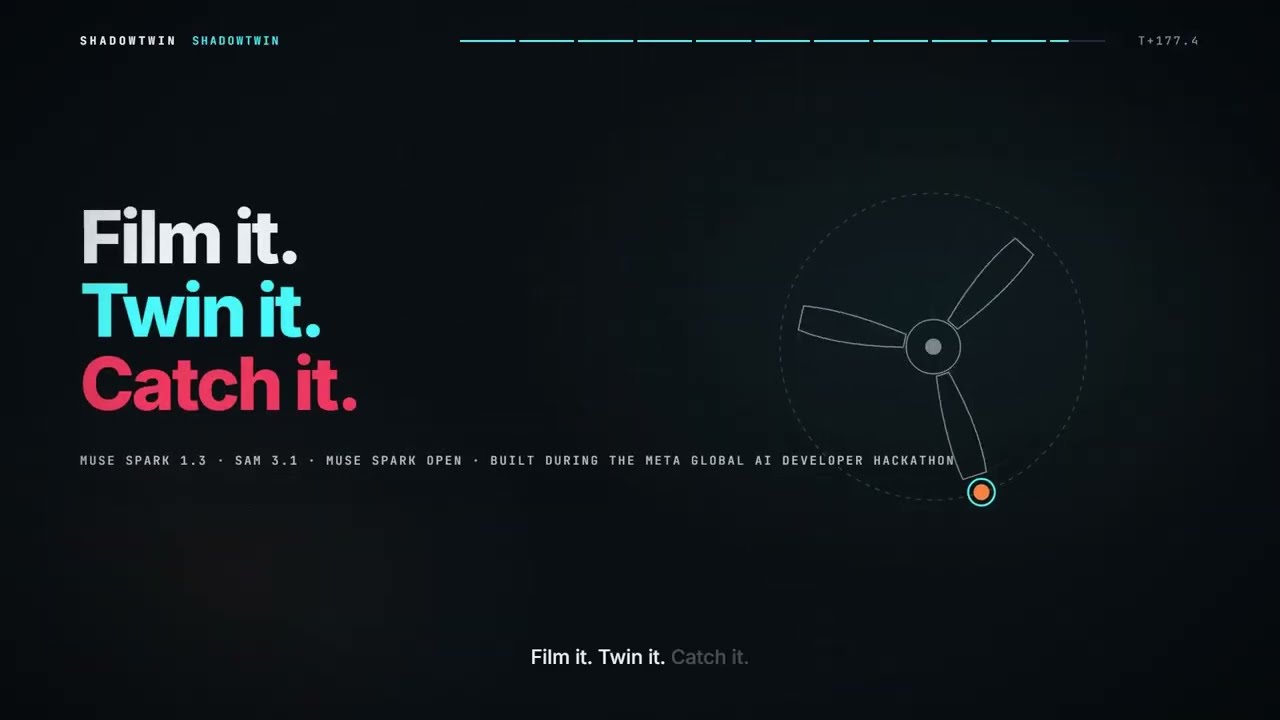
Shadowtwin turns one phone video of a spinning machine into a working physics model of that machine (a “digital twin”). It then uses that model to catch faults before they cause a breakdown. It needs no sensors, no training data, no markers and no per-machine engineering. The problem: most rotating machines in small factories, farms, pumping stations and building rooftops (fans, motors, pumps, conveyors) have no condition monitoring. Vibration sensors and specialist analysis cost too much to retrofit, so wear goes unnoticed until the machine stops. How it works: You film the machine coasting to a stop in slow motion (240 fps). SAM 3.1 tracks the blades by name. A Muse Spark agent checks the measurements and proposes candidate physics. Shadowtwin fits the machine’s own equation of motion and validates it by predicting footage it never saw. Weeks later you film it again. The healthy twin replays alongside the new footage, and when reality drifts from the twin, Shadowtwin raises an alarm, names the likely physical cause and states how confident it is. Proven on a real ceiling fan, not just a simulation: Fitted equation: dω/dt = −(0.0053·ω|ω| + 0.138·sgn ω), i.e. air drag plus bearing friction, chosen from 7 candidate physics models. 3.1% prediction error on held-out footage the fit never saw. SAM 3.1 speed agrees with an independent blade tracker to within 0.2%. Fault test, with coins taped to the blades: the deceleration change was detected at +7.5% (95% CI +4.8% to +10.3%, p = 0.012 against a resampled no-change null). The alarm fired about 9.6 s into the coast-down in 60 of 60 bootstrap runs. When the data can’t separate two causes, the system says so instead of guessing. A phone is the only sensor most of these machines will ever get. Shadowtwin turns it into a calibrated physics instrument.