paramenide
Built at Meta Global AI Developer Hackathon · Oct 26, 2026 · Remote
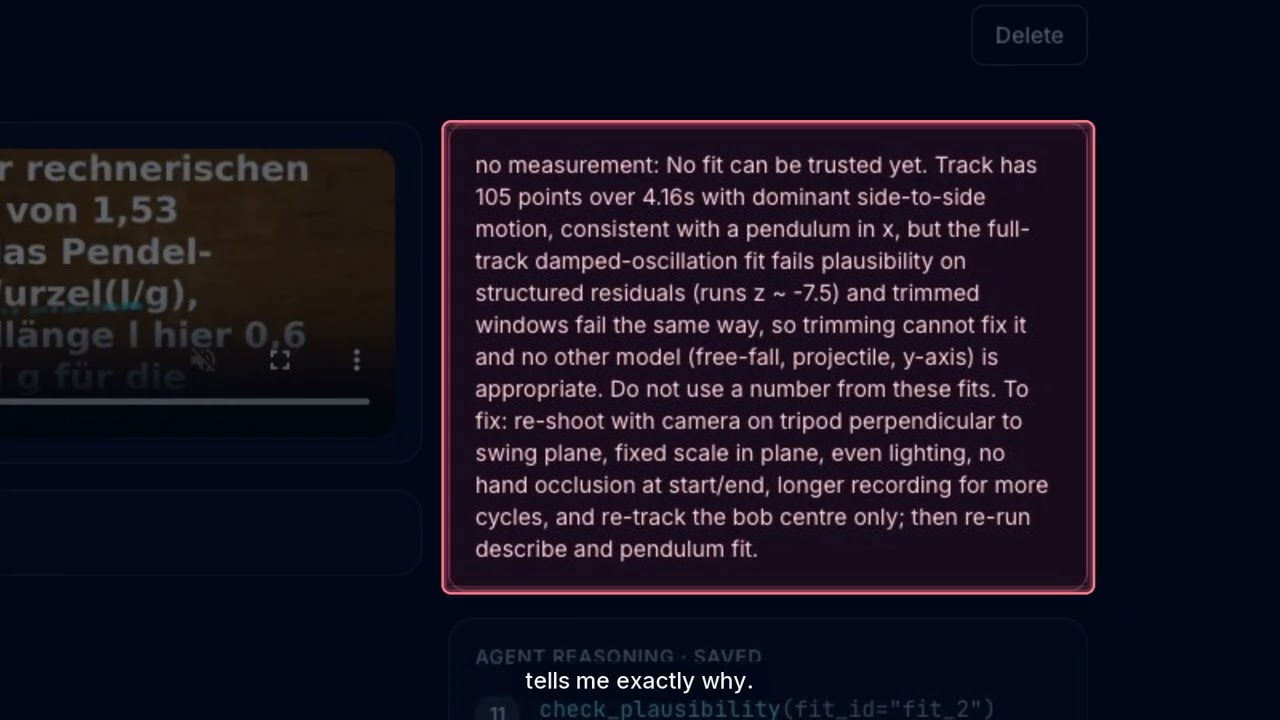
PhysicsLens: measure gravity with your phone. You film a ball drop, a throw or a pendulum with your phone. PhysicsLens tracks the ball in every frame and fits the matching physics model with SciPy (free fall, projectile or damped pendulum). It then reports g, the landing point or the pendulum length, with an uncertainty. Before you see any number, a Meta Muse Spark agent calls the fit and check tools, rejects fits that fail the checks, and explains what it kept. When the simple motion or colour trackers lose the ball, Meta SAM 3.1 segments and follows it from a single box. The numbers always come from SciPy, never from the model's text. If the motion doesn't look like a real fall, flight or swing, the app gives no measurement instead of a made-up one. What it solves: Real physics experiments usually need a lab: light gates, motion sensors or hours of frame-by-frame analysis in tools like Tracker. Most students only have a phone, and when they analyse a clip by hand it's slow, error-prone, and nothing tells them if the result is wrong. PhysicsLens turns any phone video plus a known length in the frame (a ruler or a sheet of A4) into a checked measurement in about a minute. The agent catches bad fits before they reach the student, and every run is saved to History with its video overlay, charts and the agent's reasoning so it can be reviewed later.