StackOne
Built at Meta Global AI Developer Hackathon · Oct 26, 2026 · Remote
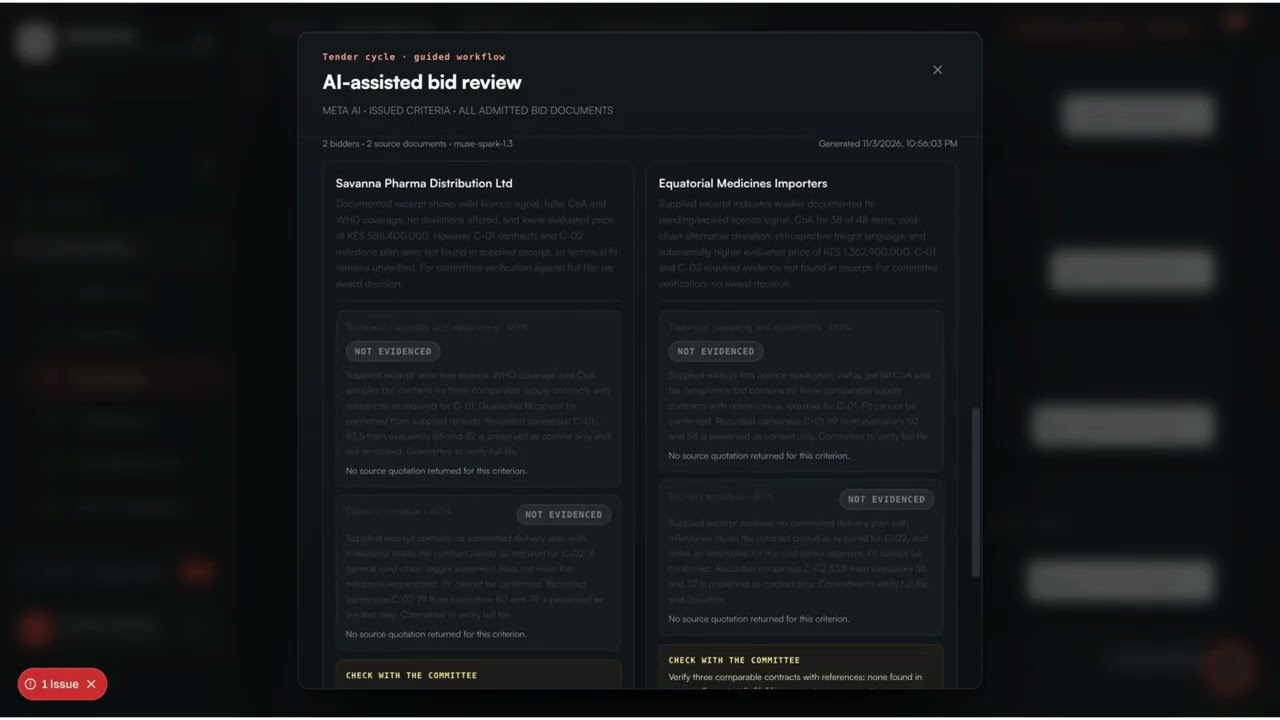
Across Africa, a procurement decision can determine whether a clinic receives medicines, a school gets equipment, or a community waits for an undelivered service. The World Bank reported in 2023 that African nations spend an average of 17% of GDP on public procurement. Getting the review right is therefore a public-service challenge at national scale. Quorum brings Meta AI into the work that happens before an award: reading the tender, checking the bids, identifying questions and assembling the evidence for a decision that people can explain and defend. The financial stakes are substantial, but different measures must remain distinct. In 2015, the UN Economic Commission for Africa cited an estimate of US$148 billion lost annually to corruption across Africa. This is a historical estimate covering corruption broadly, rather than a current procurement-only loss total. For procurement specifically, a 2022 World Bank article, citing UNODC, reports estimates that 10-25% of a public contract's value may be lost to corruption. That range is in an international context; it is not a measured loss rate for every African contract. Zambia provides the starting point for Quorum. Its public records show both the money at risk and the document failures that an officer needs time and evidence to question: US$450 million in estimated losses across several suspected offences in 2017. Zambia's Financial Intelligence Centre (FIC) reported this USD equivalent for ZMW 4.5 billion associated with cases it disseminated. Most of that total concerned suspected tax evasion; the corruption component was about US$50 million (ZMW 500 million) using the report's implied conversion. Separately, the FIC analysed 624 reports of suspected procurement corruption** that year. The US$450 million is a Zambian case-based financial-crime estimate, not an Africa-wide procurement total or a recurring annual estimate. Quorum is an AI-assisted procurement review workspace, initially grounded in Zambia's public-health procurement context and designed around the wider African need for accountable purchasing. It gives procurement officers, suppliers and committee members a connected workflow from document preparation to a reviewable decision record. For suppliers, the portal brings tender opportunities, document checks and application records into one place. For procurement officers, the review workspace brings the issued requirements and admitted bids together, applies deterministic checks, compares submissions against the published criteria, and flags potential gaps or price anomalies for inspection. Each supported model finding points back to source material, helping an officer move from a claim to the evidence behind it. For committees, Quorum prepares questions, reading aids and draft redlines. Members can inspect the documents, correct the advice and record their reasons. The product's value is the continuity between a requirement, the bidder's evidence, the reviewer's question and the eventual human decision. A missing document or unusual price is a reason to investigate, not an automatic allegation of fraud. -> How Meta AI makes the workflow possible 1. Muse Spark through Meta Model API is the primary reasoning model. It plans document review, compares admitted bidders against issued criteria, and drafts questions and redlines for officers to examine. The interface displays the returned model identity, source-document count, verified quotation count, and request duration so the reviewer can see what produced the advice. Application checks reject unknown bidders, missing criteria, fabricated quotations and unsupported recommendations before displaying a comparison. Positive or partial assessments require an exact quotation from that bidder's source. Verifying that a quotation exists is a useful evidence check; an officer must still assess whether the interpretation is correct. 2. Llama 3.2 supports a configured local fallback through Ollama, giving institutions an alternative deployment path when local processing is appropriate. 3. SAM 3.1 provides an optional table-region capability for document inspection. 4. Muse Voice Transcribe supports voice input to the desk assistant. The central demonstration focuses on document reasoning and human approval. These capabilities support the same goal: help people inspect complex procurement material while retaining responsibility for the decision.