Ashura
Built at Meta Global AI Developer Hackathon · Oct 26, 2026 · Remote
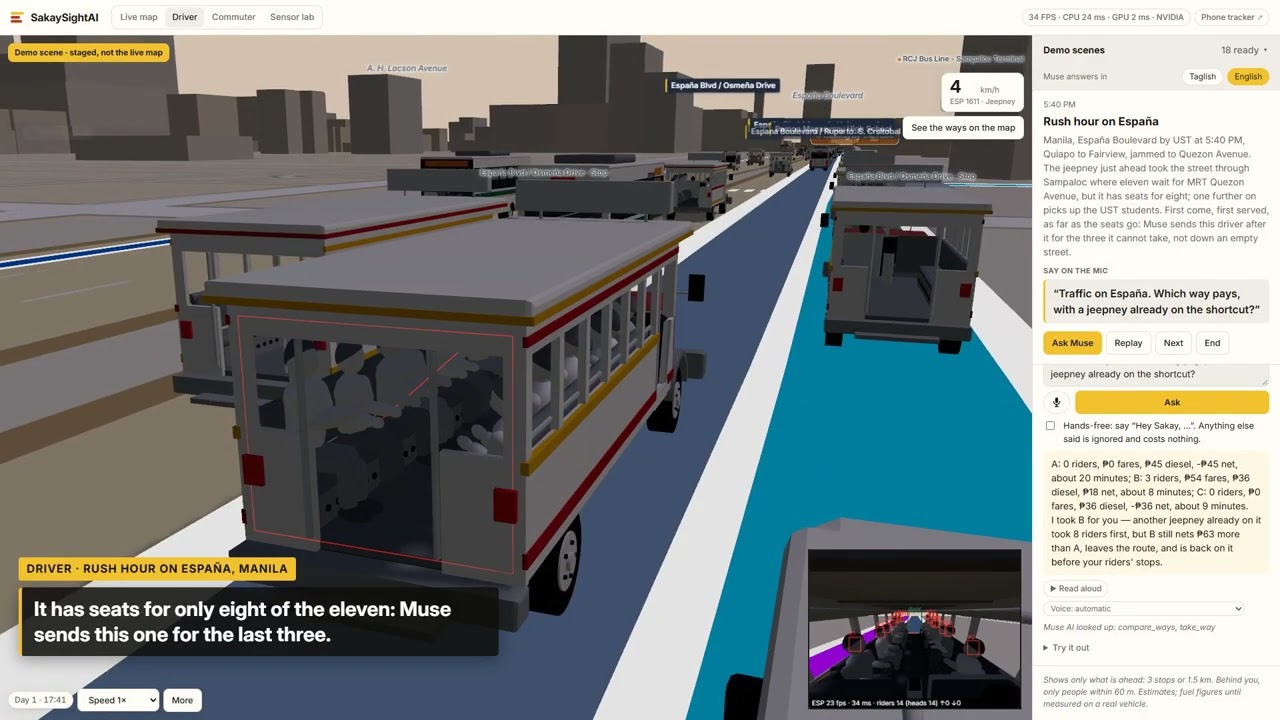
SakaySightAI is a 3D digital twin of Metro Manila's public transport, with Meta's Muse Wonder inside as an agent. It covers jeepneys, modern jeepneys, UV Express and buses on 626 real routes. Muse doesn't just answer. It looks at the road, does the math, and acts. THE PROBLEM Drivers start the day in debt. A jeepney driver pays the owner's boundary (₱700 a day, ₱5,500–7,500 for a bus) before the first fare, then diesel, which can cost ₱5 a litre more at one station than at another on the same road. Stuck in traffic that averages about 11 km/h, they can't see riders running from side streets, a crowd stranded across the road, or which way round a jam still pays. Commuters can't tell whether the next ride has a seat. A signboard shows only the two ends of a route. Off the main road, people pay a tricycle just to reach it. And on the long ride home, they doze off past their stop. 29 DEMO SCENES, EACH A REAL MOMENT ON A MANILA ROAD For drivers (18): - Which way pays? Muse prices the main road and two side streets in fares, diesel and minutes, draws all three on the map, and drives the best one: ₱107 net instead of ₱42. It uses public streets only; gated subdivisions are closed using OpenStreetMap tags. - Spread the fleet: if every driver takes the same shortcut, the jam just moves. Muse works first come, first served across the whole fleet. Riders another jeepney reaches first are theirs, so it sends this one down a different street that still pays. - Rush hour on España: the jeepney ahead has only 8 seats left, so Muse sends this one for the 3 who would be left behind. - Riders running late: Muse sees people running from side streets and holds at the stop for the 3 who will make it. - Pass riders on, go back: Muse hands the last 3 riders to the jeepney behind, then U-turns for 8 people stranded across the road. - Also: a diesel plan from Fairview to Quiapo, a bus low on diesel, buses bunched together, "UV Express: alis na o hintay?", how far to the boundary, not enough seats, someone waving by the road, and a pregnant rider and seniors next in line. For commuters (11). Each scene says who it is for (new to the city, or sanay na) and why it helps: - How do I get there? The rides, the changes and the fare, drawn on the map. - Read this signboard: a photo of a board in Cubao, and Muse checks whether the route passes Quirino Memorial. - The jeep comes to my street: four neighbours deep in Sampaloc wait where they are and keep ₱80 they would have paid in tricycle fares. - Wake me at my stop: Muse speaks up without being asked. - Also: I missed my modern jeepney, Will the bus have a seat?, a long queue at the terminal, a roomy jeep for a pregnant rider, a senior's bus fare, a safe place to cross to the stop, and waving one down by the road. NOT ONLY MANILA Shared, informal rides move a large share of people across the Global South: angkots in Indonesia, songthaews in Thailand, shared autos in India, matatus in Kenya, trotros in Ghana. SakaySightAI is built on OpenStreetMap, so a new city needs its own routes, fares and rules, not a new app. WHAT IS REAL Real: OpenStreetMap streets and buildings, 626 routes (2015 DOTC data), LTFRB fares, DOE diesel prices, phone GPS, and Muse's live answers. Simulated: riders, traffic and earnings.