Single-Threaded
Built at Meta Global AI Developer Hackathon · Oct 26, 2026 · Remote
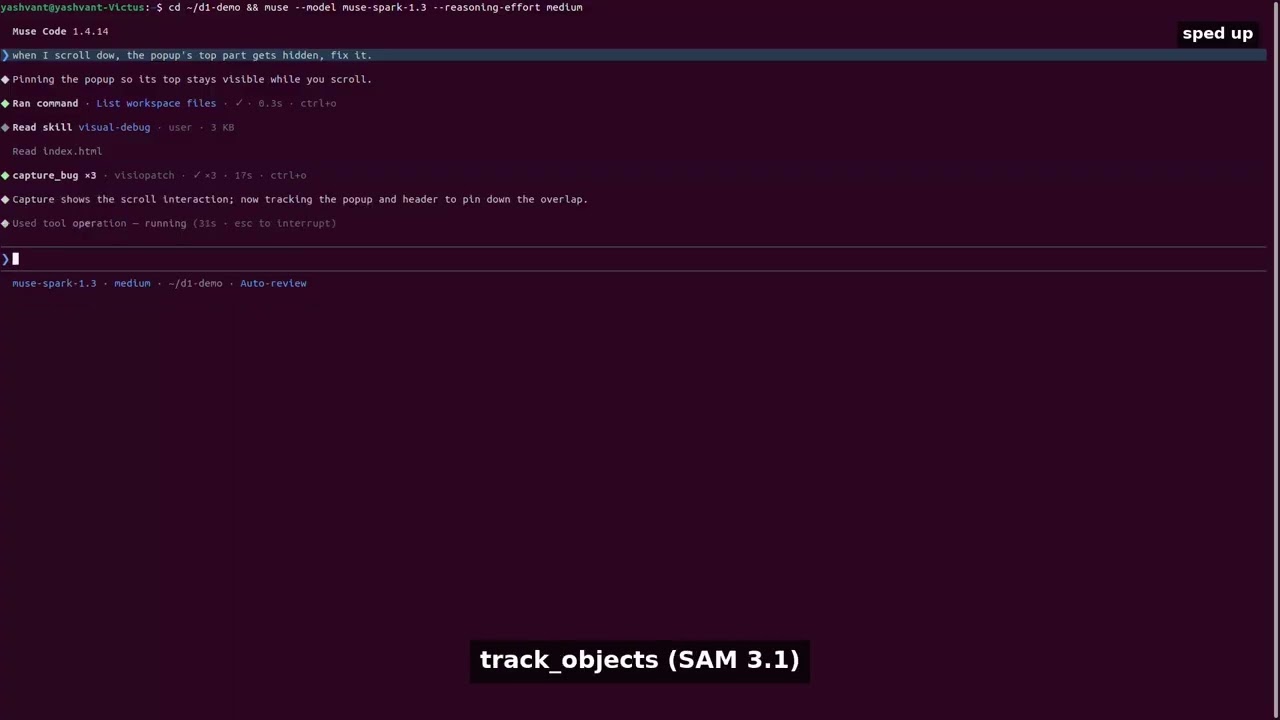
VisioPatch gives Muse Code eyes. Coding agents read code, but they can't see what's on screen, so visual bugs (a popup sliding under a header, a sprite that moves wrong, cropped text) pass every text-based test. With VisioPatch, a developer describes the bug in one sentence. Muse Code then records the page, finds the moment that looks wrong, diagnoses the root cause and fixes it. It ships as an MCP server plus a Muse Code skill. The pipeline: capture a screen recording, track objects with SAM 3.1, find the anomaly with Muse Spark 1.3, diagnose the root cause with Muse Wonder, then two gates. Gate 1: Wonder writes a deterministic Playwright test that must FAIL on the current code, proving the bug before anything is touched. Gate 2: three Muse Code sub-agents try different fix strategies in isolated git worktrees, and a fix ships only if the new test and the existing suite both pass. On a 6-case benchmark (4 real merged bug fixes from the open-source kaplay game engine plus 2 DOM bugs), Muse Wonder diagnosed 6/6, Gate 1 separated 4/6, and Gate 2 produced a verified fix for 4/4. Every picked fix touches the same files as the human fix. When Gate 1 can't prove a bug, VisioPatch refuses to repair it rather than guess. In the live demo, a fresh Muse Code session goes from one sentence to a verified 2-line CSS fix in about 7 minutes. Total API cost for the whole project: about $5.