Shadow Fenced AI
Built at Meta Global AI Developer Hackathon · Oct 26, 2026 · Remote
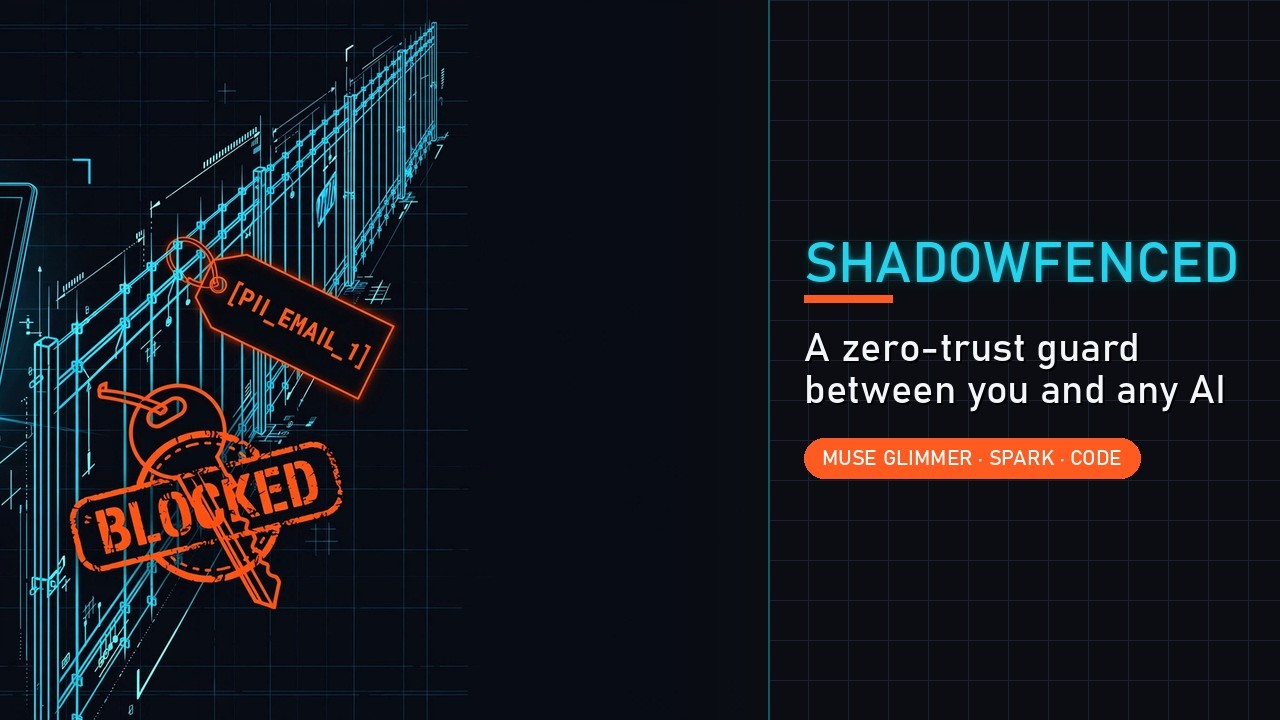
Many companies ban AI chats because staff paste customer data, contracts and keys into them. Shadowfenced is a guard on your own PC, between people (or coding agents) and any AI, that lets them say yes. It underlines sensitive text as you type and checks files before upload. Keys are blocked, even base64-encoded or merely pointed to ("the prod key is in ~/.aws/credentials"). Personal data, codenames and contract clauses travel as placeholders like [PII_EMAIL_1], and the real values are restored locally in the answer. A full identity bundle (name + birthday + address + phone + email) is blocked outright, in code. Bank statements are stopped before upload, with a one-click redacted copy. It works in its own chat app, inside ChatGPT and Gemini via a browser extension, and for coding agents through an OpenAI-compatible proxy. Decisions are tiered and fail closed. Tier 1, pattern rules written by Muse Code, scans every message for keys, decoy keys, personal data and identity bundles, and settles 70% of messages in under 1 ms (p95 0.94 ms). Tier 2, Muse Glimmer on the user's own GPU, reads the unclear cases for meaning, such as a sentence saying where a key is kept. Tier 3, a code fact-check, confirms what the model flagged is really in the text; a model can only raise the risk, never clear a Tier 1 finding. Tier 4, the person, decides the rest, with the reason shown. It learns from what you allow and suggests rule changes you approve, and it never stores what you typed. Every decision goes to a tamper-evident log with fingerprints only. On 40 sealed test messages written by a separate author, it caught 26 of 26 sensitive messages; 3 still leaked one or two personal details, and 7 of 14 harmless messages were held for review. Try it with no install at https://wellytg--shadowfenced-asgi.us-east.modal.run, or run setup/try_cases.py for 10 quick cases. Honest limits: it errs on the side of caution, so 27.5% of messages still go to a person. Glimmer needs about 12 GB of GPU memory; without a GPU, the code tiers caught the same 26 of 26 and hard cases come to you. Answers that need the real value cannot come from the cloud model. All test data is synthetic. The product uses no trained model; a separate Nov 4 experiment trained a small Llama 3.2 3B judge (23 of 26 caught, 2 of 14 harmless flagged, twice as fast as Glimmer), reported in the README.