Lilith01
Built at Meta Global AI Developer Hackathon · Oct 26, 2026 · Remote
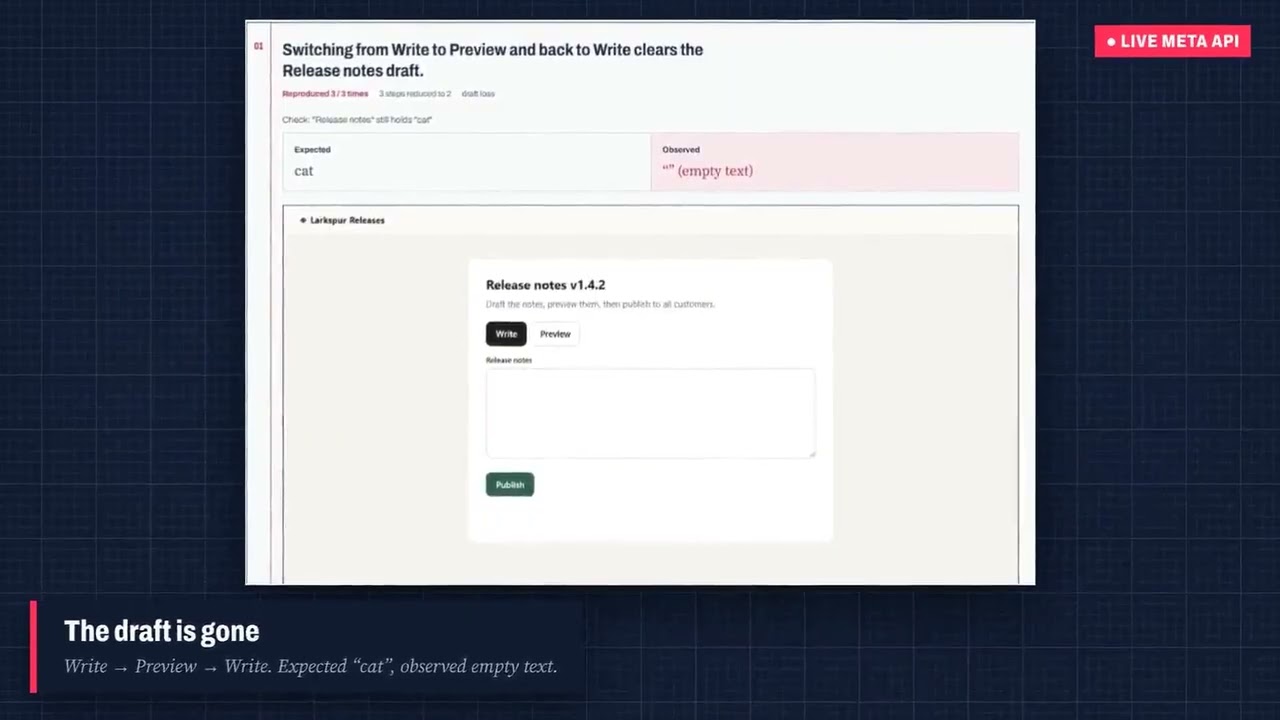
Faultline breaks your web app on purpose, then hands you the failing test. Happy-path tests pass, yet real users on slow networks lose work: a late response overwrites what they typed, search shows results for "ca" after they typed "cat", a double-click places two orders, a failed save wipes the form. These bugs depend on timing, so they hide on localhost and in test suites. Faultline explores a local app with Playwright. A Meta Muse model reads the page inventory and the developer's goal and proposes competing, falsifiable hypotheses, each with one experiment: steps, a network fault to inject and the invariants that must hold. A strict validator only admits known controls, synthetic input and observed requests. Playwright runs every experiment with the injected faults and decides pass or fail; the model never grades itself. Every failure is minimized, re-run three times and attributed by removing each injected fault. Faultline then exports a ready-to-run Playwright Test spec that fails while the bug exists, and one click replays the same counterexample against the fixed build. It fits into a developer's workflow: CI exit codes and JUnit reports, saved Playwright login state for local apps behind a sign-in, and review-only fix proposals for source files the developer selects. Faultline never applies or runs a generated patch. On six demo apps (each with a buggy and a fixed build), a rules-only baseline finds 6/6 bugs in the dev apps but only 2/4 in the held-out apps. Plans written by muse-spark-1.3 find 4/4 in the held-out apps, with zero false alarms on the fixed builds. All results, every evaluation attempt and the recorded model answers are in the repository. Live check (27 Oct 2026): through the hosted Meta Model API, muse-spark-1.3 reproduced the 4/4 held-out result with zero false alarms on the fixed builds, and all 12 live model calls succeeded. The demo video shows one of these live runs; the reports with per-call evidence (timestamps, latency, tokens, HTTP status, returned model) are in eval/live/2026-10-27.