Saathi Systems
Built at Meta Global AI Developer Hackathon · Oct 26, 2026 · Remote
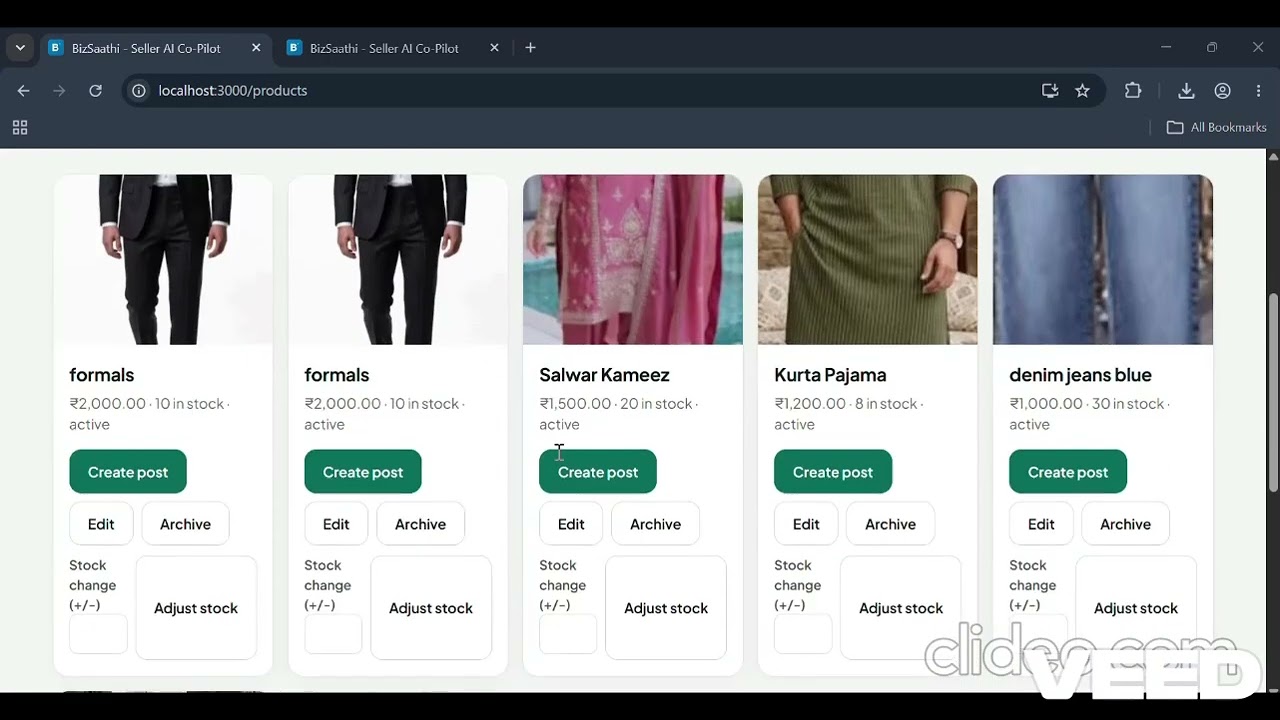
Project Description BizSaathi is a 15-stage agentic AI co-pilot that lets small sellers run their business without losing control of their facts. AI proposes. Deterministic controls validate. Sellers approve. The problem we solve Small sellers run on photos, voice notes and chat messages. They spend hours writing listings, posts and repeat replies by hand, and they lose sales to slow answers. Generic AI makes this worse. It can invent a price, promise stock that doesn’t exist, or answer a policy question with no evidence. One wrong promise costs a small shop its customers’ trust. What we built Product intake: the seller uploads a photo or brief. Meta Muse Glimmer drafts a structured listing and flags what it is unsure about. The draft is never a confirmed fact until the seller reviews it. Content drafting: the app writes marketing copy, then checks every factual claim against the seller’s own database. Unsupported claims are flagged or blocked. Customer chat: the store chat answers only from the tenant’s verified catalog and policies. It escalates anything it can’t support, instead of guessing. Seller in control: agents cannot publish, confirm payments or change policy. Every consequential step goes through human approval, and every job leaves a trace without raw model reasoning. How people benefit Sellers get their time back. Our design targets are listing creation in under 30 seconds, posts for three platforms in about a minute, and first customer replies in under 30 seconds. They are targets we will measure, not results we are claiming. One seller saves about an hour a day on listings, captions and replies Sellers also save money. The target is cost per completed task, measured from logged model calls. We report it only once we’ve measured it. Customers get faster answers that are accurate and grounded in the real catalog. The technical depth Typed LangGraph workflows with bounded retries and approval checkpoints. Tenant isolation enforced in the backend, not by the model. BizSaathi is a 15-stage agent architecture that separates the writer, the evidence verifier, the multimodal critic and the policy gate, so no model grades its own work. Next.js PWA, FastAPI, PostgreSQL and a typed OpenAPI contract. Proof: 236 of 236 backend unit tests pass. 9 of 9 executed integration tests pass. Mock evaluations pass 12 of 12 development cases and 4 of 4 held-out cases. The API has 49 paths and 52 operations, and the generated contract matches the checked-in one. These are software checks. Live-model quality is a separate measurement we will report honestly. Where this goes next: with Meta’s help on multilingual models, verified business channels and safety classifiers, BizSaathi can grow from a seller co-pilot into a trust layer for small-business commerce, where every AI answer is grounded, checked and approved. Illustrative example with assumed inputs: Take one seller with 30 new products a month and 20 routine customer questions a day. Assume 26 working days. Listings: Manual is 4 minutes each. Assisted is 1.5 minutes, including review. That saves 2.5 minutes × 30 = 75 minutes a month. Posts for 3 platforms: Manual is 25 minutes. Assisted is 5 minutes, including review. That saves 20 minutes × 30 = 600 minutes, or 10 hours a month. Customer questions: Say 70% are routine and the AI answers them, at 2 minutes each manually. That saves 14 × 2 = 28 minutes a day, or about 12 hours a month. Total: about 23 hours a month saved. Value of that time: at an assumed ₹150 an hour for the owner’s time, that is about ₹3,500 a month.