Adaptabyte
Built at Meta Global AI Developer Hackathon · Oct 26, 2026 · Remote
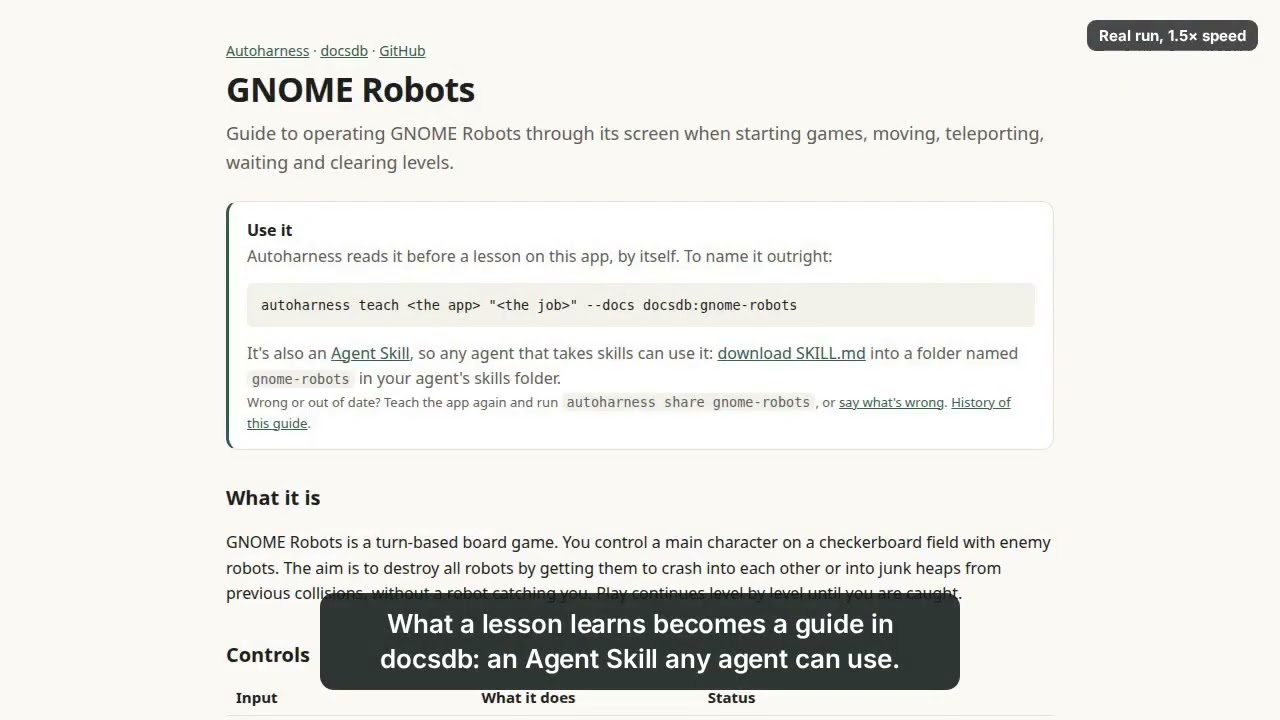
Nearly every interface was built for human eyes and hands: records systems, insurer portals, back offices, desktop apps. Nobody is going to rebuild them all for AI. Today's agents cope by sending a frontier model a screenshot at almost every step. That's slow, it costs money on every run, and everything on your screen goes to the cloud. Autoharness uses computer use as a compiler instead of a runtime. Muse Spark uses an interface once, and everything it does is recorded. Muse Wonder compiles that record into a plan: data, not code, with every decision made in advance. Then open-weight Muse Glimmer runs the plan on your own computer. It answers one narrow question per screen, while plain code holds the memory and checks every step. What it types gets read back, and what it reads gets read twice. A run ends verified, or it stops and asks. Every compiled job is also an MCP tool, so any agent can use apps that never had an API. The agent gets back only verified results, never your screen or your login. It's plug and play. autoharness up starts it and checks what's ready. autoharness teach <address> "<the job, in plain words>" teaches a new job, and autoharness call runs one. Any MCP client connects with one line, by address or by command, and a job still running after 50 seconds hands back a job id, so clients with a 60-second limit still work. When Muse Spark, acting as an agent, was asked whether an order had shipped, no job could tell it. One teach command fixed that in 141 seconds for $0.14, and Spark then answered correctly. It reaches apps on other computers too. The address can be a web address, a Linux app's command, or vnc:// for a Windows PC, a Mac or a game machine, using the screen sharing they already have. Spark reads the job and picks how to learn it: a plan when the same steps work every time, or a program, written by Muse Wonder, when each move depends on the screen. Pointed at Minesweeper on another screen over VNC with one command, Spark chose a program. For $1.24, once, it then won five of five fresh games on its own with no cloud, and now it's a tool like any other. VNC was tested here against a Linux server; Mac and Windows servers speak the same protocol but weren't tested, and nothing that needs fast reflexes will work. It can start from the manual. --docs takes a PDF, a picture of the controls, or a link to a help site. Muse Wonder reads it all once and tells Spark what to check, so Spark confirms the documented controls instead of trying every key. Given the online manual for GNOME Robots, a game whose keys can't be guessed, the program it wrote moved with exactly the documented keys and cleared level 1 in five of five runs on its own. Learning it cost $1.96, once. Every lesson then leaves a guide to the app, an Agent Skill, which the next lesson on that app reads first. With the person's yes, a guide joins docsdb, a shared library at autoharness.adaptabyte.com/docsdb, after a person reviews it. Then anyone's lesson on that app starts from it, and any agent that takes skills can load it. Nothing typed or read during a lesson goes into a guide. The finding that makes this work: the same small model went 0 for 6 reading a chart in OpenEMR when given the whole job, and 5 for 5 on unseen patients once the job was compiled. Across OpenEMR, a made-up insurer's portal, a Django admin and a native desktop calculator, it passed 35 of 35 runs on the final code and saved nothing wrong. It matched Muse Spark's pass rate with no cloud at run time. On the portal it was 3.5 times faster, 157 seconds against 556. I'm a psychiatrist. In the demo, a medication request where one page has a member ID off by one digit comes to me side by side. A clean stack fills the insurer's portal and stops at the signature. It isn't ready for real patients. All data is made up, the samples are small, and Spark is still better at jobs it wasn't taught. Pass bars were committed to git before each test, and every failure is in the repo.