Arroztek
Built at Meta Global AI Developer Hackathon · Oct 26, 2026 · Remote
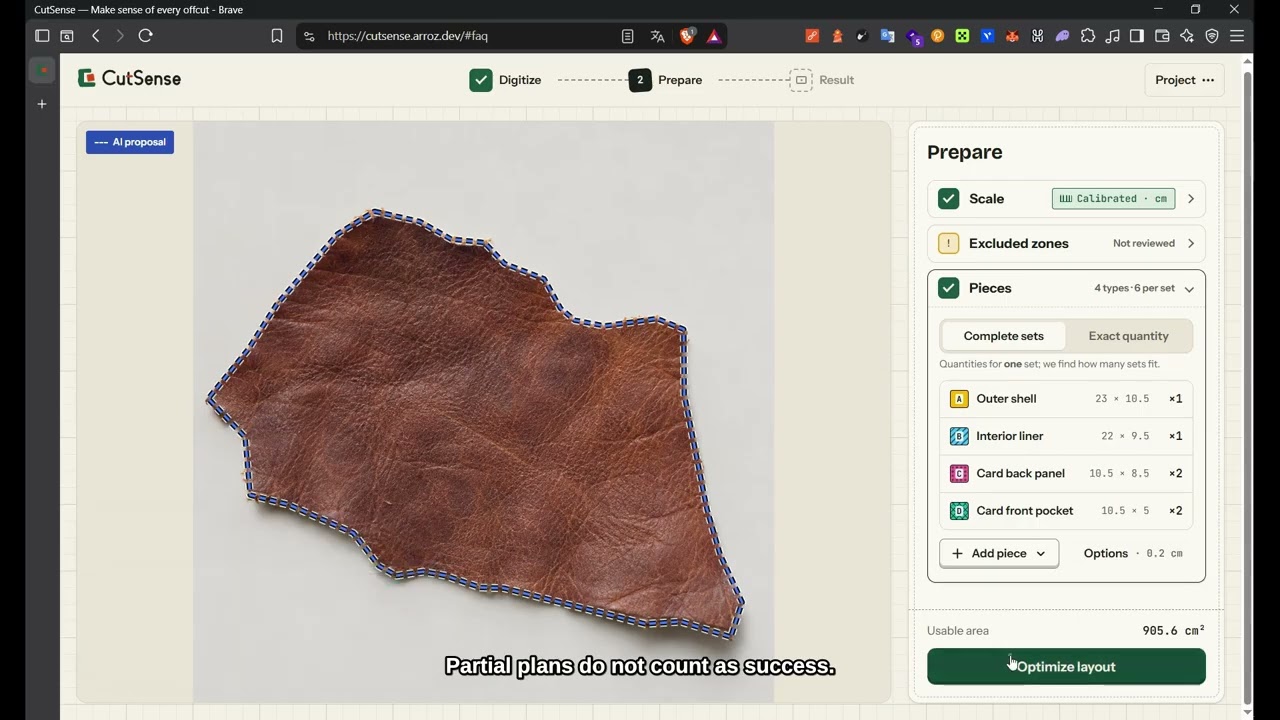
CutSense turns a photo of an irregular flat offcut (leather, felt, foam, cardboard) into a cutting plan that has been checked by an independent geometric verifier, and then helps reuse what is left. The problem: makers and small workshops keep drawers of offcuts that are too good to throw away but too awkward to plan around. The loss is measurable: a 2024 study of garment manufacturing estimated that 16–21% of fabric was wasted in the cut-and-sew process (Abou-Chakra et al., 2024). Fitting pieces onto an irregular shape with flaws by eye is slow, and it is hard to know whether a layout really fits or what can still be made from the remainder. How it works: AI outlines the scrap from the photo and you correct it and mark the defects. You calibrate the scale and pick what to make, from ready-made kits to your own shapes or a design worked out with Hilo, an AI pattern-maker chat that also shows an approximate 3D assembly preview. A deterministic nesting engine places the pieces and an independent verifier checks that nothing overlaps, leaves the material or touches a defect before you see the plan. Then you export it as SVG, PNG, a 1:1 print across paper sheets or a DXF. The leftover loop: CutSense prefers layouts that leave the largest single free fragment, lets you plan another product on it, or start again from a photo of the real remnant. AI proposes, deterministic code decides and verifies, and every result is reproducible. It is open source (MIT) and ships as a single Docker container. --- Reference: Abou-Chakra, K., Archipov, K., Berkovitz, S., Perry, E., & Spellenberg, R. (2024). Analysis of pre-consumer textile waste within the apparel supply chain. Bren School of Environmental Science & Management, University of California, Santa Barbara. https://bren.ucsb.edu/projects/analysis-pre-consumer-textile-waste-within-apparel-supply-chain