ORIGENIX
Built at Meta Global AI Developer Hackathon · Oct 26, 2026 · Remote
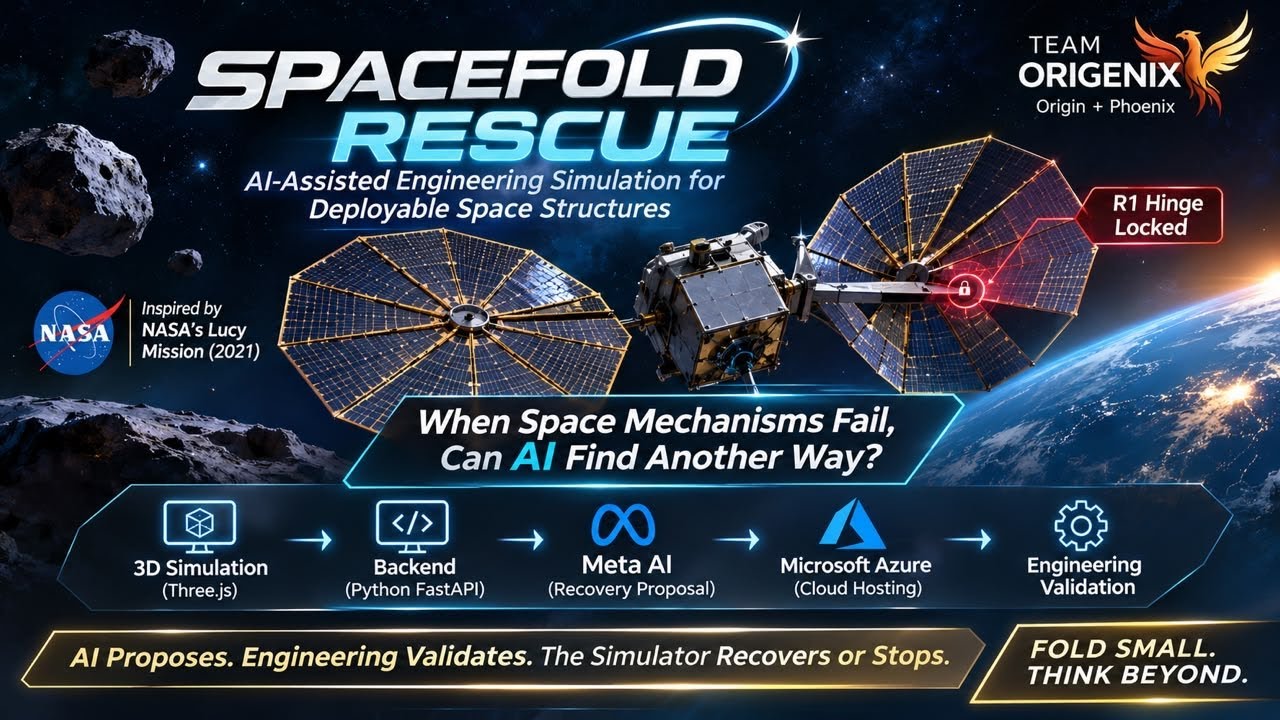
SPACEFOLD RESCUE AI-Assisted Engineering Simulation for Intelligent Mechanical Fault Recovery Team:ORIGENIX (Origin + Phoenix) Project Creator:Vaishnavi Suresh Tagline:Fold Small. Think Beyond. Category:Aerospace-Inspired Innovation | AI-Assisted Engineering | Intelligent Fault Recovery 1. Project Overview : SpaceFold Rescue is an aerospace-inspired, AI-assisted 3D kinematic simulation prototype that explores alternative recovery movements when a mechanical deployment system encounters an unexpected failure. Deployable structures depend on precisely coordinated movements between interconnected panels and hinges. When a single hinge becomes jammed, dependent components may also become blocked, interrupting the entire deployment sequence. SpaceFold Rescue explores an alternative approach: instead of forcing the original deployment sequence, it examines whether the remaining movable joints could support a different, mechanically feasible configuration. The project combines an interactive Three.js simulation, a Python FastAPI backend, a proposed Meta Model API integration, Microsoft Azure as the intended cloud-hosting platform, and engineering constraint validation. Our fundamental principle is: AI proposes. Engineering validates. The simulator recovers or stops. 2. About Team ORIGENIX : ORIGENIX combines two powerful concepts: Origin represents new beginnings, creativity, and the birth of innovative solutions. Phoenix represents resilience, transformation, and the ability to rise again after failure. Together, ORIGENIX represents our belief: "Every failure can become the origin of a new solution." This philosophy forms the foundation of SpaceFold Rescue. When a mechanical system encounters a failure, the goal is not to force an impossible movement, but to intelligently explore whether another feasible recovery path exists. Our tagline, "Fold Small. Think Beyond.", reflects the potential of combining compact engineering structures with intelligent technologies. 3. Inspiration - NASA Lucy Mission (2021) : In October 2021, NASA launched the Lucy spacecraft to study Jupiter's Trojan asteroids. Following launch, one of Lucy's two large circular solar arrays did not fully deploy and latch as intended. NASA engineers addressed the anomaly through spacecraft telemetry, engineering analysis, ground testing, and carefully planned recovery procedures. This real-world engineering challenge inspired our central question: What if AI-assisted simulation could help engineers explore alternative recovery movements when a deployment mechanism becomes blocked? That question became the foundation of SpaceFold Rescue. The project is independently inspired by this engineering challenge. It does not reproduce NASA's spacecraft, claim to solve Lucy's specific anomaly, or represent an official NASA initiative. 4. Problem Statement Deployable structures are used in spacecraft systems, robotic mechanisms, temporary shelters, and specialized engineering equipment. These systems depend on coordinated mechanical movements. A single jammed hinge can cause: 1. Interruption of the planned deployment sequence. 2. Restricted movement of dependent joints. 3. Misalignment of interconnected panels. 4. Inability to reach the intended deployed configuration. 5. Potential failure of the complete deployment operation. The engineering challenge is to determine whether alternative movements remain possible without violating mechanical constraints. Important questions include: 1. Which joints remain independently movable? 2. Can the structure reach an alternative configuration? 3. Will a proposed movement exceed the permitted joint limits? 4. Could moving components collide? 5. When should the system stop because no feasible recovery path exists? AI-generated suggestions alone cannot establish mechanical feasibility. They must be evaluated against deterministic engineering constraints. 5. Proposed Solution : SpaceFold Rescue explores an AI-assisted recovery workflow supported by engineering validation. When a simulated mechanical fault occurs, the system captures the current structural state, including hinge positions, locked joints, movement dependencies, and joint-angle limits. The Python FastAPI backend provides the recovery request interface and is designed to support communication with the Meta Model API. The intended AI reasoning component analyzes the fault condition and proposes alternative movement sequences using the remaining available joints. These proposals are then evaluated against applicable engineering constraints. A proposal that passes the required checks may proceed to simulated recovery. If no feasible movement is available, the correct outcome is to reject the proposal and stop deployment. The objective is not to guarantee recovery. It is to determine whether recovery is feasible within the modeled constraints. 6. How SpaceFold Rescue Works ? Step 1 - Start Deployment The operator starts an interactive Three.js simulation of a compact, multi-panel folding structure. The simulator visualizes the deployment sequence and tracks the movement of individual hinges. Step 2 - Introduce a Mechanical Fault The operator simulates a mechanical jam by locking a selected hinge. For example, hinge R1 becomes immovable during deployment, interrupting the intended movement sequence. Step 3 - Capture Structural Telemetry The simulator represents the mechanical state using structured telemetry, including: 1. Hinge identifiers. 2. Current joint angles. 3. Locked or unlocked states. 4. Permitted movement limits. 5. Mechanical dependencies. 6. Fault status. Step 4 - Request AI-Assisted Recovery The frontend sends the recovery request to the Python FastAPI backend through the `/api/recover` endpoint. The proposed Meta Model API integration is intended to analyze the mechanical fault and recommend alternative movement sequences. The AI response would include an explanation of the proposed recovery approach. Step 5 - Validate Engineering Constraints Before any proposed movement is accepted, the engineering validation layer must evaluate it against the applicable modeled constraints. These may include joint-angle limits, locked-hinge restrictions, movement dependencies, and collision checks where implemented. Proposals that violate the required constraints must be rejected. Step 6 - Recover or Stop If a movement sequence satisfies the implemented checks and receives the necessary approval, the simulator may explore an alternative deployment configuration. If no feasible sequence is identified, the structure remains stopped and the diagnostic interface explains the reason. 7. System Architecture : Proposed recovery workflow: Three.js Simulator ↓ Structural Telemetry Collection ↓ Python FastAPI Backend ↓ Meta Model API — AI Recovery Reasoning ↓ Alternative Movement Proposal ↓ Deterministic Engineering Validation ↓ Operator Review ↓ Simulated Recovery or Safe Stop Microsoft Azure is the intended cloud-hosting environment for the FastAPI backend. The architecture separates AI-generated suggestions from engineering validation so that a model response is never treated as proof of mechanical safety. 8. Technology Stack : Technology|Purpose| Three.js|Interactive 3D visualization and folding simulation | JavaScript / HTML / CSS | Frontend interface and user interactions | Python FastAPI | Backend APIs, telemetry processing, and recovery orchestration | Meta Model API | Proposed AI-assisted fault interpretation and recovery planning | Microsoft Azure | Intended cloud hosting and backend integration | Deterministic Constraint Checker | Evaluation of modeled joint limits and movement dependencies, with collision checks where implemented | GitHub | Source code management and project documentation | 9. Example Recovery Scenario : Consider a folding structure containing several interconnected panels. During normal deployment, the panels unfold according to a predefined sequence. Now imagine that hinge R1 becomes locked at 35 degrees. The simulator identifies the locked hinge and captures the current mechanical state. The proposed AI workflow evaluates whether other independently movable hinges could support an alternative deployment sequence. The engineering validator then checks the proposed movements against the modeled constraints. Possible outcome A - Feasible alternative The proposal satisfies the required checks, allowing the simulator to explore an alternative configuration without moving the locked hinge. Possible outcome B - No feasible alternative The proposal violates one or more constraints, so the system rejects it and keeps deployment stopped. The key outcome is a constraint-based decision, not an assumption that every failure can be recovered. 10. What Makes SpaceFold Rescue Innovative? AI-Assisted Fault Reasoning : The project explores how AI could suggest alternative movements based on the current mechanical fault rather than relying exclusively on a predefined deployment sequence. Engineering-Grounded Validation : AI-generated recommendations are intended to undergo deterministic constraint checks before simulated execution. Explainable Recovery Decisions : The workflow is designed to explain why a movement is proposed, accepted, or rejected. Recovery-or-Stop Logic : The approach recognizes that some mechanical failures cannot be resolved using the remaining available degrees of freedom. Adaptable Engineering Concept : With suitable geometry, kinematic models, and validation rules, the approach could be investigated across different deployable engineering structures. 11. Repository Structure : The project repository includes: "index.html" - Three.js-based frontend and interactive simulation interface. "azure_backend.py"- Python FastAPI backend containing the recovery API structure. "requirements.txt"- Python package dependencies. "README.md" - Project documentation, architecture, setup guidance, and development scope. The repository provides the foundation for continued development, testing, and integration. 12. Current Development Status and Limitations : SpaceFold Rescue is an engineering simulation prototype, not a flight-certified or physically validated spacecraft recovery system. The project includes the Three.js frontend and Python FastAPI backend structure. The following capabilities require further verification or implementation before they can be presented as fully operational: 1. Live Meta Model API integration. 2. Microsoft Azure backend deployment. 3. End-to-end AI-generated recovery execution. 4. Complete collision detection and movement-path validation. 5. Full engineering validation and operator approval workflow. The intended validation focuses on geometric and kinematic movement feasibility. Passing simulated checks would not establish structural strength, actuator capability, material safety, environmental resistance, or suitability for real-world aerospace operations. Physical deployment would require extensive engineering analysis, testing, safety assessments, and applicable certification. 13. Future Scope Our long-term vision is to develop SpaceFold Rescue into a broader engineering decision-support platform through: 1. Advanced 3D collision detection and motion-path planning. 2. Improved kinematic and physical constraint modeling. 3. Live AI integration with structured engineering feedback. 4. Digital-twin integration using real mechanical telemetry. 5. Testing across different folding geometries. 6. Human-supervised recovery planning. 7. Expanded cloud-based simulation and monitoring capabilities. Potential research applications include spacecraft deployment mechanisms, robotic structures, deployable shelters, and compact emergency equipment. 14. Our Vision : The NASA Lucy deployment anomaly demonstrated the importance of careful engineering analysis and recovery planning when a mechanical system behaves unexpectedly. Inspired by that challenge, SpaceFold Rescue explores how AI, cloud computing, and 3D simulation could contribute to more adaptable and explainable engineering workflows. We believe the future of intelligent engineering is not about assuming every failure has a solution. It is about understanding the failure, exploring alternatives, validating constraints, and recognizing when to stop. "AI proposes. Engineering validates. The simulator recovers or stops." TEAM ORIGENIX - "Every failure can become the origin of a new solution." SPACEFOLD RESCUE - "Fold Small. Think Beyond." Created by Vaishnavi Suresh.