SpiderLily
Built at Meta Global AI Developer Hackathon · Oct 26, 2026 · Remote
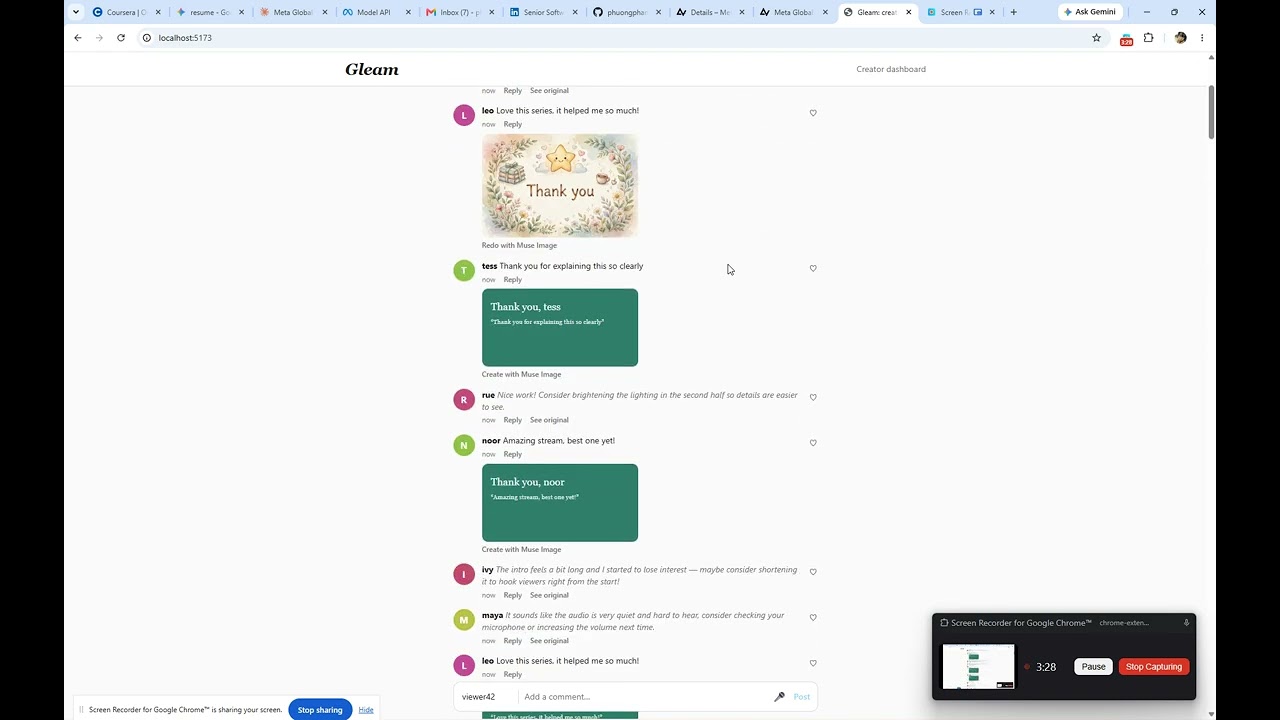
Inspiration Creators read comments to learn what their audience wants, but the first comment they see is often the cruelest one. Platforms mostly offer two options: read everything, or turn comments off. I wanted a third option that protects creators without throwing away the real feedback buried in harsh comments. What it does Gleam is a creator dashboard that sorts every incoming comment with Muse Spark into praise, feedback, held back, needs review, or neutral. Abuse and spam are held back from the creator’s main feed, and the creator can still open them. Threats go to a separate review queue instead of just disappearing. Harsh but useful feedback is rewritten into something actionable. “Your audio is trash” becomes “Consider adjusting your microphone gain or adding a pop filter.” The original is always one click away. Kind fans can get a personalized thank-you card, generated by Muse Image. Voice comments are recorded, transcribed with Muse Voice Transcribe, and sorted like any other comment. Raw and Sorted views let you see exactly what was filtered, and an Accuracy tab tests the sorting. How I built it The front end is React with Vite. A small Node and Express server holds the API key and calls Meta’s API, and comments and generated cards are stored in SQLite. Muse Spark sorts and rewrites comments, Muse Image makes the cards, and Muse Voice Transcribe handles audio. If the model is unavailable, a built-in keyword filter takes over so the app keeps working. Results I tested on 100 hand-labeled comments, including tricky ones with slang and no obvious keywords. A keyword filter scored 43 out of 100. Muse Spark scored 96 out of 100. We wrote the test comments ourselves, so we treat this as a demo result, not a benchmark. Challenges Muse Spark returns a hidden reasoning step before its answer, so our first parser read the wrong part of the response. Voice needed 16 kHz mono WAV and a specific two-part upload, so we convert the recording in the browser. Sorting is a judgment call. “This channel is a waste of space” can be abuse or an opinion, and we had to decide where to draw lines. Accomplishments A working end-to-end loop: comments are sorted, saved, and rewritten, with images and voice on top, and evidence of how well it sorts What I learned Hiding abuse is easy. The harder part is not hiding too much, which is why every filtered comment stays reachable and the creator stays in control. What’s next Real comments from real channels for testing, a Report button that exports threats with timestamps, a daily summary of what viewers want fixed, on-device filtering for live chat, and sarcasm and multi-language support. Built with React, Vite, TypeScript, Node.js, Express, SQLite, Muse Spark, Muse Image, Muse Voice Transcribe