Seam Team
Built at Meta Global AI Developer Hackathon · Oct 26, 2026 · Remote
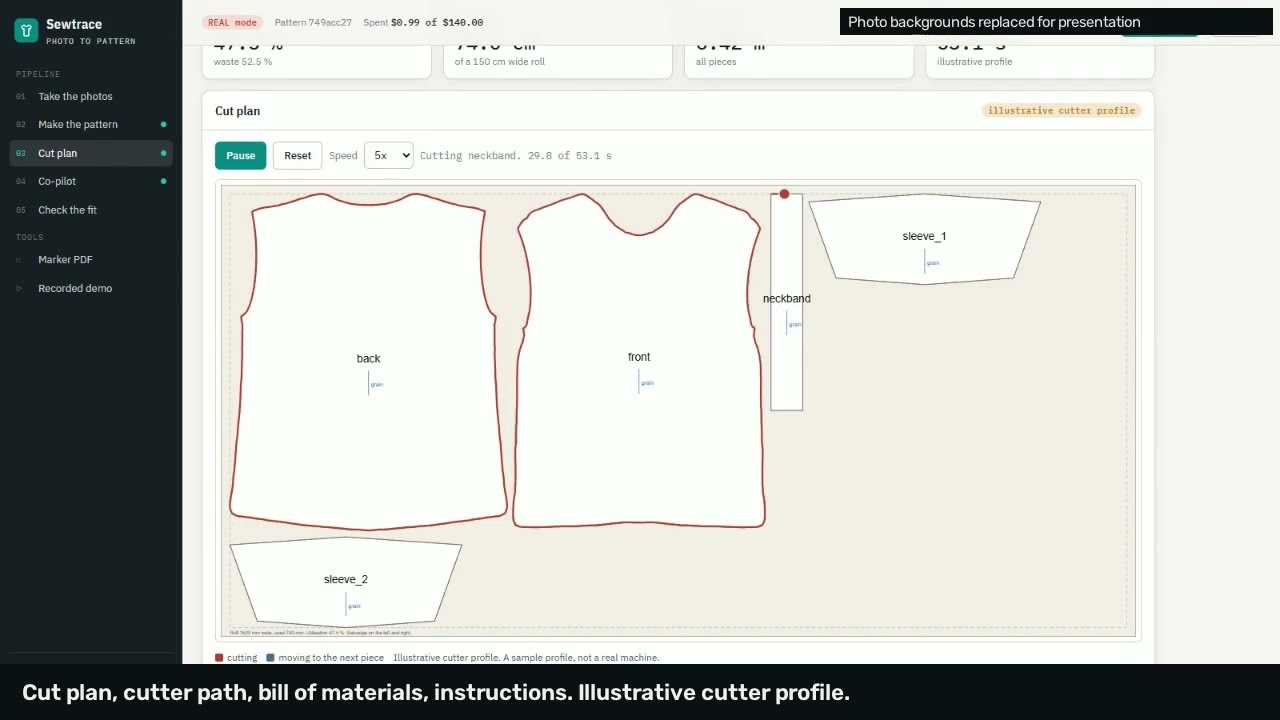
Factories already design patterns in CAD and cut fabric with automated cutters, but copying an existing garment still starts by hand. Someone traces it, measures it and marks the grain lines and notches before any machine can use it. Sewtrace automates that step. It turns a real garment into machine-readable pattern and cutting files from three phone photos, so a garment that exists only as an object can join a digital, automated workflow. Sewing is the hardest step to automate, so the next step is feeding these files to automated cutting and, as it matures, robotic sewing. Lay a kid’s t-shirt flat next to a printed 100 mm marker and take a front, back and sleeve photo. Meta SAM 3.1 finds the shirt in each photo, and the marker turns pixels into real millimetres. Muse Spark 1.3 adds what a camera can’t see: the front and back neck depths and the grain line. Code checks that every pair of seams that gets sewn together matches, and a pattern that fails is never exported. Every number is labelled with where it came from. A plain-English Co-pilot (“make it 2 cm longer”) proposes edits that code applies and re-checks. What comes out: a tiled A4 PDF at 1:1, SVG and DXF files for digital cutters, a cut plan nested on a fabric roll, an ordered cutter path, a bill of materials and sewing instructions, all in one bundle. A real run costs about three cents. The cutter profile is a sample today. The next step is sending these files straight to automated cutting and sewing. It starts at home: a parent can remake a child’s favourite t-shirt in the next size with a phone and a home printer, and the same files scale to a factory.