PAVLENS AI
Built at Meta Global AI Developer Hackathon · Oct 26, 2026 · Remote
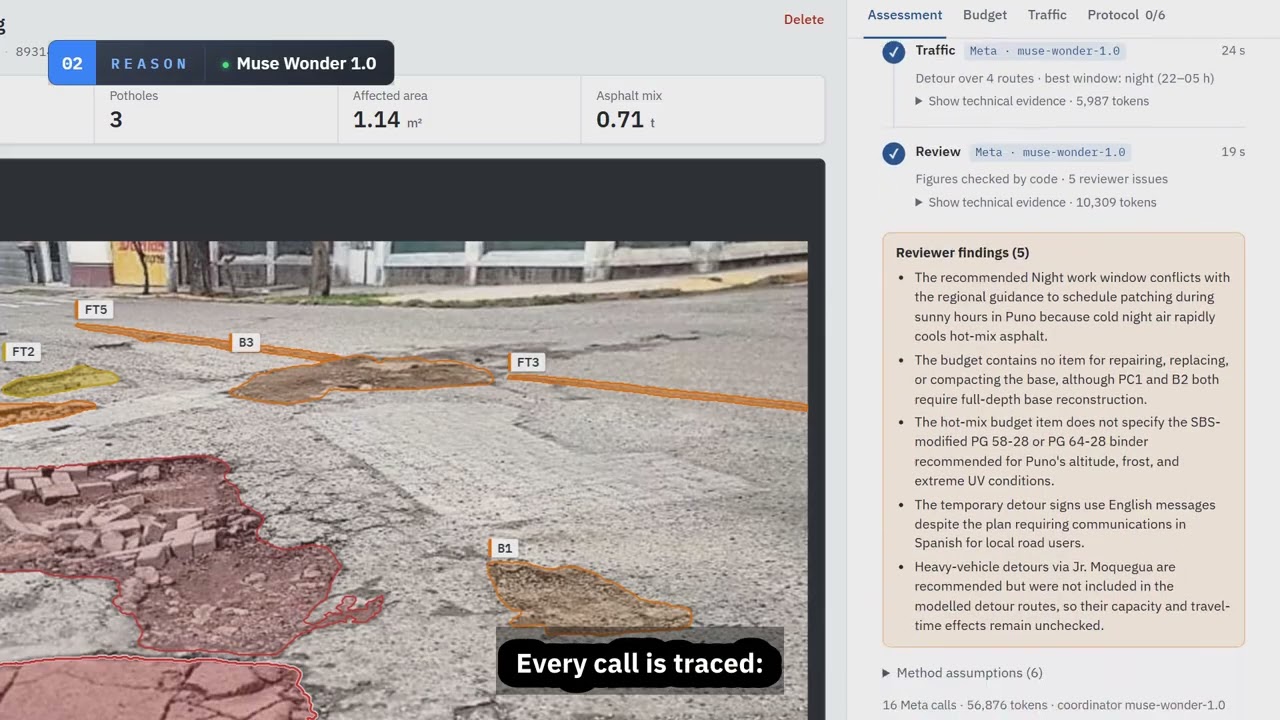
PaveLens AI turns one photo of a damaged street into a measured, costed and traffic-aware repair plan in about 90 seconds. THE PROBLEM In Puno, Peru (3,800 m above sea level), nightly frost and extreme UV break the asphalt, and maintenance budgets are small. Inspectors still measure on foot with a tape, severity depends on who looks, patch quantities are estimated by eye, budgets can't be audited, and every lane closure jams nearby streets. HOW IT WORKS 1. Capture: upload a phone photo and give it a scale, either the road width or four corners of a known rectangle for angled shots (homography). Before running, it reports the ground resolution and the finest crack it can measure. 2. See (Meta SAM 3.1): text prompts like "pothole" and "alligator crack" return the exact outline of every distress. Each outline is projected onto the road plane, so every area is in real square metres. 3. Reason (Meta Muse Wonder): runs the job as an agent. It calls nine tools, classifies each distress by ASTM D6433 severity and writes the repair protocol. An independent reviewer checks the work, and every step (model, time, evidence) stays visible. 4. Compute: the AI never does the maths. The Pavement Condition Index, patch quantities and the unit-price budget in soles come from tested, deterministic code, and recalculate when the crew enters the real depth measured in the field. 5. Plan: closing a street has a cost too. PaveLens solves a Wardrop traffic equilibrium (Frank-Wolfe + BPR) on a demo network of central Puno, compares peak, off-peak and night, and finds the cheapest work window. Muse Wonder then writes the traffic management plan: routes, signs, work phases and public notices. WHY IT MATTERS The same ASTM rules for every inspector, budgets you can audit to the square metre, and repairs scheduled when they hurt traffic least, for municipalities that can't afford survey crews. BUILT WITH Meta SAM 3.1 and Muse Wonder via API · .NET 10 Clean Architecture · Angular 22 · 174 automated tests · Spanish/English UI · accessibility options (larger text, high contrast, colour-blind-safe palette) · open source, MIT.