AutoLab
Built at Meta Global AI Developer Hackathon · Oct 26, 2026 · Remote
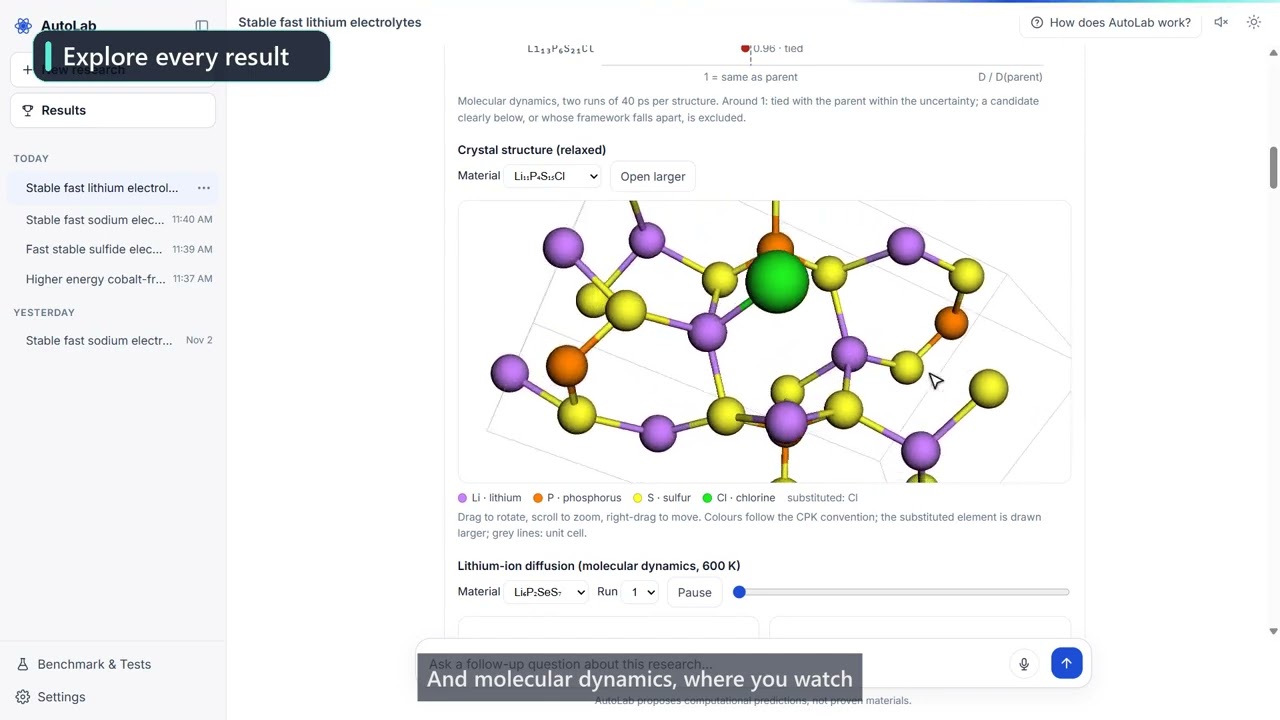
AutoLab is an autonomous AI lab for materials discovery. Every battery, chip and solar panel starts with a material, and finding a new one can take years of trial and error. AutoLab hands that search to an autonomous AI scientist, built on Meta models. A researcher states a goal in plain language, by text or by voice. AutoLab then runs the whole investigation in a closed loop: Propose: new candidate crystals are designed by chemical substitution in known materials, each with a hypothesis. Simulate: each crystal is built and relaxed atom by atom, and its energy is compared with every known phase of its chemical system. Test: candidates go from the cheapest filters to the most demanding ones: charge balance, stability, electronic insulation, contact with the electrodes, and finally ion motion by molecular dynamics. Learn: when a candidate fails, the code measures why (for example, "chlorine diffuses at 17.7% of lithium"), the agent turns the measurement into a hypothesis, and the next round corrects course. Conclude: the finalists are ranked by explicit rules, checked against the literature, and the champion's band gap is verified by DFT. A scientific report, exportable as PDF, closes the research, followed by a review of the whole campaign and the next one to run. Everything can be explored: the agent at work in a live lab view, every crystal in 3D, ions hopping through the framework next to the parent crystal, and a Results page with each champion's properties and error bars. The researcher can question the agent about its own work. AutoLab is built to be trusted: thresholds are explicit, methods are checked against reference calculations, and blind benchmarks test the whole pipeline. It is applied today to three battery challenges: lithium solid electrolytes, cobalt-free cathodes and sodium batteries. Its design extends to materials for any industry. The project is open source and its demo runs without a GPU.