RmemFab
Built at Meta Global AI Developer Hackathon · Oct 26, 2026 · Remote
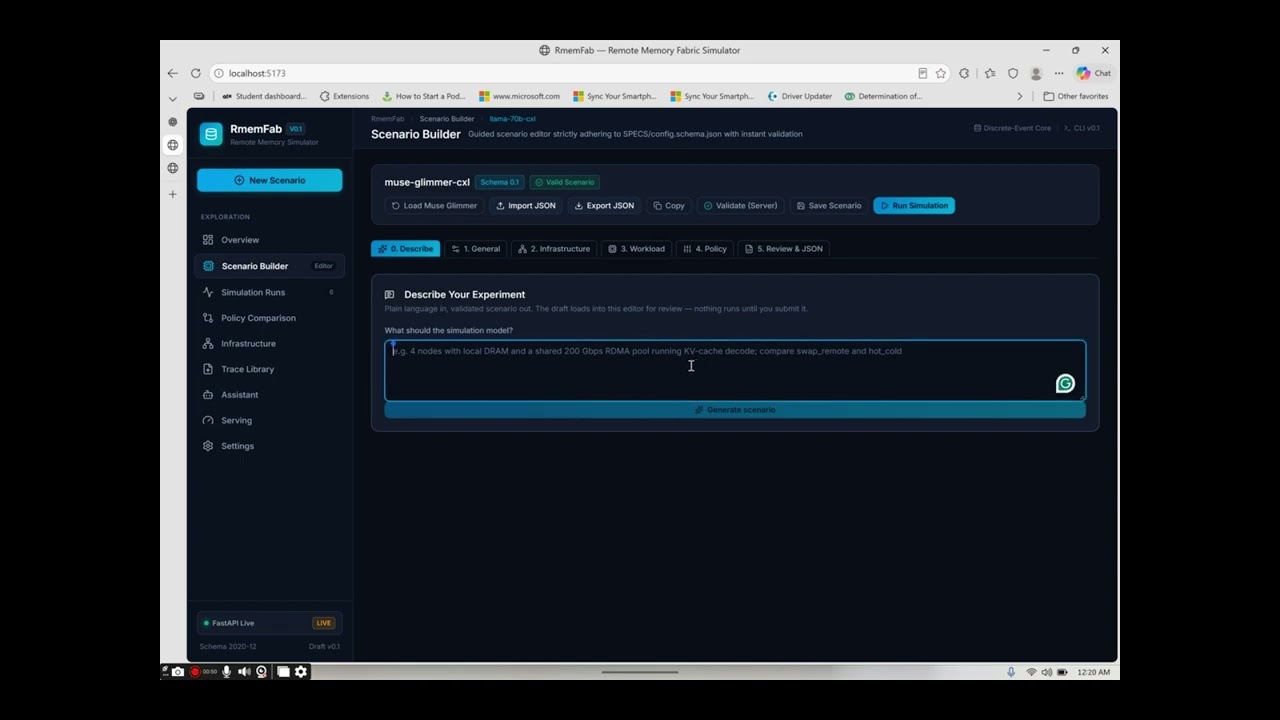
AI infrastructure has a memory problem. As LLM context windows, concurrent serving workloads, and Mixture-of-Experts models grow, memory demand is outstripping what individual nodes can economically provide. Disaggregated memory over CXL and RDMA fabrics promises a solution, but introduces an entirely new systems-design problem: where should data live, when should it move, and what happens when the network becomes the bottleneck? Experimenting with these architectures on physical hardware is expensive, difficult to reproduce, and constrained by available infrastructure. Engineers need a way to explore the design space before committing to it. RmemFab is an interactive experimental laboratory for remote-memory architectures. Its core is a deterministic, trace-driven discrete-event simulator modeling multi-node memory hierarchies, CXL/RDMA fabrics, bandwidth contention, queueing, page migration, caching, and workload failures. Engineers can explore placement strategies including local-only, remote swap, hot/cold migration, frequency-aware eviction, and predictive prefetching. But RmemFab goes beyond running simulations. Its interactive dashboard turns experiments into something engineers can inspect, challenge, and modify. Its Muse Spark-powered co-pilot translates natural-language questions into validated scenarios, explains results using actual simulator telemetry, and proposes reproducible follow-up experiments. A particularly important feature is its scientific comparison guard: if two experiments differ in anything beyond the policy being evaluated, RmemFab refuses the comparison rather than producing a misleading verdict. The result is a laboratory where engineers can ask not just whether a strategy works, but why it works, where it breaks, and what to investigate next. RmemFab doesn't replace hardware benchmarking. It makes the architectural decisions leading up to it considerably more informed.