The Context Bible — Scholar Citation Engine
Built at Meta Global AI Developer Hackathon · Oct 26, 2026 · Remote
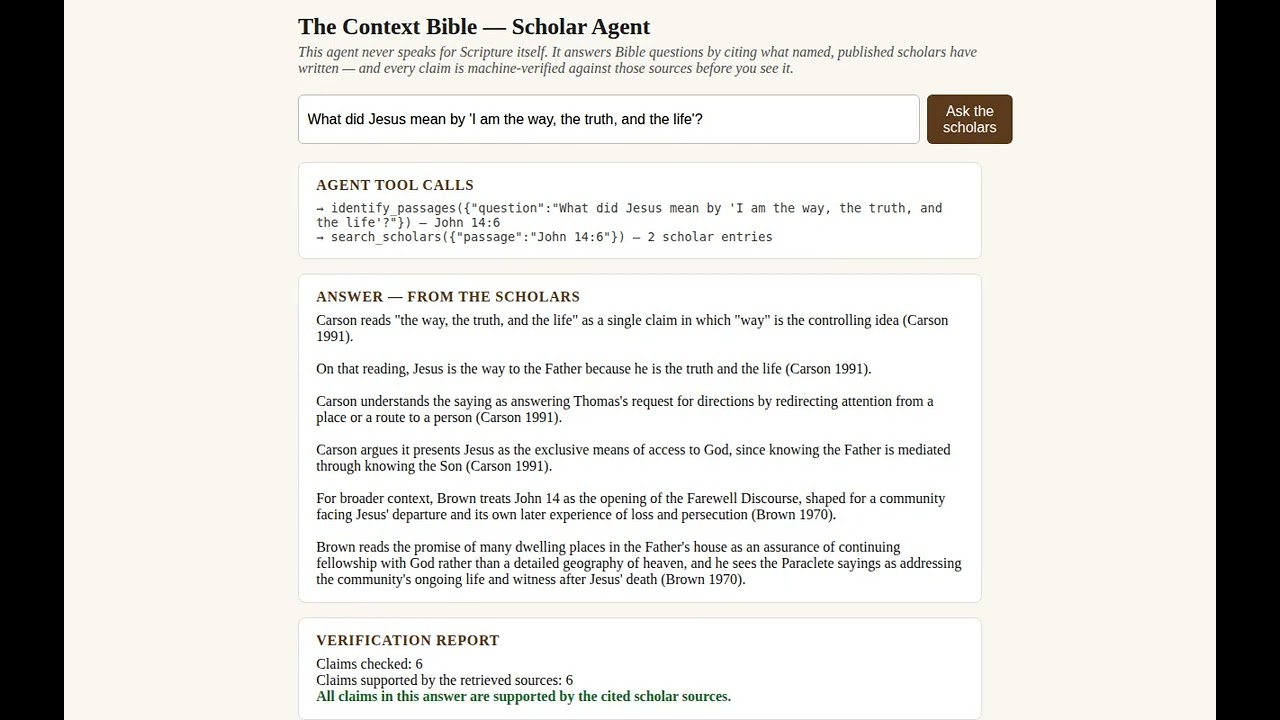
Millions of people now ask AI their Bible questions — but a large share of serious Bible readers reject the answers on principle. They do not want a machine summarizing or interpreting Scripture itself; to them, that is ground a model should not occupy. Every current AI Bible tool crosses that line: chatbots and basic RAG apps paraphrase the text in their own voice, blend sources without attribution, make claims nobody can check — and when they have nothing solid to draw on, they answer anyway. For the more than 100,000 readers of The Context Bible, that makes today's AI Bible tools unusable — fluent, but unverifiable and out of bounds. What does not exist is an AI Bible tool whose every claim is attributed to a named, published scholar and machine-checked against that scholar's work before anyone sees it. The Context Bible — Scholar Citation Engine answers Bible questions the way a careful research librarian would: it never speaks for the biblical text itself. Instead, an agent built on Muse Spark retrieves what named, published scholars have written about a passage — D. A. Carson, Raymond E. Brown, John Goldingay, Derek Kidner, and others — and drafts an answer only from those retrieved sources, with an inline citation attached to every claim. A second Muse Spark pass then fact-checks the draft claim by claim against the sources; anything unsupported is struck, the answer is regenerated, and the result re-verified before the user sees it. The interface shows the whole trail: the agent's tool calls, the citations, and the verification report. Two things this is not. It is not basic RAG: there is no chunk store and no single stuffed prompt — the model works as an agent, identifying the passage and retrieving structured, attributed scholar entries through tool calls, then drafts under a hard rule that every claim must trace to a retrieved entry. And it is not an education chatbot: it never teaches or interprets in its own voice — it has no voice of its own, only the scholars'. Where a chatbot always answers, this system verifies its draft claim by claim and, when no scholarship is retrieved, declines to answer at all. The design answers a real conviction in the audience I serve. I teach at Pepperdine University and built The Context Bible, a Bible-study app with a Facebook community of over 100,000 readers. Many of them will not use an AI that summarizes Scripture — they consider that ground a machine should not occupy. An agent that cites scholarship, and can prove its citations, earns trust a chatbot cannot. The engine currently covers John 14 and Psalm 91 from a curated library built during this hackathon; the format extends to any passage and any commentary library.