Sunny Sonnendeck
Built at Meta Global AI Developer Hackathon · Oct 26, 2026 · Remote
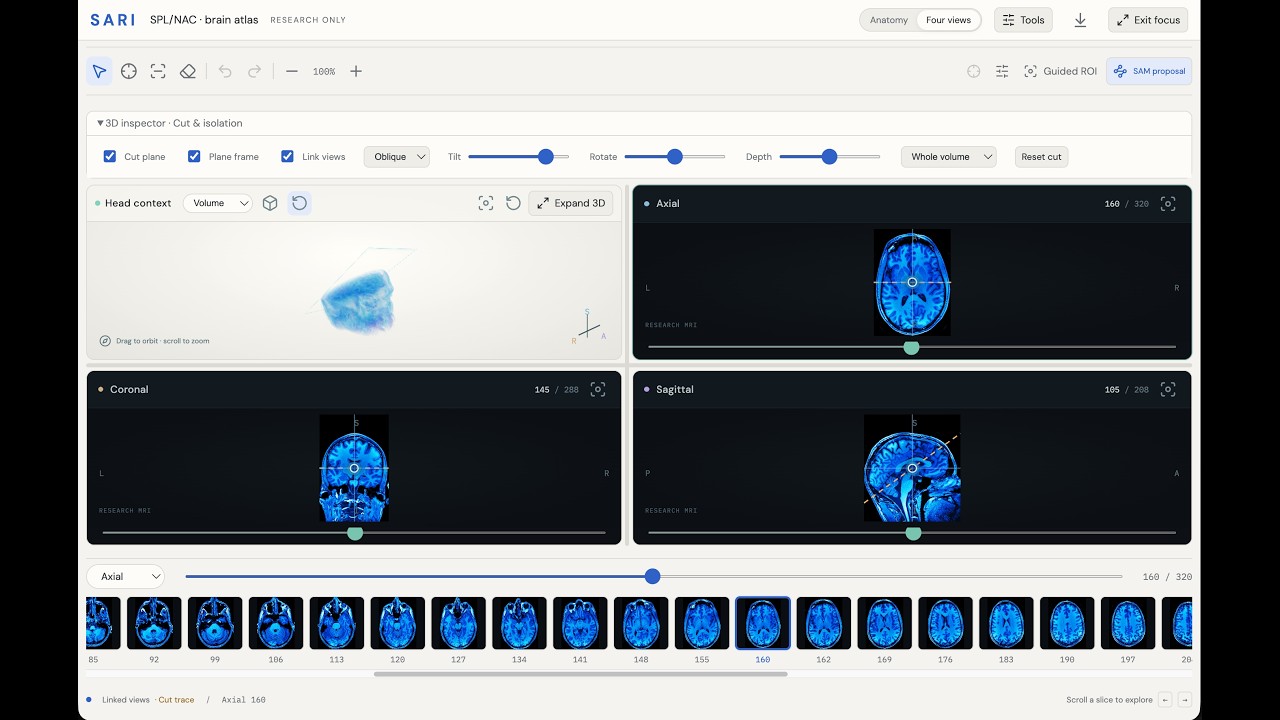
Medical images contain extraordinary detail, but understanding them requires more than looking at a slice. A researcher must connect a point in a two-dimensional image to three-dimensional anatomy, find the right viewing angle, keep an annotation in context, and relate a question to published evidence. That often means moving between an image viewer, an anatomy reference, notes and a literature search, and mentally holding the connections together. SARI brings those connections into one research workspace. Starting from a human-body overview, users enter a brain study and explore linked axial, coronal and sagittal images alongside interactive 3D anatomy. A crosshair, cut plane or marked region stays connected across views. Researchers can isolate structures, adjust rendering, and choose a clean light or dark workspace. The human leads; Muse and SAM assist. Researchers can ask Muse Spark to arrange the views, explain the general functions of an atlas-labeled structure, or discuss reviewed image cross-sections with appropriate uncertainty. In Guided ROI, the researcher chooses a target and seed, Muse suggests image-based segmentation prompts for review, and SAM 3.1 produces draft masks. SARI combines the sampled masks into a sparse research proposal that the human can inspect, correct and isolate. It preserves which planes were sampled rather than pretending to have segmented an entire organ. From an answer, researchers can ask Muse to formulate an editable literature question using the original question, answer and reviewed image context. A separate sourced search helps them follow the evidence. Questions and answers also retain restorable views, linking the conversation to the exact slices, camera and markings that prompted it. My medical background made this a personal project. I wish I had a tool like SARI while studying medicine: something that made anatomy easier to explore spatially and let me follow a question without losing my place. I built the starting point I would want to use myself, with room to extend beyond the brain to regions such as the thorax, heart and thyroid. SARI is for professional research and medical education. Research use only; not clinically validated and not for diagnosis, treatment or medical advice.