Dr Penrod & Mayordomo
Built at Meta Global AI Developer Hackathon · Oct 26, 2026 · Remote
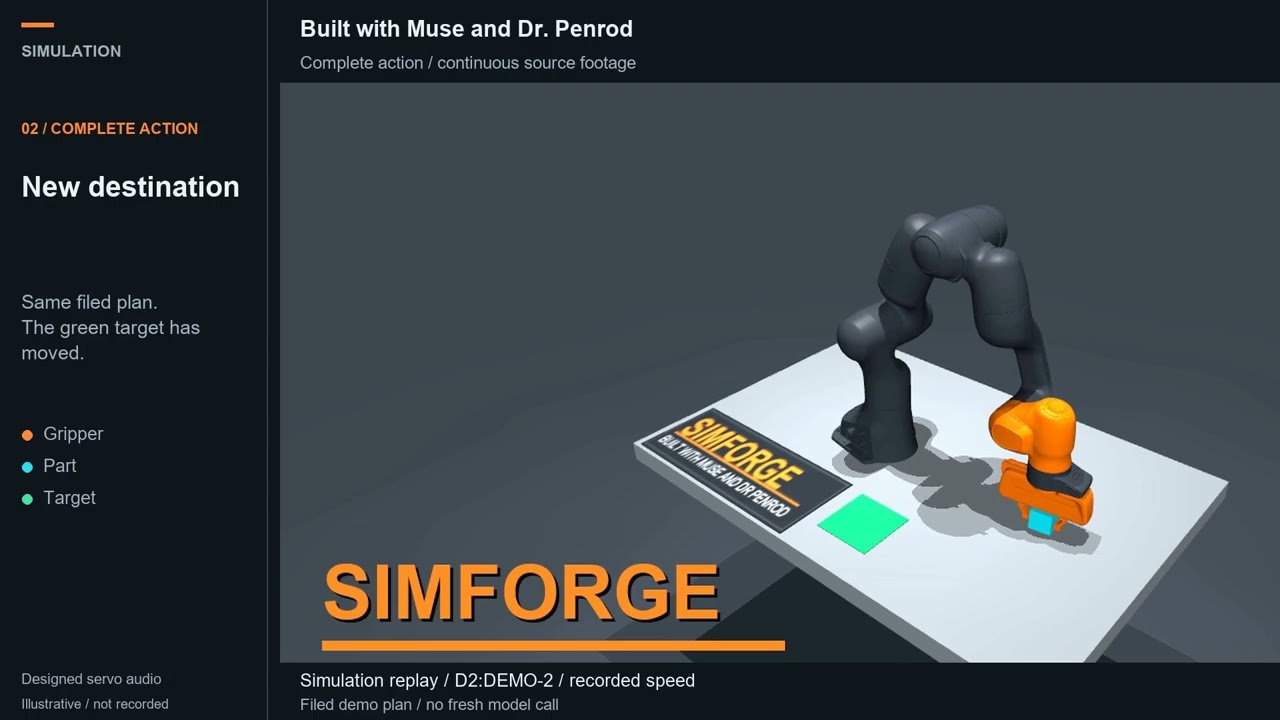
SimForge — repeatable, measured tests of robot part-handling tasks in simulation. Team: Dr Penrod & Mayordomo. Mayordomo is Brian's Muse personal agent and build partner on this project — Spanish for a chief steward: the one who runs the house. SimForge explores whether repeatable simulation evidence can help manufacturers evaluate a proposed robot-handling task before committing to hardware. The prototype demonstrates the technical workflow in one bounded simulated cell; customer discovery remains ahead. A Franka Panda cell in MuJoCo runs pick-and-place cycles against a frozen scene with fixed seeds. A Muse Spark planner (via the Meta Model API, behind an OpenAI-compatible adapter) proposes a structured plan; a strict admission boundary validates it against the live scene before anything executes; a human approves; and a separate evaluator applies fixed scoring rules to simulator telemetry — the planner and controller do not assign the verdict. Rejected plans produce no execution — and the audit trail shows why. The engineering results are evaluated against documented gate criteria; the repository preserves the criteria, dated amendments, candidate identity, and recorded outcomes. The outcomes: determinism (Gate 1, three runs, 0.0 diffs), a 20-attempt grasp battery at 20/20 (Gate 2), scenario robustness across fresh random draws (Gate 3, 8/8 with zero flips, target variation demonstrated), and a Gate 5 acceptance suite that met 11 of 11 expected paths — executed successes, validation stops with zero execution, and human rejections with zero motion — on a frozen, hash-locked candidate (commit 8dacc16; acceptance pushed as e31d8ab), independently verified. Gate 4 is reported exactly as filed: NOT PASSED. Its trap case exposed a substitution that proceeded to execution: asked for a nonexistent red gear, the model substituted the real part, the human approved, and the executor moved it. Independent review caught an incorrect verdict; the runtime did not stop it. Separate repair checks passed on re-run: guarded-causality checks using an offline approval fixture, and six stub-orchestration cases (F1). These are remediation evidence; Gate 4 remains NOT PASSED, and F1 does not demonstrate a fresh live-model trap passing. In the Gate 5 demo, the same saved trap response is rejected by a human, with zero motion. Pre-existing vs. event work: work present before October 27 includes repository scaffolding, the initial plan schema and validators, a Meta API adapter with mock support, a stub scenario evaluator and perturbation helpers, smoke tests, scene specifications, and gate documents. The initial commit is dated October 24; the build log records a live API smoke test on October 26. From October 27 onward, the work added the working MuJoCo cell, grasp controller and telemetry scoring, strengthened admission and approval controls, live planning experiments, frozen acceptance evidence, and the submission demonstration. The commit history distinguishes these additions from the earlier foundations. What this does not claim: no confirmed buyer, no paid pilot, no product-market fit. SimForge is an exploratory discovery program; the business hypothesis remains untested by interviews, which follow the submission. It was built by an awesome Meta-powered agent, in partnership with its badass super-smart human — the one who keeps it honest.