ZeLabs Ltd
Built at Meta Global AI Developer Hackathon · Oct 26, 2026 · Remote
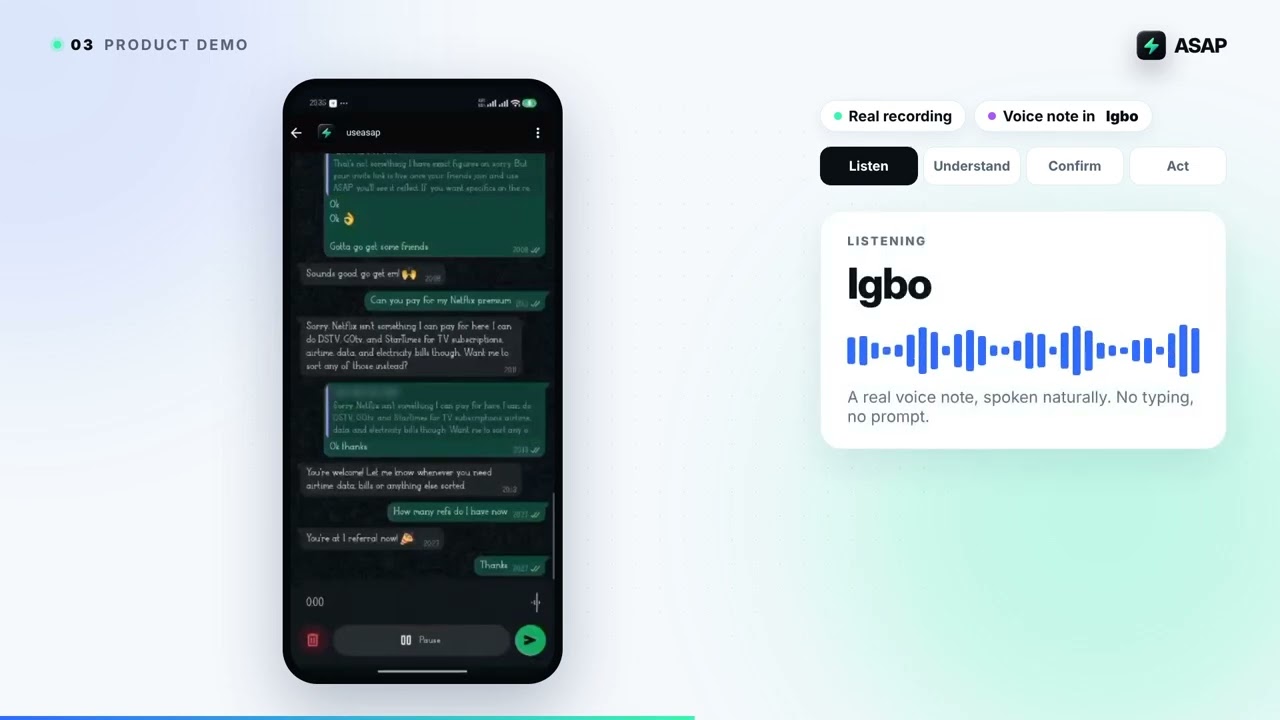
ASAP is an AI-powered agent that enables people to communicate naturally in their local languages and delegate everyday tasks to AI. AI agents are becoming increasingly capable of performing real-world tasks, from discovering products and shopping to ordering food, booking services and making payments. However, most AI experiences are designed around people who can comfortably communicate in English or other dominant languages. In Nigeria alone, hundreds of languages are spoken. Millions of people communicate through their native languages, local expressions, slang and a natural mixture of languages. While they may understand what they want to accomplish, expressing those needs through written English prompts or navigating complex digital interfaces can be difficult. Some instructions are simply easier to explain through speech than typing. ASAP addresses this gap by allowing users to interact with an AI agent through voice notes or text in the languages they naturally speak. Instead of requiring users to translate their thoughts into English or learn how to write effective AI prompts, ASAP is designed to understand their requests, identify their intentions, ask relevant follow-up questions and use connected tools and services to carry out tasks on their behalf. For example, a user could send a voice note in Yoruba, Hausa or Igbo asking ASAP to find a product, check its price or help them make a purchase. The agent interprets the request, interacts with relevant services and guides the user through completing the task. What makes ASAP different is that it goes beyond speech recognition, translation or conversational responses. It connects multilingual communication with agentic execution, allowing people to move from expressing a need in their own language to getting something done. We are starting with Nigeria and focusing on making AI-powered services accessible across its diverse linguistic communities, with a broader vision of extending this experience to other African languages and multilingual populations. Our belief is simple: people should not have to change the way they communicate to access AI. AI should learn to understand people, in the languages they naturally speak, and help them get things done.