Glassbox
Built at Claude Build Day · Jun 13, 2026 · San Francisco, CA
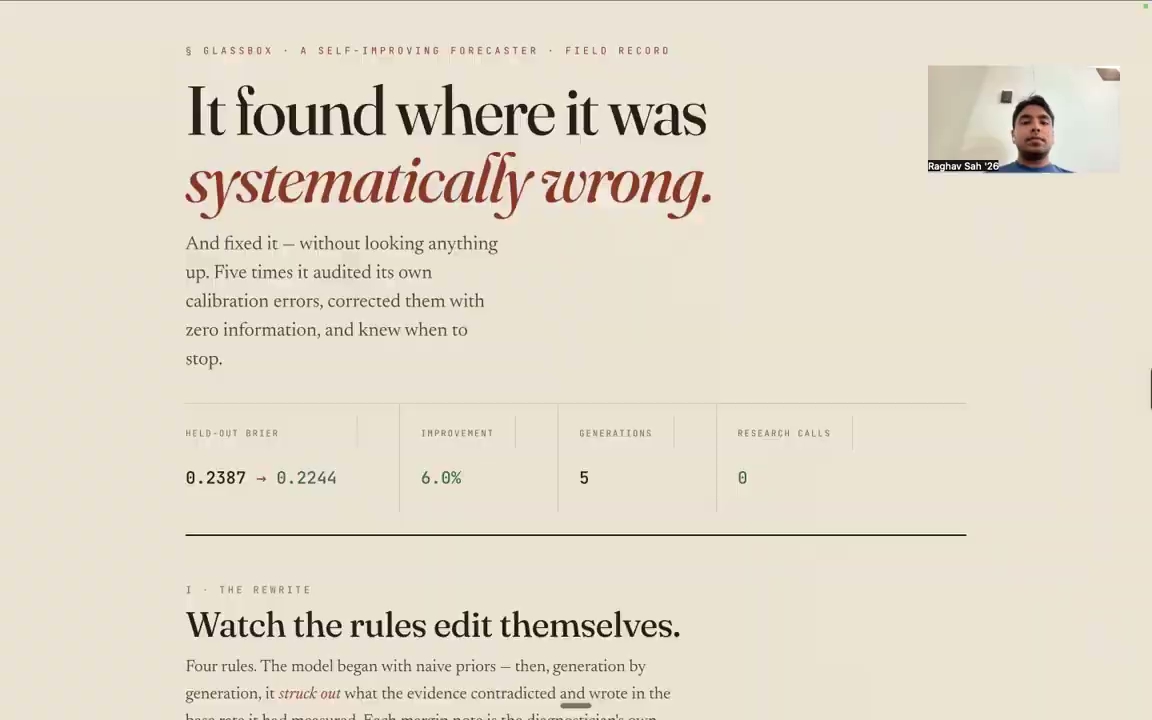
Glassbox is a self-improving forecasting engine. Hand it any set of already-answered yes/no questions and it teaches itself to forecast them better, with no new information, by grading its own predictions, finding its own mistakes, and rewriting its own rules, generation after generation. Why forecasting? On prediction markets like Kalshi, a crowd prices the future and often beats the experts. That is the wisdom of crowds, and once a market resolves you are left with a forecasting question that has a verified answer. Forecasting is really two skills: getting information, and reasoning well about what you already have. Tetlock's research found the best forecasters win on the reasoning. So we built a machine to sharpen that second skill on its own, with the internet switched off. It runs as one repeatable Claude Code workflow with three autonomous agents: a forecaster, an isolated grader, and a diagnostician. They loop unattended for five generations. The whole run is leak-proof, zero web calls, so any gain is provably the model reasoning over its own mistakes, not looking anything up. On resolved Kalshi markets it measurably improved its accuracy on questions it had never trained on, and twice it judged there was no honest gain left and deliberately changed nothing. The deliverable is the engine, not a forecaster. The same workflow, same git commit, taught itself a second and unrelated skill, "will this GitHub issue close within 30 days?", with no code changes. Point it at any history of verified outcomes, like tickets, claims, trades, or SLAs, and it bootstraps a calibrated, self-documenting forecaster for that domain, where every rule it writes cites the evidence that created it.