Aging Lab
Built at Built with Claude: Life Sciences · Jul 7, 2026 · Remote
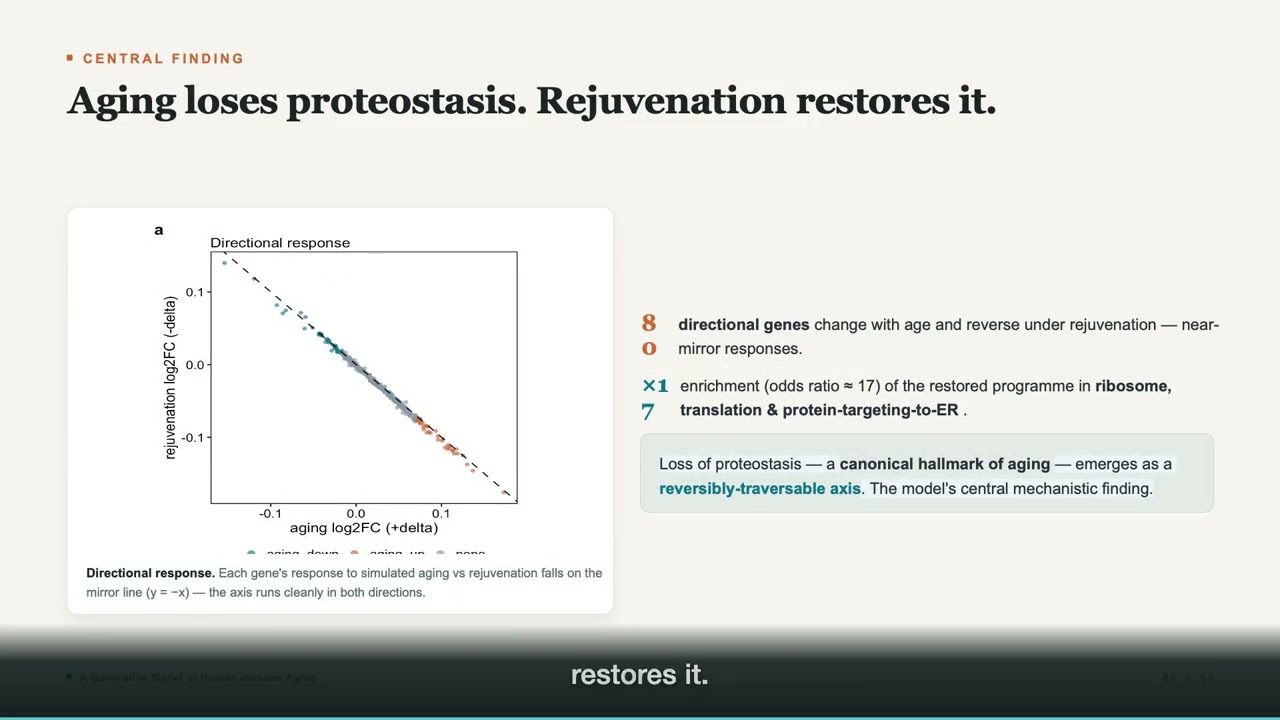
What I built. A deep generative single-cell model of the human immune system that simulates aging and rejuvenation at single-cell resolution, then reasons forward from the simulation to mechanism and to candidate drugs. On an atlas of 1,248,980 immune cells from 981 donors (ages 19–97), I trained an scVI latent space and an OT-CFM flow field whose forward direction is aging and backward direction is rejuvenation — a trajectory you can traverse in silico in both directions. The entire pipeline, from research proposal to submission-ready manuscript, was run with Claude alone through a purpose-built toolchain of 9 Claude Code skills (proposal → analysis plan → methods → figures → manuscript, with an adversarial reviewer loop). What I found. The simulation reveals a reversible loss-of-proteostasis / translation axis as a central mechanistic feature of immune aging. It recovers known hallmarks as positive controls (p16/CDKN2A, GZMK⁺ inflammaging, WRN, the mTOR/PI3K geroprotector axis) and nominates 1,558 new biological-age markers absent from any curated aging database. Closing the loop from simulation → target → drug, a genome-scale CRISPRi screen identified 47 causal reverser genes, and molecular docking against three druggable targets (LSD1/KDM1A, MAO-A, VEGFR1/FLT1) yielded 12 structurally-plausible clinical/approved drug candidates that reverse the cytotoxic-inflammaging arm of immune aging. A key signature replicated in an independent cohort (CD8 T, r = 0.92, different chemistry). Why it matters. Aging is nearly impossible to study experimentally — you can't wait decades for a cohort to age, or for a rejuvenation to happen and then sample it. A generative engine that traverses the aging trajectory virtually turns that intractable experiment into something you can run in silico, in both directions, and mine for interventions. This work demonstrates a complete, reproducible loop — virtual simulation → mechanism → causal target → concrete drug hypothesis — carried end-to-end by an AI agent. The results are computational hypotheses, not validated geroprotectors, but they define a new, testable, low-cost front end for anti-aging drug discovery.
